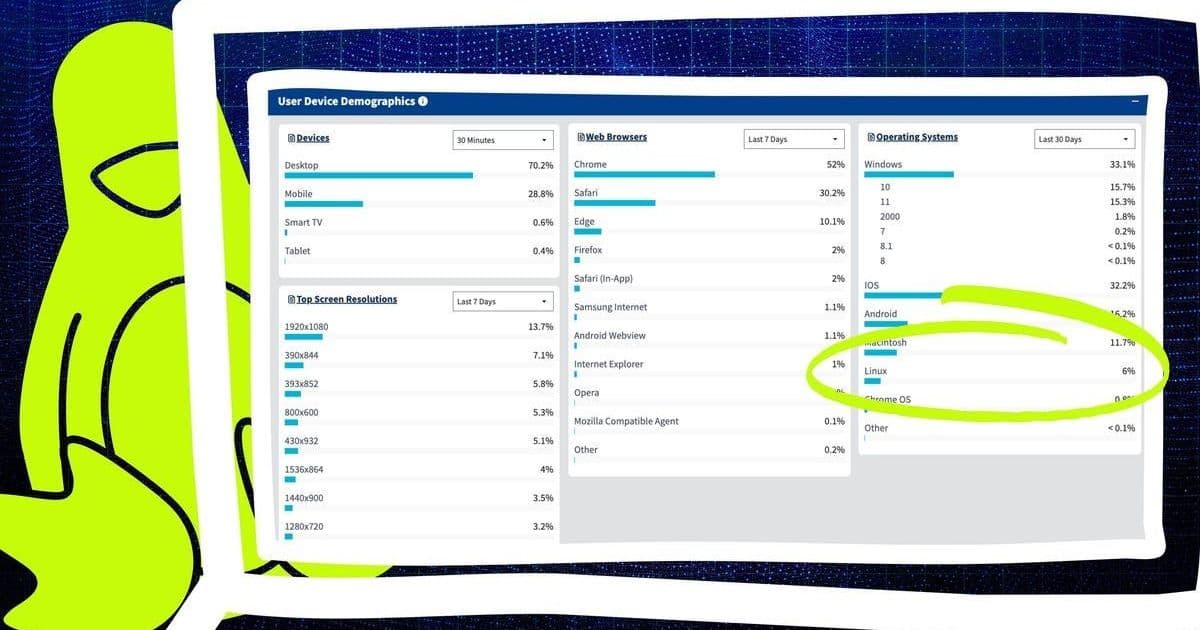
US Federal analytics reveal Linux now powers over 6% of desktop visits to government sites, with broader trends showing rapid adoption. This milestone, fueled by user-friendly distros and legacy hardware needs, signals a pivotal shift in the OS landscape away from traditional dominance.
For decades, the "Year of the Linux Desktop" felt like a mirage—a running joke in tech circles. Yet new data from the US Federal Government Website and App Analytics paints a startling picture: Linux now accounts for 6.3% of desktop visits across over 5,000 government domains, based on 1.6 billion sessions analyzed in the past month. This isn't a statistical blip—it's part of a sustained acceleration that challenges long-held assumptions about operating system dominance.
The Numbers Behind the Shift
Federal tracking, which aggregates visits to Cabinet department sites, shows Linux usage surging when combined with other Linux-based systems. Android (16.2%) and Chromebooks (0.8%) push the total to 23%, eclipsing both macOS (11.7%) and Windows variants like Windows 11 (15.3%). Unlike opaque third-party trackers, the government's methodology is transparent: data is sourced from Google Analytics, open-sourced, and available in JSON format for independent verification.
"StatCounter's 'market share' reports bear only the most casual relation to the real world," warns veteran analyst Ed Bott, highlighting skepticism around commercial trackers.
While StatCounter reports a global Linux desktop share of 5.03% (7.74% with ChromeOS), its page-view-centric approach introduces noise. Still, the trajectory is undeniable: Linux hovered near 1.5% in 2020, crossed 4% in 2024, and now breaches 5% in the US—doubling its share in under five years.
Why Linux Is Gaining Ground
Several factors drive this growth:
- Legacy Hardware Revival: Windows 11's stringent hardware requirements have stranded millions of PCs. Linux distros like Linux Mint and Zorin OS offer performant alternatives that breathe new life into aging machines.
- User Experience Evolution: Once requiring command-line expertise, modern Linux desktops now rival macOS and Windows in polish. Distributions prioritize intuitive interfaces, one-click software installs, and Windows-like workflows.
- Cost and Control: Government and enterprise shifts—like Denmark's move to LibreOffice and Linux—highlight growing aversion to vendor lock-in and licensing fees.
What This Means for Developers and the Industry
This isn't just about desktop percentages—it's about ecosystem momentum. As Linux's user base expands:
- Cross-platform development gains urgency, with tools like Flutter and Electron becoming non-negotiable.
- Security practices must evolve; Linux vulnerabilities (like recent XZ backdoor scares) will attract greater scrutiny.
- Hardware manufacturers face pressure to improve out-of-the-box driver support, reducing installation friction.
The era of dismissing Linux as a desktop afterthought is over. Its growth curve—from 1% to 2% taking a decade, but 3% to 4% in under a year—signals a fundamental realignment. For developers, this expanding footprint means more users to serve, more devices to target, and validation that open-source innovation can reshape even the most entrenched markets.
Source: Adapted from Steven Vaughan-Nichols' reporting for ZDNET
Comments
Please log in or register to join the discussion