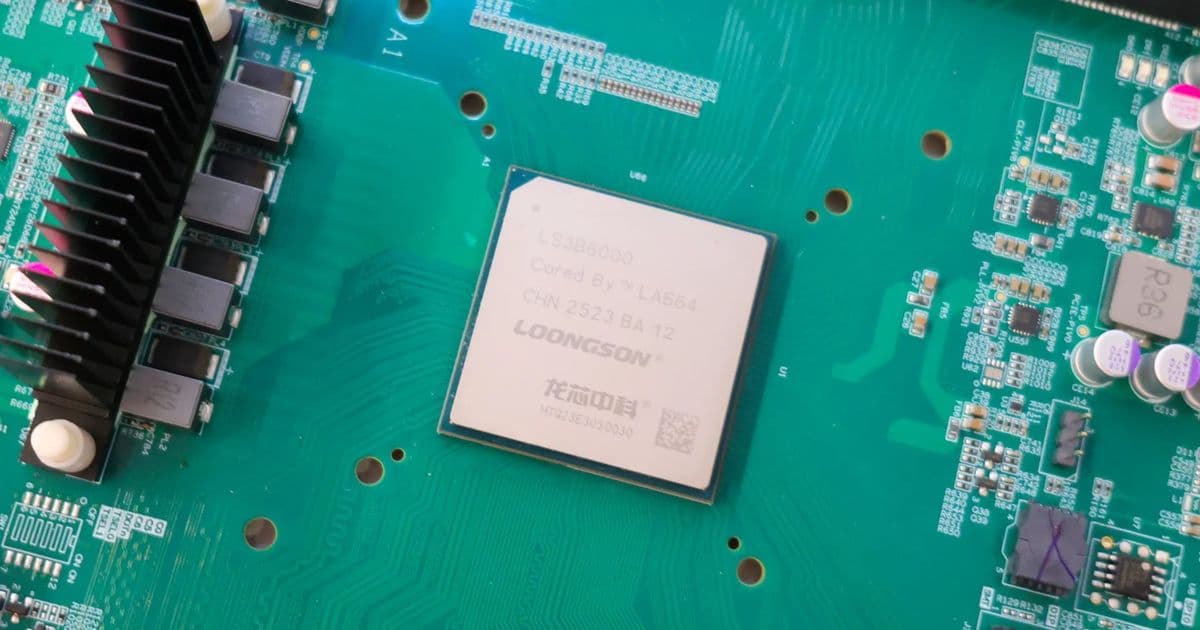
The Loongson 3B6000 brings China's homegrown LoongArch ISA to desktop computing, but how does this 12-core processor stack up against current AMD Zen 5, Intel Arrow Lake, and even the Raspberry Pi 5? Our comprehensive Linux benchmarks reveal the performance reality.
China's Loongson Technology has been developing its own processor architecture for years, and the LoongArch ISA represents their most ambitious effort yet. After finally getting hands-on time with the Loongson 3B6000, we can now benchmark this 12-core, 24-thread processor against current desktop CPUs from AMD and Intel, plus the Raspberry Pi 5 for ARM context.
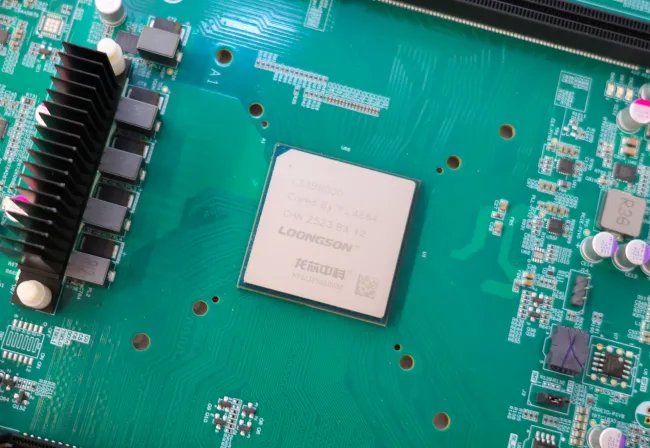
The Loongson 3B6000 represents a significant evolution from the company's earlier MIPS64-based designs. This desktop-class processor features 12 cores with simultaneous multithreading (SMT2), dual-channel DDR4 ECC memory support, and integrated display outputs including HDMI and VGA. The review sample arrived on a micro-ATX motherboard with the CPU soldered in place, featuring two PCI Express x16 slots, one x4 slot, M.2 NVMe support, four SATA ports, and a PCIe slot for WiFi adapters.
Linux System Setup and Compatibility
The LoongArch64 Linux ecosystem is still maturing, but the basics are functional. The motherboard arrived with a working Linux installation, and we were able to run our standard Phoronix Test Suite benchmark suite. However, the limited software availability and optimization for LoongArch means that many applications run through emulation or lack native compilation, which impacts performance measurements.
Performance Against Modern Desktop CPUs
When comparing the Loongson 3B6000 to current-generation processors, the results are sobering. Against AMD's Zen 5 and Intel's Arrow Lake desktop CPUs, the LoongArch processor shows significant performance gaps across most workloads.
In single-threaded performance, which remains crucial for many applications, the Loongson 3B6000 struggles to keep pace even with budget-friendly options. The architecture's IPC (instructions per cycle) appears to be substantially lower than what AMD and Intel have achieved with their latest designs. Multi-threaded workloads show better scaling due to the 12 cores, but even here the performance per core falls short of expectations.
The Raspberry Pi 5 serves as an interesting comparison point. Despite being a much smaller, lower-power design aimed at embedded and hobbyist applications, certain benchmarks show the Pi 5 trading blows with or even outperforming the Loongson 3B6000 in specific scenarios. This highlights just how far behind the LoongArch architecture is in terms of raw computational efficiency.
Power Efficiency and Thermal Performance
While comprehensive power measurements weren't part of this initial testing, the LoongArch architecture's efficiency appears to lag behind both x86 and ARM competitors. The integrated nature of the motherboard and the lack of detailed power monitoring tools made it difficult to draw definitive conclusions, but the thermal performance suggests higher power consumption per unit of work compared to modern alternatives.
Software Ecosystem Challenges
One of the biggest hurdles for LoongArch adoption is the software ecosystem. Unlike x86 and ARM, which have massive software support, LoongArch users face limited native application availability. Many Linux distributions and applications require either native compilation or run through binary translation layers, introducing performance overhead and compatibility issues.
Future Prospects and Follow-up Testing
This article presents preliminary benchmarks, with more comprehensive testing planned against older Intel and AMD processors to better understand where the Loongson 3B6000 fits in the broader performance landscape. The company offers CPU variants with up to 64 cores, which could change the performance equation for highly parallel workloads, though single-threaded performance remains a fundamental limitation of the architecture.
The Loongson 3B6000 represents an important step for China's semiconductor independence goals, but from a pure performance perspective, it's not competitive with current desktop processors. The architecture shows promise in terms of core count scalability, but significant work is needed to improve per-core performance and build out the software ecosystem.
For enthusiasts interested in alternative architectures or those focused on software portability across different ISAs, the LoongArch platform offers an interesting playground. However, for users seeking maximum performance or the best performance-per-dollar, current x86 and ARM options remain far superior choices.

The journey toward competitive homegrown processor technology is a long one, and while the Loongson 3B6000 doesn't match up to current market leaders, it represents progress in China's broader technology development efforts. Future iterations of the architecture may close the gap, but for now, this processor serves more as a proof of concept than a practical alternative for most users.
Comments
Please log in or register to join the discussion