China's 12-core Loongson 3B6000 processor delivers only about one-third the performance of AMD's six-core Ryzen 5 9600X, held back by just 2.5GHz clock speeds despite its high core count.
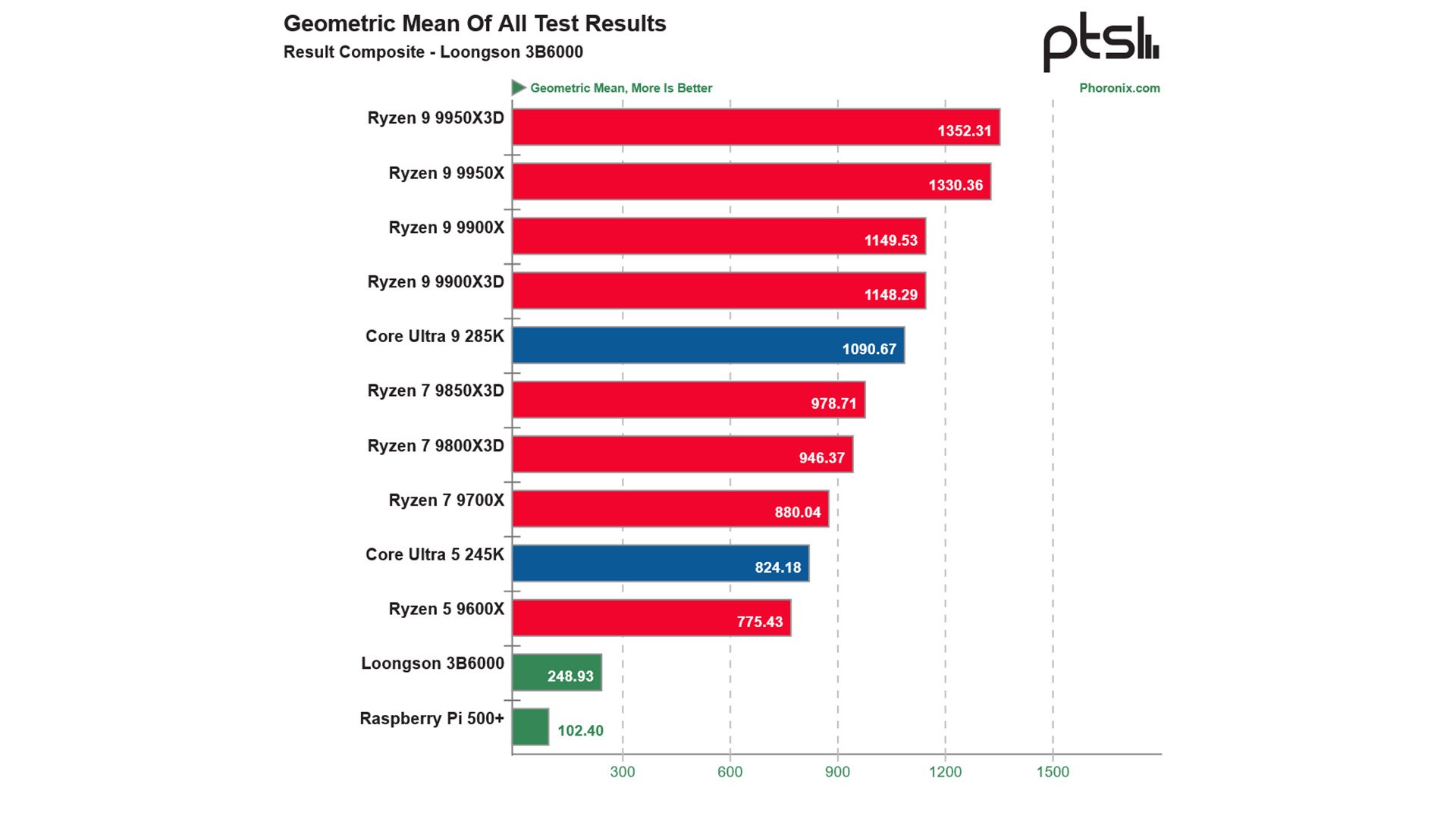
China's Loongson 3B6000 processor, a 12-core chip designed for domestic use, has been benchmarked against Western competitors and found severely lacking in performance despite its high core count. The chip, tested by Linux review site Phoronix, delivered only about one-third the performance of AMD's six-core Ryzen 5 9600X in most workloads.
(Image credit: Phoronix)
The 3B6000 was sent to Phoronix by the Loongson Hobbyists Community and tested on a 3B6000x1-7A2000x1-EVB micro-ATX motherboard featuring two DIMM slots, one M.2 slot, two PCIe x16 slots, and limited USB connectivity. Despite having twice as many cores as the Ryzen 5 9600X, the Loongson chip struggled to keep pace in the extensive benchmark suite.
In the comprehensive testing across dozens of Linux-based applications, including those with AVX-512 support, the 3B6000 consistently placed last or near-last in performance rankings. The only processor it managed to outperform was the quad-core ARM CPU found in the Raspberry Pi 500, highlighting the significant performance gap.
However, the results weren't uniformly poor across all workloads. In specific tests like C-Ray 2.0, the 3B6000 surprisingly matched the performance of the Ryzen 5 9600X. In OpenSSL 3.6, it approached the performance level of Intel's Core Ultra 5 245K, and in QuickSilver 20230818, it slightly outperformed the 245K and achieved scores on par with the high-end Core Ultra 9 285K. These exceptions proved rare, with the chip significantly underperforming in nearly all other benchmark runs against both AMD and Intel x86 processors.
The fundamental limitation appears to be clock speed. The 3B6000 operates at just 2.5GHz, which is approximately half the clock speed of most modern Intel and AMD processors. While Loongson's LA664 CPU architecture reportedly achieves IPC (Instructions Per Clock) performance comparable to AMD's Zen 3 architecture, the severely limited clock speed negates any potential advantages from the architecture's design.
This performance deficit reflects the broader challenges facing China's domestic processor industry as it attempts to reduce dependence on Western technology. The 3B6000 represents an early-generation product that, while architecturally interesting, cannot compete with mature x86 designs that have benefited from decades of development and optimization.
Loongson appears aware of these limitations and is already working on next-generation architectures. The company is developing a new LA864 architecture that reportedly aims for performance levels matching 13th and 14th generation Intel Raptor Lake processors. More importantly, chips based on this newer architecture are expected to feature significantly improved clock speeds in the 3.0 to 3.5GHz range.
While 3.0-3.5GHz still falls well short of the 5+GHz frequencies achieved by Intel and AMD's latest processors, this represents a substantial improvement for Loongson. The company's roadmap suggests a recognition that clock speed remains crucial for competitive performance, even as core counts increase.
The testing of the 3B6000 provides valuable insight into the current state of China's processor independence efforts. While the chip demonstrates that domestic designs can achieve reasonable IPC performance, it also shows that manufacturing capabilities, clock speed limitations, and ecosystem maturity remain significant hurdles. As Loongson and other Chinese processor developers continue to iterate on their designs, future generations may narrow the performance gap, though catching up to Western leaders will likely require sustained investment and technological advancement over multiple product cycles.
For now, the 3B6000 serves as a reminder that core count alone does not determine performance, and that clock speed, architecture optimization, and software ecosystem all play crucial roles in delivering competitive processor performance. The chip's performance in these Linux benchmarks suggests that China's processor independence remains a long-term goal rather than an immediate reality.
Comments
Please log in or register to join the discussion