
Stockholm-based Lovable has achieved a staggering $100 million in annualized revenue just eight months after launch by using generative AI to empower non-coders. Its platform transforms simple prompts into fully functional websites and apps, enabling entrepreneurs to build businesses in days, not months, and challenging the very nature of software development.
Oskar Munck af Rosenschöld, a pharmaceutical project manager with no coding experience, built FrameSage—a marketplace connecting filmmakers with financiers—in just 10 days. He didn't hire a development team or spend months learning to code. Instead, he used Lovable, a Stockholm-based AI platform, turning coffee-break ideation into a live business generating $50,000 in revenue shortly after launch.
"You feel like you have the magic key to build software," says Munck af Rosenschöld. "This has saved us tens of thousands of dollars on developers and around four months’ work."
His story exemplifies Lovable’s explosive impact. Founded in September 2023 by CEO Anton Osika and CTO Fabian Hedin, Lovable has become the fastest-growing software startup ever recorded, hitting $100 million in annualized subscription revenue within eight months of its November 2023 launch. This pace eclipses previous record-holders like cloud security firm Wiz (18 months) and HR platform Deel (nearly 2 years). In June 2024 alone, users created approximately 750,000 functional projects—ranging from restaurant management systems to premium education platforms—using only descriptive sentences and a few clicks.
 ALL YOU NEED IS LOVE | Lovable CEO Anton Osika (right) and CTO Fabian Hedin champion the 'minimum lovable product' over the traditional MVP. (Sebastian Nevols for Forbes)
How Lovable Disrupts Development
Lovable leverages generative AI (primarily Anthropic's Claude models) to translate user prompts into deployable web applications with features like Stripe payments, user logins, and email integrations. Unlike basic website builders or static wireframes, Lovable outputs working, interactive products:
- Quicktables: Built in 2 months by non-technical founder Jaleel Miles, generating $120,000+ in restaurant management SaaS sales since May.
- QConcursos Premium: Developed in 2 weeks for Brazilian exam prep giant QConcursos, earning $3 million in its first 48 hours. CEO Caio Moretti estimates it would have taken a year using traditional coding.
- Remotely Good: Transformed from a newsletter into a functional job-hunting site by non-coder Theresa Anoje over a single weekend.
"Humans are builders at heart, but being able to write code, or having access to capital, has been the defining part of being able to build software," says Osika. "Now we are entering a new era."
The Engine and the Competition
Lovable's growth attracted a $200 million Series B led by Accel, valuing the 45-person company at $1.8 billion. Accel partner Ben Fletcher, who built both a pickleball tournament app and internal sales tools on Lovable, sees it as "an opinionated CTO that builds your product for you."
However, challenges loom:
- Technical Limitations: Lovable excels at front-end web apps but struggles with complex backend logic. Dutch AI startup Airweave used it for rapid prototyping to secure Y Combinator admission and $6 million funding but had to hand-code the backend. "It was a massive win with the speed this market moves," concedes co-founder Lennert Jansen.
- Model Dependency & Cost: Lovable spends millions monthly on third-party AI models like Claude. Rivals like Replit ($1.2B valuation) and StackBlitz ($105M raised) face similar costs, while AI giants OpenAI and Google (via Firebase Studio) directly threaten the "vibe coding" space. Anthropic itself now offers a competing coding tool.
- Evolving Market: Established players like Figma (code generation tools) and Wix ($80M AI acquisition) are rapidly adding AI capabilities.
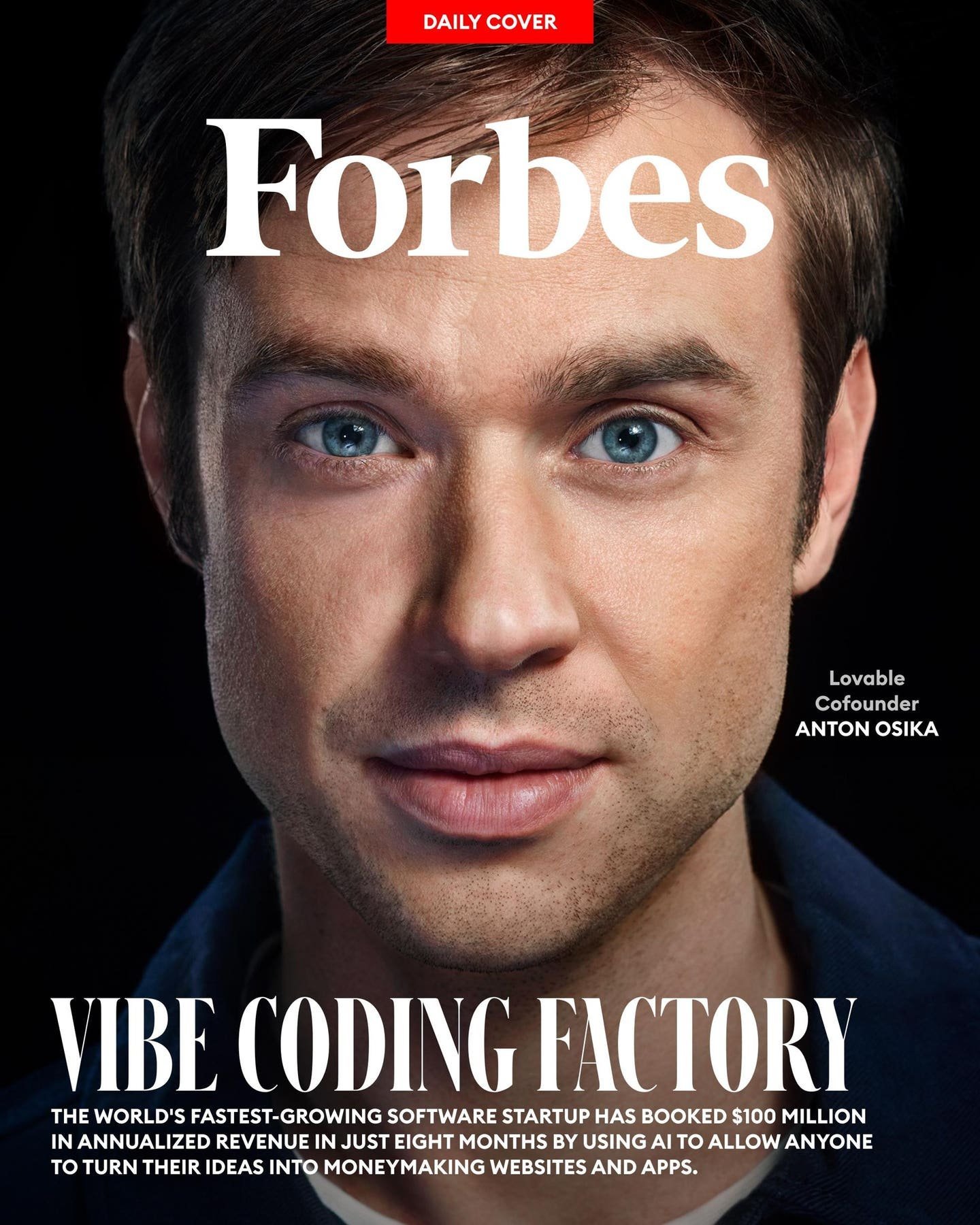 Lovable co-founder Anton Osika. (Sebastian Nevols for Forbes)
The Democratization Dilemma
Lovable’s core mission—democratizing software creation—resonates powerfully. Its freemium model (starting at $25/month for advanced features) makes development radically affordable. Building a simple game like Snake costs roughly $1 in credits; complex apps might reach $50—far below a human developer's hourly rate.
Osika, a physicist who left CERN disillusioned by the slow pace of "impossible projects," believes this accessibility unlocks human potential: "The realization was that you have much, much more impact being in industry, building companies." His earlier open-source project, GPT Engineer, foreshadowed Lovable’s potential when it trended #1 on GitHub.
While Lovable doesn't target professional developers ("Developers are really important, but they’re only 1% of the market," notes Fletcher), its rise coincides with a seismic shift in professional coding. Microsoft and Google report significant portions of internal code are now AI-generated, impacting hiring for entry-level developers.
The Path Forward
Lovable’s record-breaking growth underscores a massive demand for accessible creation tools. Yet, its long-term dominance hinges on navigating model costs, expanding technical depth beyond web interfaces, and outpacing well-funded incumbents and giants. Osika’s strategy is pragmatic: prioritize user experience and remain agile with AI model choices. "Humans understand humans," he asserts, positioning Lovable as the enabling catalyst turning fleeting ideas into tangible products almost instantly. The era where coding skill was the primary gatekeeper to digital entrepreneurship is rapidly fading.
Source: Originally published on Forbes.com. All figures in USD.
Comments
Please log in or register to join the discussion