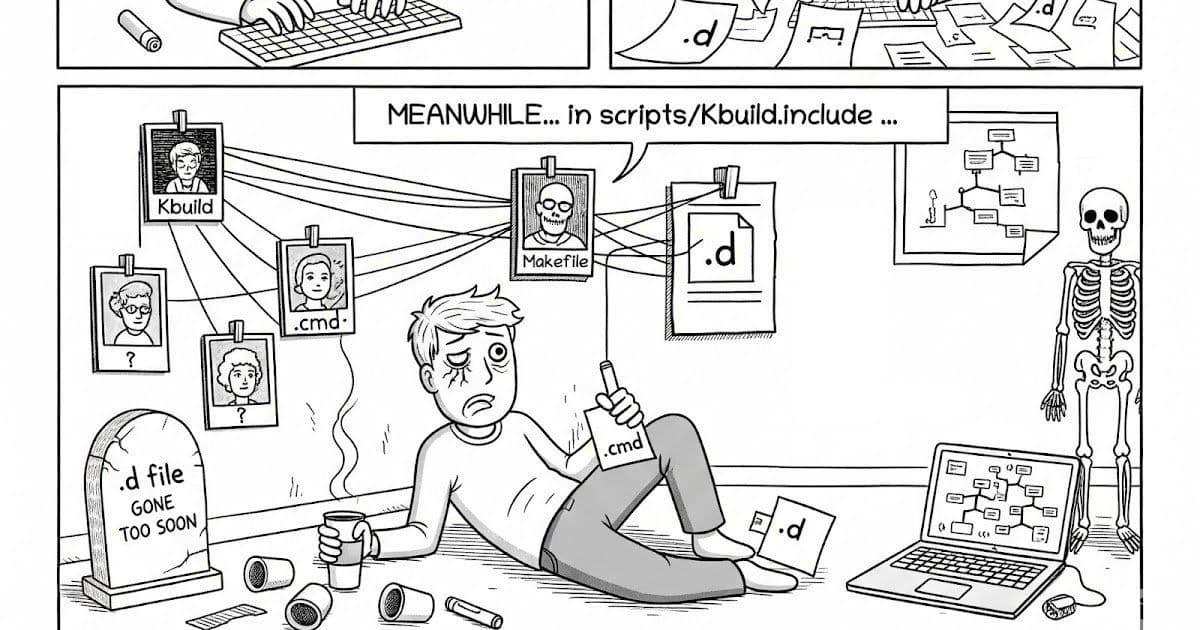
Tracking every file in a Linux kernel build seems trivial until you encounter disappearing dependency files and untracked header changes. Discover why the kernel deliberately deletes critical build artifacts and the clever workaround to reveal true dependencies.
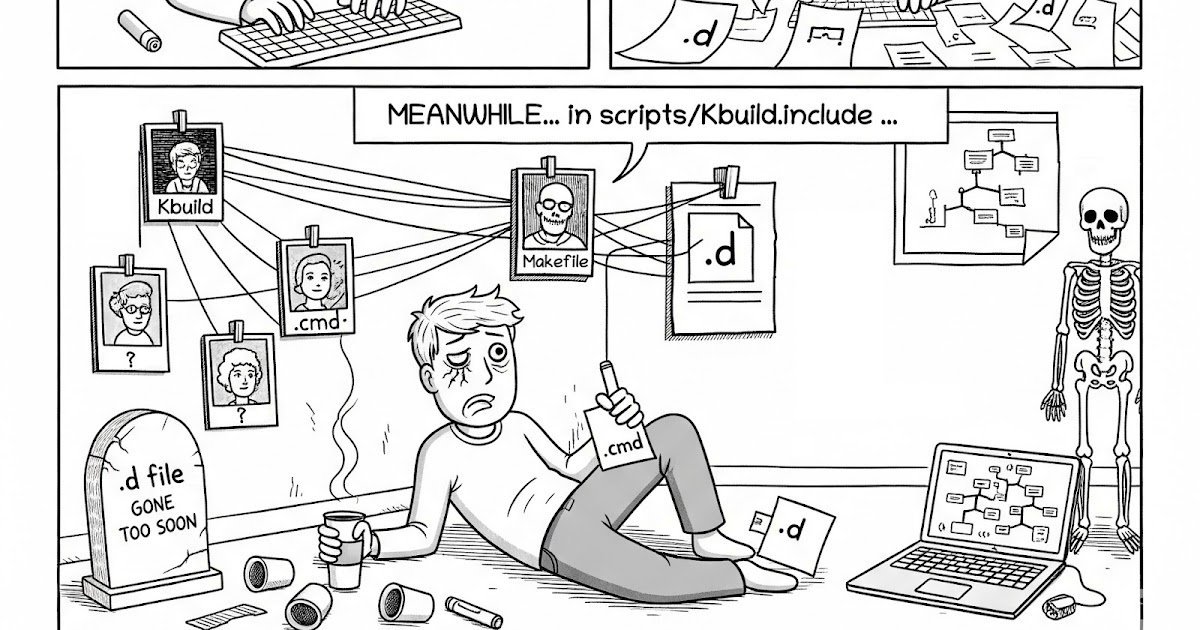
Every kernel developer has faced this maddening scenario: You modify a header file buried deep in the source tree, rebuild, and... nothing happens. No recompilation. No error. Just silence. As one developer's quest to list all build files reveals, this frustration stems from the kernel's deliberate—and often misunderstood—handling of dependency tracking.
The Dependency Illusion
At first glance, solution seems straightforward:
- Use
.configfor enabled options - Parse Makefiles for compiled
.cfiles - Resolve
#includedirectives recursively
Reality shatters this plan when encountering macros like:
#include TRACE_INCLUDE(TRACE_INCLUDE_FILE)
Static parsing fails because TRACE_INCLUDE_FILE is evaluated during preprocessing. The compiler's -MMD flag generates .d dependency files with true header trees, but they vanish instantly after creation.
The Ninja Cleanup: .d Files vs. .cmd Files
The kernel build system executes a precise ritual:
- Compiler generates
.dfile via-MMD - fixdep tool processes it
- Outputs condensed
.cmdfile - Deletes
.dfile
This .cmd file (e.g., net/core/.sock.o.cmd) contains:
- Full compile command
- Direct headers only
CONFIG_*wildcards
cmd_and_fixdep = \\
    $(cmd); \\
    scripts/basic/fixdep $(depfile) $@ '$(make-cmd)' > $(dot-target).cmd;\\
    rm -f $(depfile)  # The critical deletion
The Recursion Gap
.cmd files sacrifice completeness for Kbuild integration:
| Method | Pros | Cons |
|---|---|---|
| .d files | Accurate, compiler-generated | Deleted after use |
| .cmd files | Tracks CONFIG_*, Kbuild-friendly | No nested headers |
| strace build | Comprehensive | Extremely noisy |
| Static parsing | Theoretically possible | Fails on macros like TRACE_INCLUDE |
This explains why changing deep headers doesn't trigger rebuilds—.cmd files lack recursive dependencies. The fix? Manually deleting object files, a hack every veteran developer knows.
The Extraction Workaround
The solution lies in repurposing existing artifacts:
# 1. Find all .cmd files in build directory
# 2. Extract compile commands
# 3. Re-run with -MMD (skip fixdep and deletion)
This regenerates full .d files with complete header trees. Though computationally expensive, it provides accurate, unaltered dependencies without modifying the build system.
Beyond the Build
This dependency opacity reveals a kernel design philosophy: Optimize for incremental builds, not transparency. The fixdep trade-off prioritizes build speed over exhaustive tracking—a reasonable choice for daily development, but a hurdle for auditing or reproducibility. As one developer wryly notes, sometimes the only way forward is to embrace the kernel's chaos and outsmart it with its own tools.
Source: Carmine T. Alessandro
Comments
Please log in or register to join the discussion