
A new design framework explores how to make AI systems' real-world actions traceable and responsibility boundaries explicit through intent-state-effect models and structured protocols.
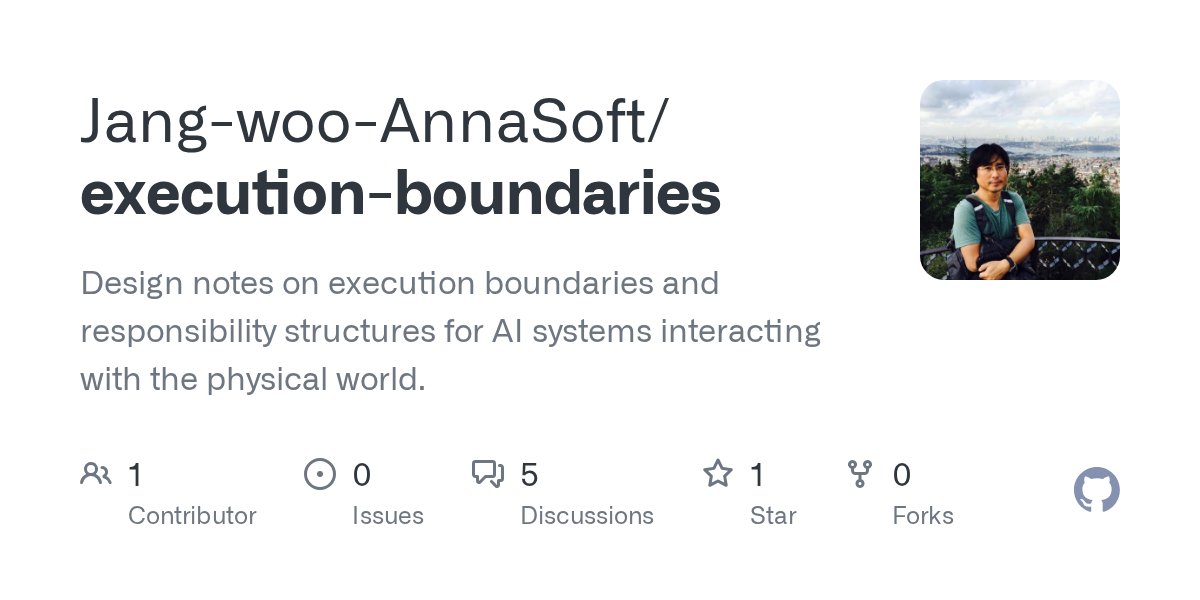
As artificial intelligence systems increasingly interact with the physical world, a critical question emerges: how do we ensure their actions remain traceable and their responsibility boundaries explicit? A new design exploration from GitHub repository execution-boundaries tackles this challenge head-on, proposing a framework that prioritizes constraint and clarity before autonomy.
The Core Problem: Capability vs. Control
The repository's central thesis is provocative yet practical: "Define execution boundaries first — let autonomy grow only where judgment remains explicit." This inverts the typical AI development approach, which often focuses on expanding capabilities before establishing robust control mechanisms.
The challenge isn't about making AI smarter; it's about making AI actions interpretable. As the notes explain, "As AI begins to participate in real-world decisions, the core challenge is no longer model capability — but how execution is allowed, constrained, and interpreted."
The Intent-State-Effect (ISE) Model
At the heart of the framework lies the ISE Model, which separates three critical components of any AI action:
- Intent: What the system aims to achieve
- State: The current conditions and context
- Effect: The actual outcome and consequences
By explicitly separating these elements, the framework creates natural checkpoints for human oversight and accountability. This separation prevents the dangerous conflation of goals, context, and outcomes that can lead to unpredictable behavior.
The 9-Question Protocol
Before any autonomous action occurs, the framework proposes a structured evaluation through nine critical questions. While the specific questions aren't detailed in the repository overview, the concept represents a systematic approach to judgment completeness — ensuring that AI systems don't act until humans have explicitly defined the boundaries of acceptable behavior.
This protocol transforms what could be an open-ended decision process into a structured checklist, making it easier to audit and understand why certain actions were permitted or denied.
Button vs. Switch: Action Semantics Matter
One particularly insightful exploration addresses the subtle but crucial difference between "buttons" and "switches" in AI interfaces. Buttons represent discrete, intentional actions with clear consequences, while switches imply ongoing states that can be toggled without full consideration of implications.
The framework argues for preserving clear action semantics at runtime, preventing the dangerous drift from intentional actions to continuous, potentially uncontrolled behaviors.
Making the Physical World "Callable"
The repository explores how to structure AI interactions with physical systems in a way that maintains human oversight. Rather than treating the physical world as an open playground for AI experimentation, it proposes treating physical actions as "callable" functions with explicit parameters, constraints, and accountability measures.
Not a Standard, But a Starting Point
Importantly, the creators emphasize that these notes are "not intended as a standard or a complete framework." Instead, they represent "a set of connected design explorations" that can anchor broader discussions about execution boundaries and responsibility structures.
This humility is refreshing in a field often dominated by grandiose claims about AI capabilities. The framework acknowledges that the challenge of responsible AI interaction with the physical world is ongoing and requires continuous exploration and refinement.
Why This Matters Now
As AI systems move from digital assistants to physical agents — controlling vehicles, managing energy systems, or making healthcare decisions — the need for explicit execution boundaries becomes critical. The framework provides a practical starting point for developers, policymakers, and ethicists to think systematically about how to structure AI autonomy in ways that preserve human judgment and accountability.
The repository serves as a hub connecting multiple design explorations, including related discussions on Hugging Face and the broader Nemo-Anna project. For anyone building AI systems that interact with the real world, these design notes offer a valuable perspective: start with boundaries, not capabilities.
Comments
Please log in or register to join the discussion