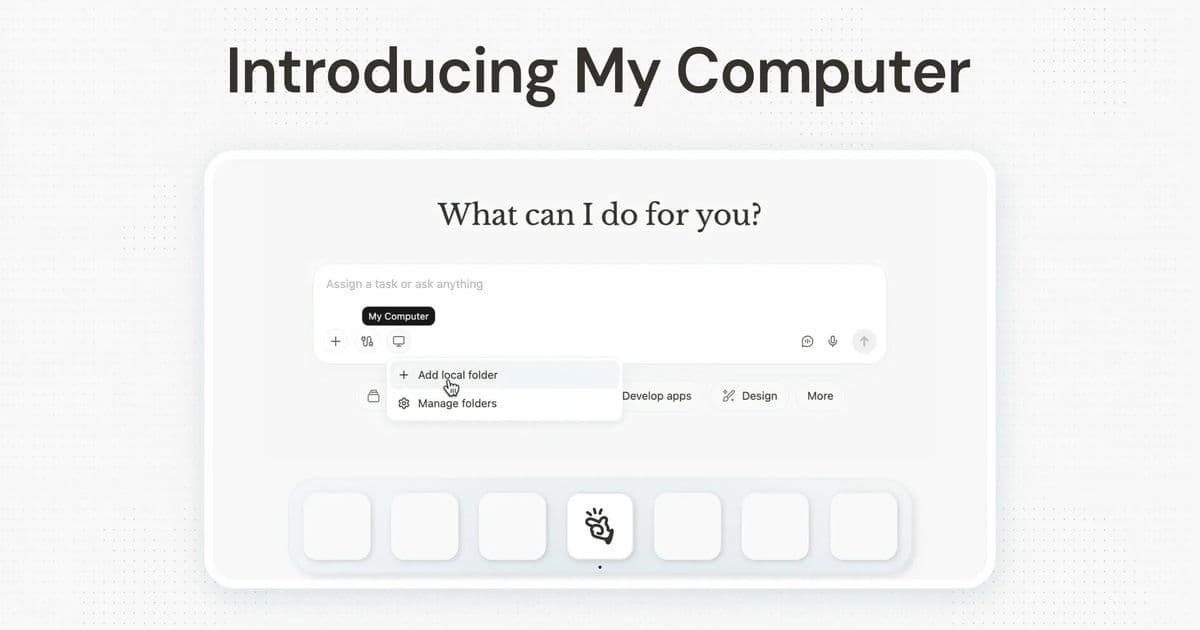
Manus launches My Computer, enabling its AI agent to interact with users' local files, tools, and applications through a desktop application.
Chinese AI startup Manus has unveiled a new desktop application called My Computer that allows its AI agent to directly interact with users' local files, tools, and applications. The announcement, made on March 16, 2026, represents a significant step toward integrating AI agents more deeply into personal computing workflows.
What Manus Is Actually Building
The My Computer application creates a bridge between Manus's cloud-based AI capabilities and a user's local computing environment. According to the company's announcement, the software enables the AI agent to "interact directly with the user's local files, tools, and applications" - essentially giving the AI read/write access to the user's desktop environment.
This approach addresses one of the fundamental limitations of current AI assistants: their inability to work with local data and applications without cumbersome workarounds. Most AI tools today operate in isolated environments, requiring users to copy-paste information or upload files manually.
The Technical Architecture
While Manus hasn't released detailed technical specifications, the application likely works by creating a secure local agent that communicates with Manus's cloud infrastructure. This architecture would allow the AI to:
- Access and modify local files and folders
- Launch and interact with installed applications
- Read system information and user data
- Potentially automate workflows across multiple local tools
The desktop application appears to be the client-side component of a broader system where the AI's intelligence remains in the cloud, but its ability to act is extended to the local machine.
Why This Matters
This development represents a convergence of several trends in AI:
Agentic AI Expansion: Companies are increasingly moving beyond simple chatbots toward AI agents that can take autonomous actions. Manus's approach gives its agent genuine agency within a user's computing environment.
Local-Cloud Hybrid Models: Rather than keeping everything in the cloud or requiring full local installation, Manus appears to be adopting a hybrid approach that balances performance, privacy, and functionality.
Desktop AI Integration: As AI becomes more capable, users want it to work seamlessly with their existing tools rather than requiring them to switch contexts or copy data between applications.
The Competitive Landscape
Manus isn't alone in pursuing this vision. Other AI companies are exploring similar territory:
- OpenAI has been developing tools for AI agents to use computers, though primarily in research contexts
- Anthropic has demonstrated AI systems that can use computers autonomously
- Microsoft is integrating AI deeply into Windows, though with different architectural approaches
- Google continues to expand AI's ability to work with local data through its ecosystem
What makes Manus's approach notable is the explicit focus on creating a dedicated desktop application that serves as the interface between AI and local computing resources.
Privacy and Security Considerations
Any system that grants AI access to local files and applications raises significant privacy questions. Manus will need to address:
- Data access controls: What files and applications can the AI access, and how are these permissions managed?
- Security boundaries: How does the system prevent malicious use or accidental data exposure?
- Local processing: Does any processing happen locally, or is all data sent to Manus's servers?
- User control: How easily can users revoke access or audit what the AI has done?
These are critical questions that will likely determine whether enterprises and privacy-conscious users adopt the technology.
Current Availability and Reception
The My Computer application appears to be in early release, with limited public information about pricing, system requirements, or availability outside of Manus's existing markets. The announcement generated discussion on social platforms, with users expressing both excitement about the capabilities and concern about the privacy implications.
Looking Forward
If successful, Manus's approach could influence how AI agents are designed and deployed. The ability to work seamlessly with local files and applications addresses a genuine user need - reducing the friction between AI assistance and actual work being done.
However, the success of this approach will depend on execution details that aren't yet public: the security model, performance characteristics, integration quality, and how well Manus balances capability with user control.
The broader trend is clear: AI agents are evolving from passive tools that respond to queries into active participants in computing workflows. Manus's My Computer application represents one vision of how this evolution might unfold - bringing AI's capabilities directly to where users already work, rather than requiring them to adapt to the AI's limitations.
For now, the technology remains in early stages, and its long-term impact will depend on how well it addresses both the technical challenges of integration and the human factors of trust and control in AI-human collaboration.
Comments
Please log in or register to join the discussion