A new monospace font designed specifically for developers combines clean glyphs, cursive italics, and extensive customization options to create a more enjoyable coding experience.
When developers spend hours staring at code, the font they choose becomes more than just a visual preference—it becomes the lens through which they experience their craft. Maple Mono emerges as a thoughtfully designed open-source monospace font that addresses the subtle frustrations developers encounter with existing programming fonts.
The Problem With Existing Fonts
The creator of Maple Mono identified a pattern familiar to many developers: despite the abundance of excellent monospace fonts on the market, each falls short in specific ways when used for actual coding work. JetBrains Mono offers refined glyph design but feels too rigid. Fira Code provides rich ligatures yet lacks proper italics with an overly steep angle. Victor Mono features cursive italics but with an exaggerated style that doesn't suit everyone's taste. Sarasa Gothic solves the Chinese-English width ratio problem but makes English characters too narrow for comfortable reading.
This observation reveals a fundamental truth about developer tools: what works beautifully in marketing screenshots often reveals its limitations during actual use. The gap between theoretical excellence and practical utility drives innovation in unexpected places.
Design Philosophy: Clean, Cursive, and Customizable
Maple Mono was built around three core principles that distinguish it from other programming fonts. First, it features clean glyphs with rounded corners—a rarity in monospace fonts that creates a softer, more approachable appearance. Second, it incorporates cursive-style italics that bring life to code without being overly decorative. Third, it offers fine-grained configuration options that let developers tailor the font to their exact preferences.
The font also prioritizes support for Nerd Font and Chinese characters, addressing needs often overlooked by mainstream programming fonts. With a 2:1 monospace ratio for Chinese and English characters, it ensures proper alignment and readability across different languages.
Variable Weight and Smart Features
One of Maple Mono's standout features is its variable font support, allowing developers to select any weight they prefer rather than being limited to predefined options. This flexibility extends to the font's extensive OpenType features, which can be configured or frozen according to individual preferences.
Smart ligatures transform plain text into connected letters and tags, bringing fonts to new levels of expressiveness. The font includes special ligatures for debugging tags like [DEBUG], [INFO], [WARN], [ERROR], and [TODO], making log files and task lists more readable. Connected strokes in italic style add visual interest to code, while smart spacing handles generic types and bitwise operations gracefully.
Nerd Font Integration and Icon Support
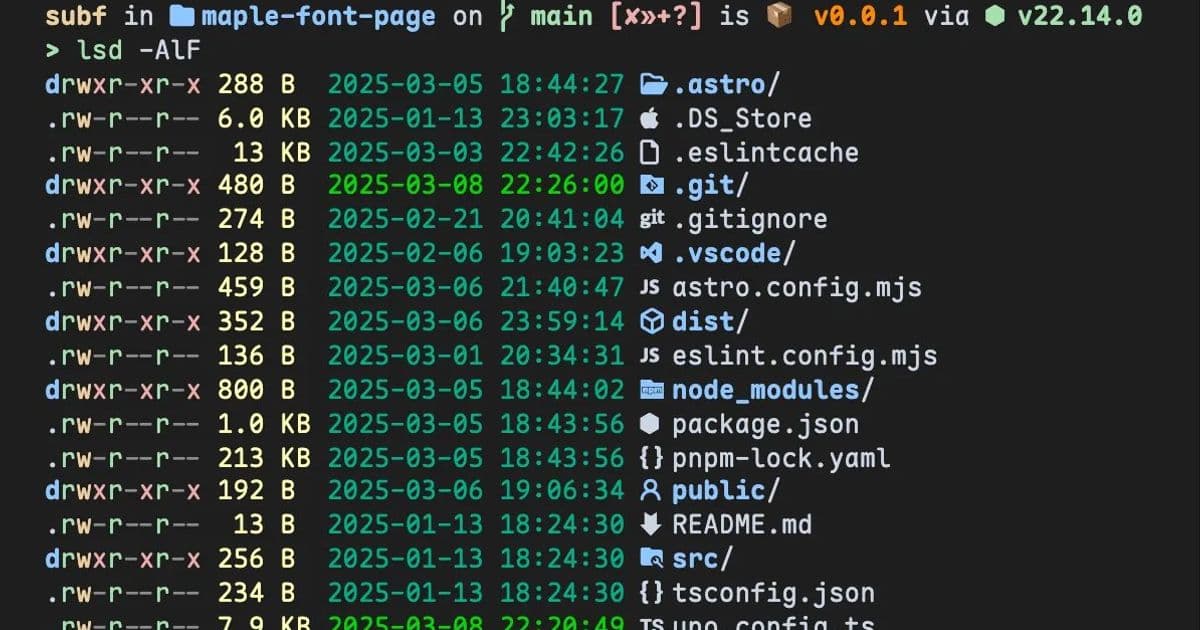
First-class Nerd Font support means developers can iconize their modern terminals without compromise. This integration allows for beautiful icons that enhance the visual experience of working in the terminal, making it easier to distinguish between different types of output and information.
Customization Through Configuration
Maple Mono takes customization seriously. Developers can configure or freeze OpenType features through a JSON schema, creating their perfect font setup. This level of control means the font can adapt to different coding styles, languages, and personal preferences rather than forcing users to adapt to the font.
For those who find certain glyphs too unusual, Maple Mono Normal offers a preset that resets strange glyphs to create a style similar to JetBrains Mono with slashed zeros. This option demonstrates the font's commitment to user choice and accessibility.
Real-World Performance
Across multiple programming languages and frameworks, Maple Mono demonstrates its versatility. In TypeScript and JSX, the font handles modern syntax with clarity. Vue components benefit from the italic styling that makes template syntax more readable. Java code with Spring Boot annotations appears clean and professional. Go's HTTP handlers and Python classes both benefit from the font's attention to detail in handling different character sets and ligatures.
Even in C++, where template syntax and complex type declarations can challenge font rendering, Maple Mono maintains readability and visual appeal. The font's ability to handle such diverse codebases speaks to its thoughtful design and comprehensive testing.
Community Reception
The developer community has embraced Maple Mono enthusiastically. Users praise its combination of pizazz and good italics, noting it as exactly what they were looking for after growing bored with JetBrains Mono. The Nerd Font support receives particular acclaim, with developers appreciating the ability to customize font features to their exact needs.
Some users report that colleagues have complimented their editor and terminal appearance, suggesting the font's aesthetic improvements extend beyond individual preference to create a more professional and polished development environment. Others appreciate how the cursive flair makes code feel more alive compared to the monotonous print of traditional programming fonts.
Standing on the Shoulders of Giants
Maple Mono acknowledges its debt to the broader font ecosystem. It builds upon JetBrains Mono's base, integrates Nerd Fonts for icon support, and draws inspiration from Commit Mono, Fira Code, Iosevka, Monaspace, Monolisa, Recursive, Roboto Mono, and Victor Mono. This collaborative approach to font development reflects the open-source ethos that drives much of the developer tools ecosystem.
The font uses Fonttools and FoundryTools-CLI for building, with the website built using Astro, SolidJS, UnoCSS, and ESM.sh—demonstrating that the same modern web technologies used to build applications can also create beautiful documentation and distribution platforms.
The Future of Coding Typography
Maple Mono represents more than just another programming font—it embodies a shift toward recognizing that typography in development environments deserves the same attention to detail as typography in published works. As developers spend increasingly long hours in their editors and terminals, the quality of their visual experience becomes a factor in productivity, comfort, and even job satisfaction.
The font's success suggests a growing appetite for tools that combine technical excellence with aesthetic refinement. By addressing the specific pain points developers encounter with existing fonts while adding thoughtful features like variable weights and extensive customization, Maple Mono sets a new standard for what programming fonts can achieve.
For developers seeking to enhance their coding experience, Maple Mono offers a compelling combination of functionality, beauty, and flexibility. Whether you're writing TypeScript, Python, Java, Go, or C++, this open-source font provides a fresh perspective on how code can look and feel—proving that sometimes, the smallest details can make the biggest difference in our daily work.
Try Maple Mono now and join thousands of developers who have already discovered how the right font can transform their coding experience.
Comments
Please log in or register to join the discussion