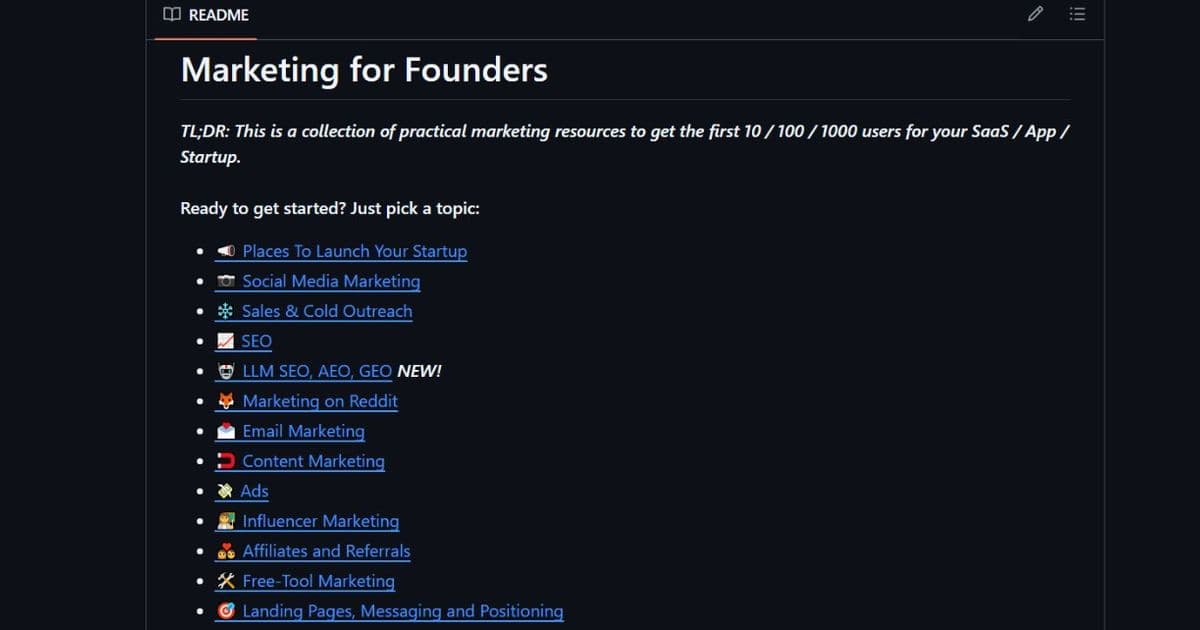
A comprehensive review of EdoStra's Marketing-for-Founders GitHub repository, which curates practical marketing resources specifically designed for technical founders seeking their first 10, 100, or 1,000 users.
The marketing landscape for early-stage startups presents a paradox: while there's an overwhelming amount of advice available, most focuses on scaling well-funded companies rather than helping bootstrapped founders acquire their first users. EdoStra's Marketing-for-Founders GitHub repository addresses this gap by curating practical, actionable marketing resources specifically designed for technical founders navigating the challenging early stages of building a SaaS, app, or startup.
Target Audience and Purpose
This resource collection stands out by recognizing that technical founders often lack marketing expertise and budget. The repository explicitly focuses on "getting the first 10 / 100 / 1000 users" rather than scaling to 100,000 users or $1M ARR—a refreshing departure from the typical startup marketing content that assumes substantial funding and resources.
The organization of resources into categories like Places To Launch, Product Hunt Marketing, Social Media Marketing, and more creates a practical roadmap that founders can follow methodically. This structure acknowledges that marketing isn't a single activity but a collection of coordinated efforts across different channels.
Key Resource Categories
Launch Platforms and Communities
The repository provides an extensive list of launch platforms, software directories, and communities where founders can gain initial visibility. These include well-known platforms like Product Hunt, Betalist, and Indie Hackers, alongside specialized directories like SaaSHub, G2, and Capterra.
What makes this section particularly valuable is the inclusion of niche communities like specific subreddits (Sideproject, Selfhosted, Indiehackers) with guidance on proper engagement etiquette. The advice to "always check the rules before posting anything" reflects an understanding that community engagement requires authenticity, not just promotion.
Product Hunt Strategy
Product Hunt remains one of the most effective channels for early user acquisition, but success requires careful preparation. The repository curates practical guides for planning a successful launch, including frameworks for ranking #1, step-by-step processes, and templates for launch posts.
This section acknowledges that Product Hunt success isn't just about the launch day itself but involves significant preparation, promotion, and follow-up work—a reality that many founders underestimate.
Modern Marketing Channels
The repository includes sections on emerging marketing channels that are particularly relevant for early-stage startups:
- LLM/AEO/GEO Optimization: With the rise of AI search engines, getting recommended by ChatGPT, Claude, Perplexity, and Gemini has become a significant acquisition channel. The resources here provide practical guides for optimizing for AI discovery.
- Reddit Marketing: Recognizing Reddit's value for initial traction, the collection includes strategies for authentic engagement without getting banned—a common pitfall for founders new to the platform.
- Social Listening and Building in Public: These approaches leverage the founder's personal brand and organic conversations rather than paid promotion, making them ideal for budget-constrained startups.
Sales and Outreach
For many early-stage startups, direct outreach remains one of the most effective user acquisition strategies. The repository provides frameworks for identifying ideal customer profiles, crafting effective cold emails, and scaling outreach efforts.
What stands out here is the emphasis on early-stage sales strategies that acknowledge resource constraints. Resources like "How to do startup sales with no experience" and "The GTM Outreach Playbook: From Triggers to Demos" provide practical guidance rather than theoretical frameworks that require large teams to implement.
Foundational Marketing Elements
Beyond specific channels, the repository recognizes the importance of foundational marketing elements:
- Landing Pages and Messaging: Many startup websites fail to clearly communicate who the product is for, what it does, and why it's better. The curated resources help founders create effective websites that convert visitors into users.
- Pricing Strategy: Pricing is often an afterthought for technical founders, but it significantly impacts both user acquisition and business sustainability. The resources provide frameworks for pricing that balance accessibility with business viability.
- Idea Validation: The repository emphasizes validating demand before building a product, helping founders avoid the common mistake of building something nobody wants.
Practical Implementation Focus
What makes this collection particularly valuable is its emphasis on practical implementation over theory. Rather than discussing abstract marketing concepts, it provides specific guides, templates, and examples that founders can adapt to their own contexts.
For instance, rather than just explaining the importance of email marketing, it includes actual email examples, frameworks for different types of sequences, and specific tools like Userlist for lifecycle email planning. This "show, don't tell" approach makes the resources immediately actionable.
Critical Analysis
While the repository is comprehensive, it's worth noting a few considerations:
Channel Overload: The sheer number of channels and tactics might overwhelm founders new to marketing. The collection would benefit from clearer guidance on prioritization based on different startup types and stages.
Resource Quality Variation: As a curated collection, the quality of individual resources varies. Some links may become outdated over time, and not all advice applies equally to all types of startups (B2B vs. B2C, technical vs. non-technical products).
Missing Context: The resources provide tactical guidance but less strategic context about how different marketing activities fit together into a cohesive strategy. Founders might need additional guidance on developing an integrated marketing plan.
Conclusion
EdoStra's Marketing-for-Founders repository fills an important gap in startup marketing resources by focusing specifically on the challenges faced by technical founders in the early stages. Its practical, implementation-focused approach provides a roadmap for acquiring those crucial first users without requiring substantial marketing budgets or expertise.
The most valuable aspect of this collection is its recognition that marketing for early-stage startups isn't about scaling existing channels but about finding creative ways to gain initial traction with limited resources. By curating resources that emphasize authenticity, community engagement, and organic growth, it provides a foundation that founders can build upon as their startups evolve.
For technical founders feeling overwhelmed by marketing, this repository offers both a starting point and a reference guide for the ongoing challenge of user acquisition. Its organization into practical categories makes it easy to navigate, and the emphasis on actionable advice rather than theory increases the likelihood that founders will actually implement these strategies.
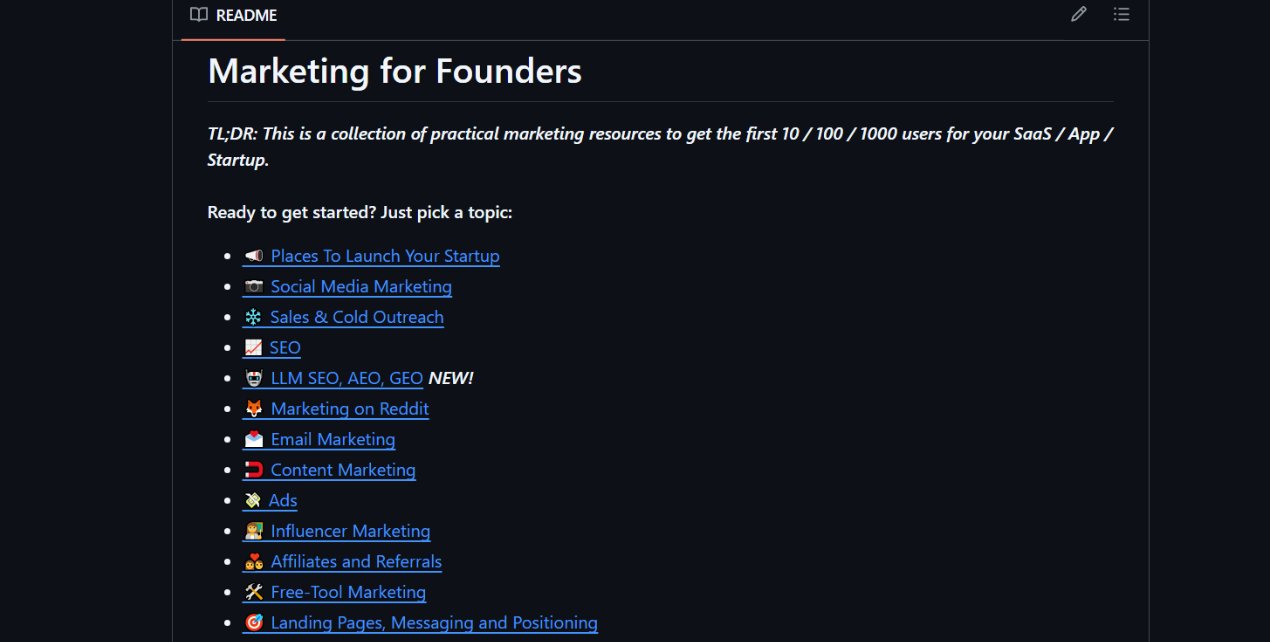
The repository is maintained by Edoardo Stradella and inspired by "Marketing for Engineers" by Lisa Dziuba and Ahmed Awad. As with any curated resource, founders should consider their specific context and adapt the recommendations accordingly, but this collection provides an excellent foundation for early-stage marketing efforts.
Comments
Please log in or register to join the discussion