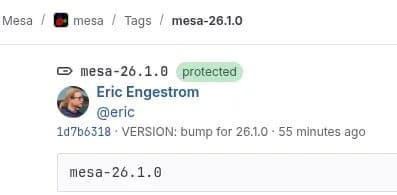
Mesa 26.1 brings significant Vulkan driver enhancements, performance optimizations, and new extensions for Intel, AMD, and other hardware, while marking the end of maintenance for VirGL virtualized graphics support.
The Mesa graphics stack continues its rapid development cycle with the release of Mesa 26.1, bringing substantial improvements to open-source Vulkan drivers across multiple hardware platforms. This release represents another significant step forward for Linux gaming, professional workloads, and virtualized environments that rely on open-source graphics drivers.
What Makes Mesa 26.1 Significant
Mesa serves as the critical foundation for open-source graphics on Linux systems, providing the implementation for OpenGL, Vulkan, and other graphics APIs across a wide range of hardware. The 26.1 release continues the project's tradition of timely feature updates, bringing both performance optimizations and new functionality to users of Intel, AMD, and other open-source drivers.

The release announcement from Eric Engestrom highlights the continued maturation of the open-source graphics ecosystem, with particular emphasis on Vulkan support. This is crucial as Vulkan becomes increasingly important for both gaming and professional applications on Linux.
Key Vulkan Driver Improvements
Mesa 26.1 introduces numerous new Vulkan extensions across different driver implementations:
AMD RADV Improvements
The AMD RADV driver sees substantial enhancements with:
- VK_KHR_sampler_ycbcr_conversion support
- VK_KHR_internally_synchronized_queues for improved performance
- VK_KHR_shader_integer_dot_product for advanced compute workloads
- VK_EXT_descriptor_heap (experimental, requires 'export RADV_EXPERIMENTAL=heap')
- VK_KHR_device_address_commands for better memory management
- VK_EXT_primitive_restart_index for enhanced geometry processing
- VK_VALVE_shader_mixed_float_dot_product on Vega20, Navi14, and RDNA2+ GPUs
- VK_KHR_copy_memory_indirect on GFX8+ GPUs
These extensions collectively improve RADV's feature parity with proprietary drivers while often providing better performance characteristics.
Intel ANV Enhancements
Intel's ANV Vulkan driver gains:
- VirIO-GPU native-context support for improved Intel GPU performance in para-virtualized VMs
- VK_EXT_present_timing for better frame timing information
- VK_KHR_pipeline_executable_properties for debugging and optimization
The VirIO-GPU support is particularly noteworthy as it provides a more efficient alternative to the now-deprecated VirGL for virtualized environments.
Nouveau NVK Progress
Nouveau's NVK driver continues its impressive development with:
- VK_KHR_copy_memory_indirect support
- VK_KHR_present_timing implementation
NVK has made remarkable progress in recent releases, bringing Vulkan support to NVIDIA GPUs without requiring proprietary blobs.
Turnip Improvements
For Qualcomm Adreno GPUs, the Turnip driver adds:
- VK_QCOM_image_processing for enhanced image processing capabilities
- VK_EXT_present_timing support
PowerVR and Panfrost Enhancements
The open-source drivers for mobile and embedded GPUs also see significant improvements:
PowerVR (PVR)
- VK_KHR_sampler_ycbcr_conversion
- VK_KHR_pipeline_executable_properties
- VK_KHR_maintenance4
- VK_KHR_shader_integer_dot_product
- VK_EXT_non_seamless_cube_map
- fullDrawIndexUint32, multiDrawIndirect, depthBiasClamp, wideLines
Panfrost/PanVK
- VK_KHR_present_id and VK_KHR_present_wait
- VK_EXT_present_timing
- VK_EXT_acquire_drm_display
- VK_EXT_image_view_min_lod
- VK_EXT_depth_clamp_control
- VK_EXT_conditional_rendering
- VK_EXT_attachment_feedback_loop_layout and dynamic state
- VK_EXT_shader_atomic_float
- VK_EXT_shader_stencil_export
These improvements bring better feature parity and performance to ARM-based systems and embedded devices.
Performance Optimizations
Beyond new extensions, Mesa 26.1 includes several performance optimizations:
RADV Vulkan Video
The implementation of low-latency encode/decode capabilities for RADV Vulkan Video represents a significant improvement for content creators and users working with video in virtual environments.
Zink Improvements
Zink, which implements OpenGL on top of Vulkan, continues to improve with:
- Better performance for OpenGL ES 2.0 on PowerVR GPUs
- Various OpenGL extension support through cl_khr_subgroup_* extensions
Rusticl OpenCL
The Rusticl OpenCL implementation sees continued improvements, bringing better performance and compatibility for OpenCL workloads on open-source drivers.
Experimental and Forward-Looking Features
Mesa 26.1 includes several experimental features that point to future developments:
Intel Nova Lake P Support
Early experimental support for Intel's upcoming Nova Lake P platform demonstrates the Mesa project's commitment to staying ahead of hardware releases.
KosmicKrisp for Vulkan-on-Metal
Continued work on KosmicKrisp, which implements Vulkan on top of Metal, expands the options for cross-platform graphics support.
VirGL Deprecation and Alternatives
Perhaps the most significant announcement in Mesa 26.1 is the deprecation of VirGL, the code responsible for accelerated graphics in virtualized environments. Eric Engestrom noted that VirGL is "no longer considered maintained" and might be removed unless someone steps up to maintain it.
This change reflects the evolution of virtualization technology, with several alternatives now available:
- VirIO-GPU: Now supported by Intel Iris, Crocus, and ANV drivers, providing native-context support for improved Intel GPU performance in VMs
- GPU Passthrough: Technologies like VFIO allow direct GPU access to virtual machines
- SPICE with GPU Acceleration: Alternative remote desktop solution with GPU acceleration
For users relying on VirGL, this transition period requires attention to ensure compatibility with future Mesa releases.
Build Recommendations
For users looking to take advantage of Mesa 26.1:
Gaming Environments
- AMD users: RADV now supports more advanced extensions that can improve performance in newer titles
- Intel users: The VirIO-GPU support improves VM gaming performance
- NVIDIA users: NVK continues to improve, though still best suited for older or less demanding games
Professional Workloads
- Video editors: RADV Vulkan Video's low-latency encode/decode capabilities offer improved performance
- 3D artists: New extensions like VK_EXT_blend_operation_advanced on lavapipe improve rendering quality
- Compute workloads: VK_KHR_shader_integer_dot_product and similar extensions accelerate compute operations
Development Environments
- Enable experimental features with appropriate environment variables (e.g., 'export RADV_EXPERIMENTAL=heap' for descriptor heap support)
- Use the latest Mesa version for best Vulkan extension support when developing applications
Virtualization Considerations
- Plan migration away from VirGL to VirIO-GPU or other alternatives
- Test applications with new virtualization graphics solutions before VirGL potential removal
Future Outlook
Mesa 26.1 continues the project's tradition of steady, substantial improvements to open-source graphics drivers. The focus on Vulkan extensions, performance optimizations, and hardware support demonstrates the project's commitment to providing competitive open-source alternatives to proprietary drivers.
For more details on all changes in Mesa 26.1, the full release announcement is available on the Mesa-dev mailing list. Users can obtain Mesa 26.1 through their distribution's package manager or by building from the official Mesa Git repository.
The continued rapid development of Mesa, particularly in the Vulkan space, strengthens Linux as a platform for gaming, professional workloads, and virtualized environments. As hardware manufacturers increasingly collaborate with the open-source community, we can expect even more significant improvements in future releases.
Comments
Please log in or register to join the discussion