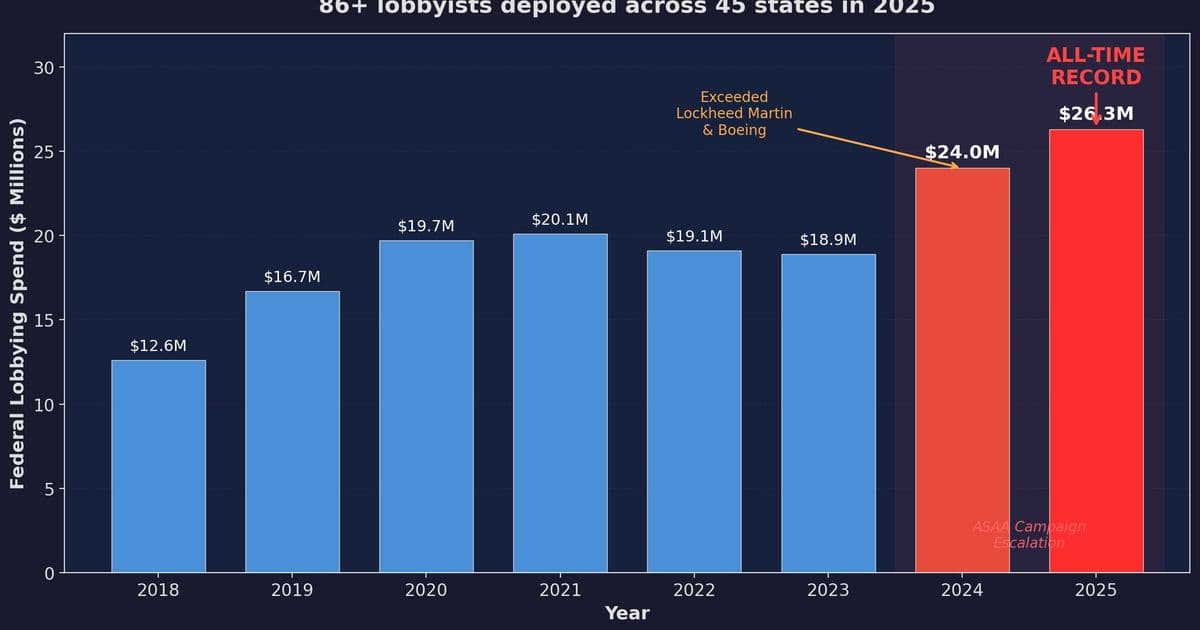
The TBOTE Project reveals how Meta's unprecedented lobbying operation, spanning federal and state levels with 86+ lobbyists and $26.3M in spending, is influencing age verification legislation through dark money networks, astroturf organizations, and competing model bills that shift regulatory burden away from social media platforms.
Meta's $26.3M Lobbying Machine Shapes Age Verification Policy Across 45 States
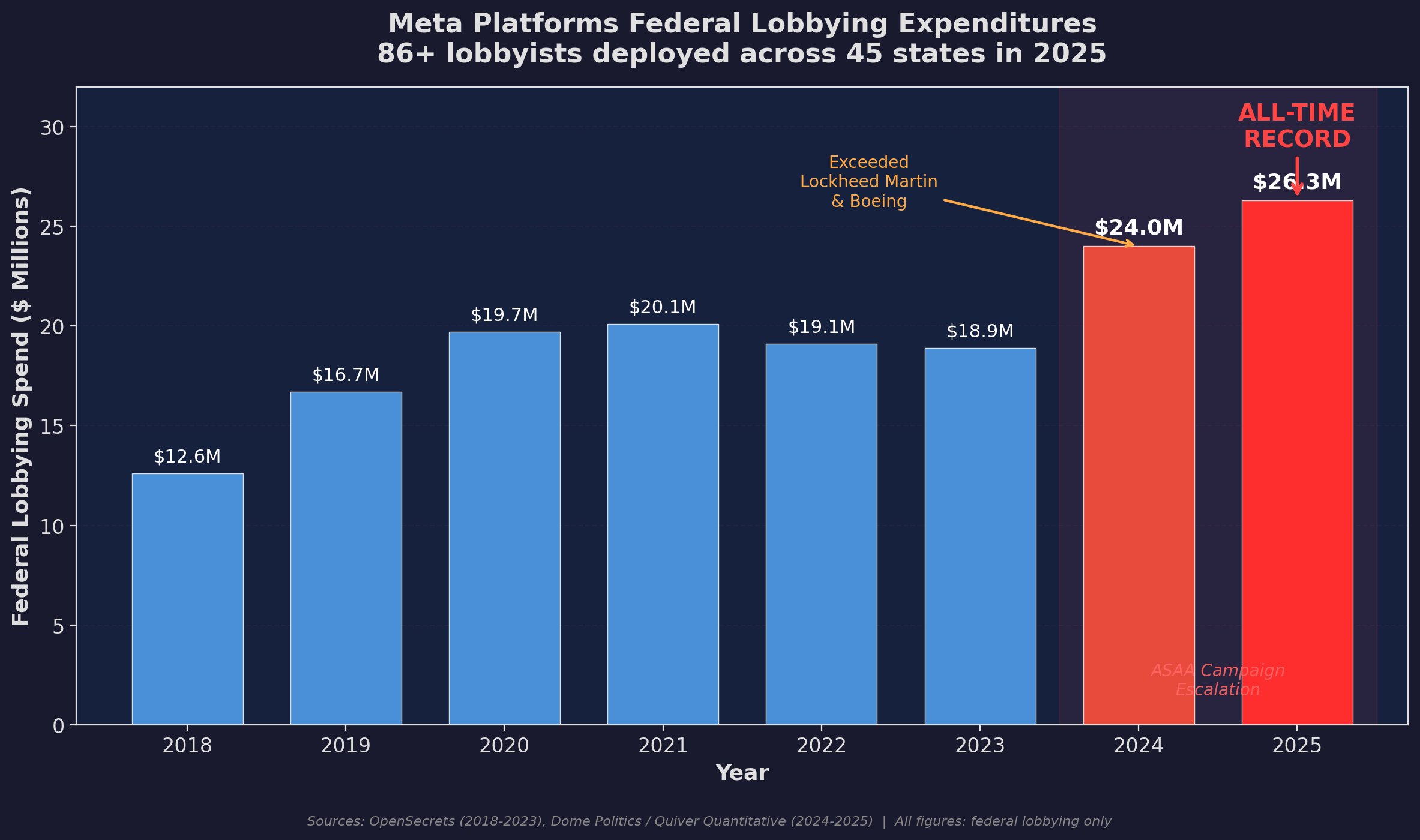
The TBOTE Project, an open-source intelligence investigation, has uncovered a sophisticated lobbying operation centered around age verification legislation that extends from Congress to 45 states and into international policy arenas. At the heart of this operation is Meta, which spent a record $26.3 million on federal lobbying in 2025 while deploying 86+ lobbyists across multiple jurisdictions to advance its regulatory interests.
Corporate Infrastructure and Influence Networks
The investigation documents how Meta has built an extensive lobbying infrastructure that goes beyond direct advocacy. The company retained 40+ lobbying firms and 87 federal lobbyists in 2025, with 85% of these lobbyists having prior government service experience. This institutional knowledge has proven valuable in crafting legislation that serves Meta's interests while appearing to address legitimate child safety concerns.
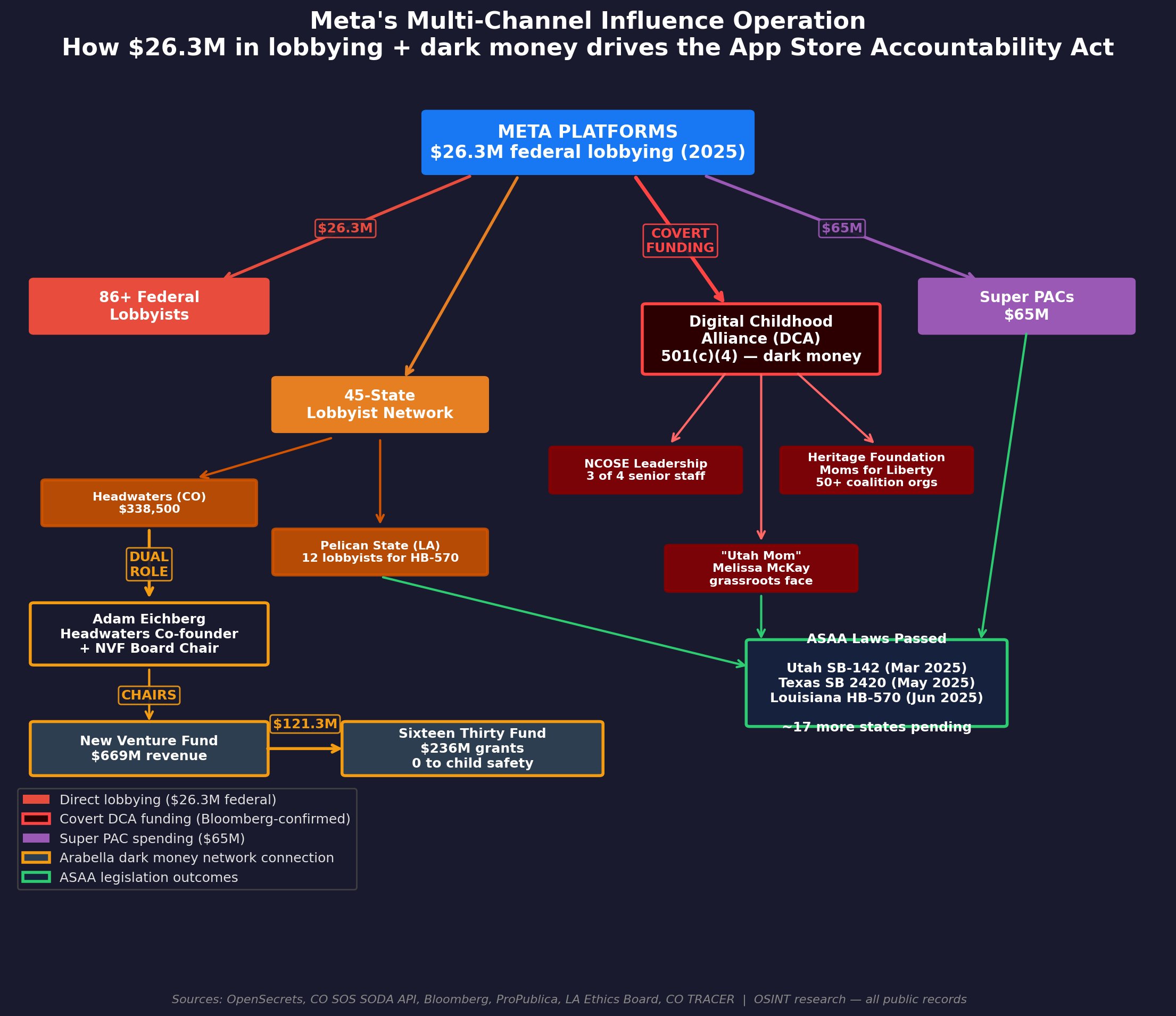
At the state level, Meta's spending is equally impressive. The company allocated $338,500 to Headwaters Strategies in Colorado, distributed $324,992 across 9 firms and 12 lobbyists in Louisiana, and invested $1,036,728 in direct California lobbying during Q1-Q3 2025 alone. Perhaps most revealing, a Meta lobbyist brought legislative language for Louisiana HB-570 directly to the bill's sponsor, Rep. Kim Carver, who confirmed this public interaction.
The Digital Childhood Alliance: Astroturf Advocacy
Meta's influence extends through covert funding of the Digital Childhood Alliance (DCA), an organization positioned as a grassroots coalition advocating for the App Store Accountability Act (ASAA). This legislation, H.R. 3149/S. 1586, was explicitly listed in Meta's Senate LD-2 lobbying disclosures as a lobbied bill.
The DCA represents a classic astroturf operation—corporate interests disguised as independent advocacy. The investigation reveals that Meta is not alone in supporting this agenda. Snap, X, and Pinterest have joined Meta in backing ASAA, creating a pattern where every confirmed supporter is a social media platform, while every opponent operates an app store. This suggests a coordinated effort to shift regulatory burdens away from social media platforms and toward app stores.
Heritage Foundation's Role in the Advocacy Pipeline
The lobbying operation extends beyond Meta to influential conservative institutions. The Heritage Foundation funds three of the six named DCA coalition organizations, creating a powerful advocacy pipeline from Capitol Hill to state legislatures. The investigation further discovered that Heritage has merged leadership with another coalition member, indicating deep institutional integration within this advocacy network.
Competing Model Legislation and Two-Track Policy Landscape
Meta's influence extends to the legislative drafting process itself. The investigation identified competing model legislation, particularly ICMEC's DAAA (Developing Age-Appropriate Accountability Act), which takes a different approach to age verification but ultimately aligns with Meta's interests in shifting regulatory burdens. This creates a two-track legislative landscape where both tracks advance similar outcomes despite different methodologies.
ICMEC, which authored the competing model legislation, operates under severe financial distress according to the investigation, with Meta confirmed as a major donor. This financial relationship raises questions about the independence of the legislative templates being promoted across multiple states.
Dark Money Networks and Funding Channels
The TBOTE Project traced funding flows across five confirmed channels, analyzing $2.0 billion in dark money grants and searching 59,736 donor-advised fund (DAF) recipients to map the financial infrastructure supporting this lobbying operation. The investigation also parsed LD-2 filings and mapped campaign contributions across four states to document the full scope of influence activities.
The Arabella network, a major dark money conduit, received particular scrutiny. The investigation found zero child safety grants across $2.0 billion in Arabella network grants, suggesting that age verification advocacy operates through more opaque channels than traditional grantmaking. This funding mechanism allows corporate interests to shape policy without direct attribution.
International Dimensions of the Lobbying Operation
Meta's influence operation extends beyond U.S. borders. The company spends EUR 10 million annually on EU lobbying—the largest single company spend in Brussels—while retaining 18+ consulting firms across multiple jurisdictions. Meta uses at least three firms operating in both Brussels and Washington, creating a coordinated international approach to regulatory influence.
In Brazil, Meta appeared at legislative hearings for PL 2628/2022, though Brazil's resulting law placed the burden directly on platforms rather than app stores. This international variation suggests Meta adapts its lobbying strategies to local contexts while advancing similar underlying objectives.
Scale and Scope of the Legislative Push
The investigation documents over 30 jurisdictions introducing age verification bills within an 18-month window, indicating a coordinated legislative strategy. This rapid, widespread introduction of similar legislation across multiple jurisdictions is characteristic of model legislation campaigns, where template bills are introduced simultaneously in multiple states with minimal modifications.
Methodology and Verification
The TBOTE Project employed open-source intelligence (OSINT) techniques to document this lobbying operation. All findings are sourced from public records including IRS 990 filings, Senate LD-2 lobbying disclosures, state and EU lobbying registrations, campaign finance databases, corporate registries, WHOIS/DNS records, charity filings, and investigative journalism.
The investigation produced 283 documented findings, categorized with 184 high-confidence, 93 medium-confidence, and 6 low-confidence determinations. This comprehensive approach provides a detailed map of the influence networks shaping age verification policy.
Implications for Democratic Process
The TBOTE Project raises significant questions about the democratic process in the age of sophisticated influence operations. When corporations can deploy millions in lobbying spending, coordinate through dark money networks, and supply model legislation to state legislatures, the line between policy development and corporate capture becomes increasingly blurred.
The investigation particularly highlights how Meta's lobbying operation creates a regulatory environment that favors social media platforms while shifting compliance costs to app stores. This outcome has significant implications for the digital ecosystem, potentially reshaping how online services are regulated and who bears the responsibility for protecting minors online.
As age verification legislation continues to advance across multiple jurisdictions, the TBOTE Project's findings provide crucial context for understanding the forces shaping these policies and the extent to which corporate interests influence the legislative process.
Comments
Please log in or register to join the discussion