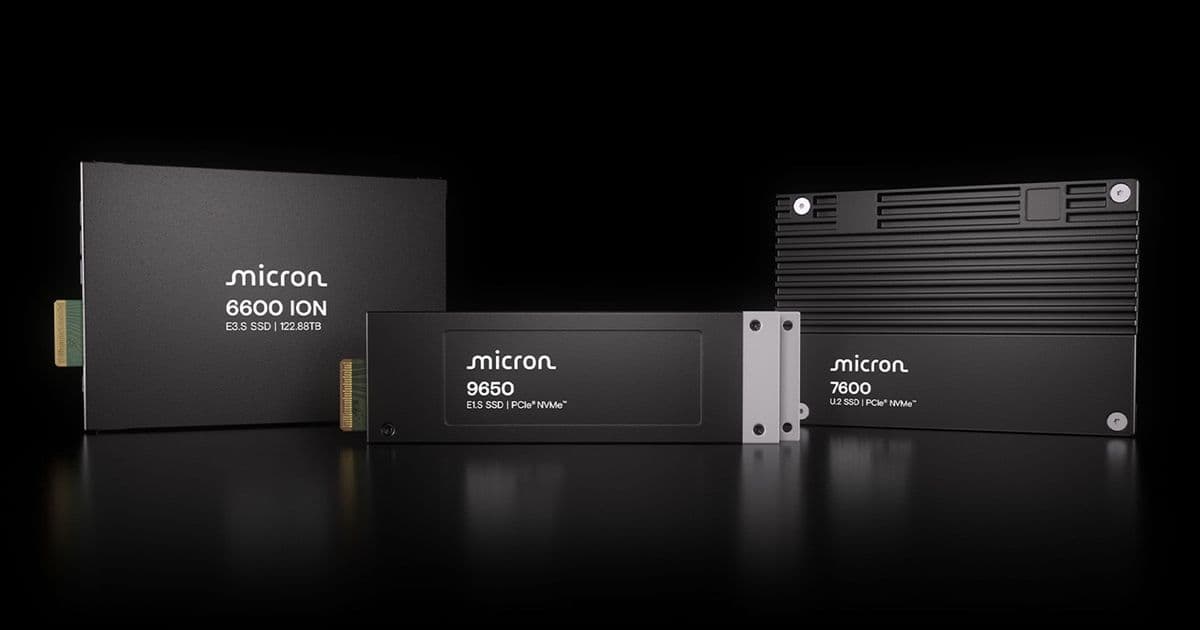
Micron Technology has begun mass production of the industry's first PCIe 6.0 SSDs, delivering sequential read speeds up to 28GB/s – double the throughput of current PCIe 5.0 drives – with specialized optimizations for AI training and data center deployments.
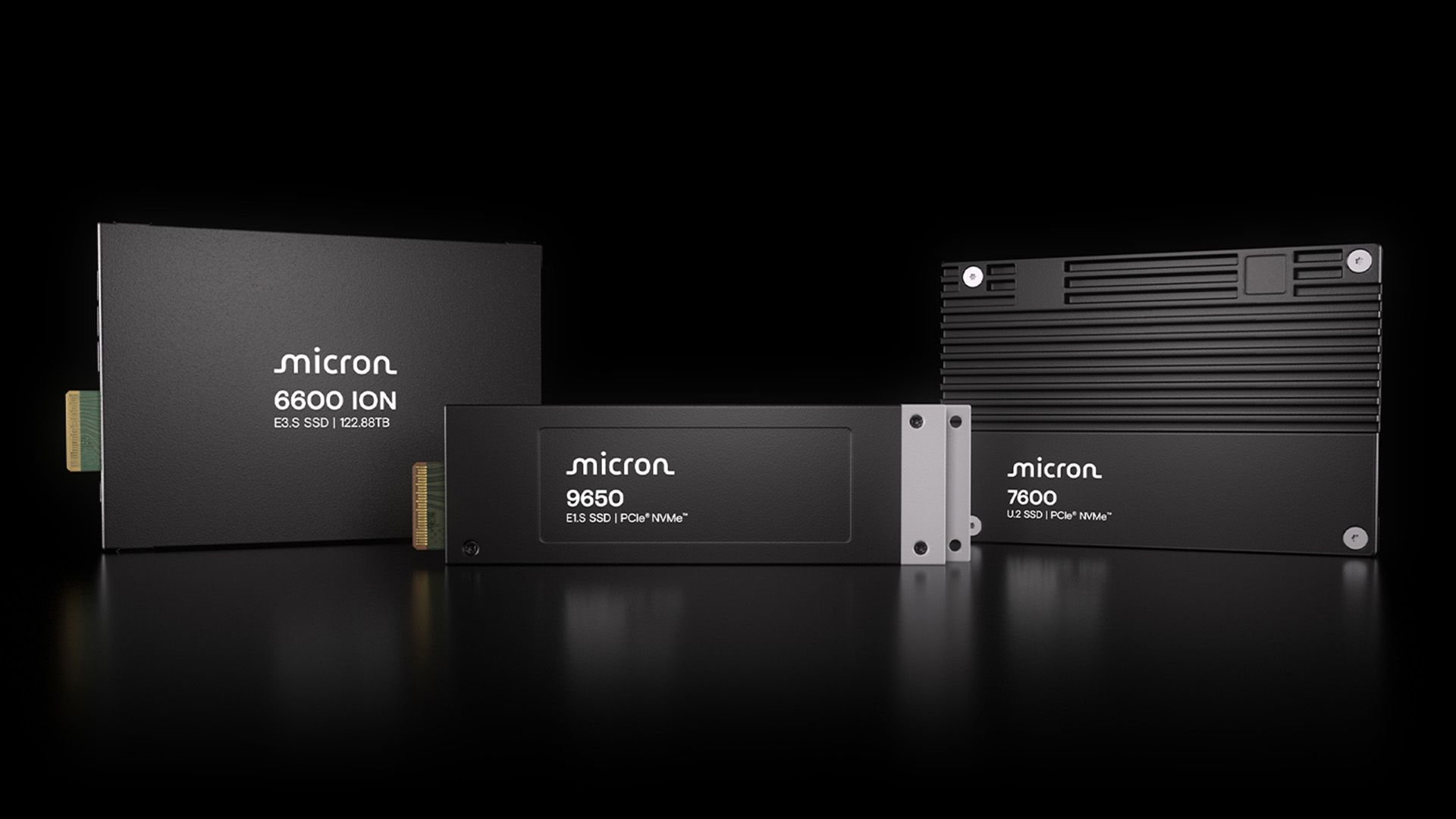
Micron Technology has initiated mass production of the world's first PCIe 6.0 solid-state drives, marking a significant leap in storage performance for data-intensive workloads. The new drives achieve sequential read speeds up to 28GB/s, effectively doubling the maximum throughput of current-generation PCIe 5.0 SSDs while maintaining the same x4 lane configuration. This generational jump comes as AI training clusters and hyperscale data centers increasingly face I/O bottlenecks that limit computational efficiency.
The technical foundation of PCIe 6.0 enables this performance doubling through two key innovations: PAM-4 (Pulse Amplitude Modulation with 4 levels) signaling replaces traditional NRZ encoding, effectively doubling data transfer per clock cycle. Additionally, the specification implements FLIT-based packet encoding with forward error correction to maintain signal integrity at higher frequencies. Crucially, Micron's implementation includes hardware-level optimizations specifically for AI workloads, including enhanced queue management for parallel read operations common in model training pipelines.
While the headline 28GB/s sequential read speed represents peak theoretical performance, real-world gains for AI applications prove more nuanced. Random read performance – critical for accessing fragmented training datasets – sees a 40-60% improvement over PCIe 5.0 drives according to pre-release benchmarks. The drives also introduce a new low-latency mode that reduces queueing delays by 30% when handling small-block inference requests, a valuable feature for real-time AI services.
Thermal management presents significant implementation challenges at these speeds. The drives generate approximately 40% more heat under sustained load than PCIe 5.0 counterparts due to the doubled signaling rate. While Micron confirms air-cooled configurations remain technically feasible, the company explicitly recommends liquid cooling solutions to maintain optimal performance consistency – a notable infrastructure requirement for potential adopters. Early test units maintained consistent throughput only when junction temperatures stayed below 70°C, necessitating robust thermal solutions in server chassis.
Market availability faces constraints beyond thermal challenges. Current server platforms lack native PCIe 6.0 support, requiring adoption of Intel's Sapphire Rapids HEDT or AMD's EPYC 9005 series processors paired with compatible server boards. Micron expects initial deployments will focus on specialized AI training infrastructure and high-frequency trading systems where the throughput justifies the cooling overhead and platform upgrade costs. The drives use a modified E1.S form factor with reinforced connectors to handle increased signal integrity requirements.
Competitive implications remain significant despite Micron's first-mover advantage. Samsung and SK Hynix have demonstrated PCIe 6.0 controller prototypes but haven't announced mass production timelines. Industry analysts project PCIe 6.0 adoption in enterprise storage will follow a slower curve than previous transitions due to the substantial thermal and infrastructure requirements. Micron's decision to prioritize E1.S form factor suggests an initial focus on hyperscale customers rather than mainstream enterprise adoption.
The performance leap arrives amid growing pressure on AI infrastructure. Recent studies show data loading consumes 40-60% of training time for large language models, making storage throughput a critical bottleneck. Micron's specifications indicate the new drives could reduce checkpoint saving times by 65% during distributed training jobs – a meaningful improvement for billion-parameter models. However, the storage subsystem represents just one component; memory bandwidth and network interconnects must evolve correspondingly to realize full system-level benefits.
Micron hasn't released detailed pricing but confirmed the drives carry a 35-50% premium over equivalent PCIe 5.0 models. Initial shipments will prioritize strategic cloud partners and AI infrastructure providers, with broader availability expected in Q3 2026. As AI workloads continue to strain existing storage architectures, this implementation demonstrates the industry's progression toward specialized hardware – albeit with tangible thermal and cost tradeoffs that will shape near-term adoption patterns.
Comments
Please log in or register to join the discussion