
Microsoft has rolled out Copilot Chat to core Office apps like Word and Excel for business users, offering AI assistance that adapts to open documents. While included free for some licenses, deeper integration with organizational data requires a costly Microsoft 365 Copilot upgrade, highlighting the company's push to monetize generative AI in enterprise workflows.

Microsoft is accelerating its AI ambitions with the integration of Copilot Chat directly into Microsoft 365 applications—Word, Excel, PowerPoint, Outlook, and OneNote—for business customers. This move, announced by Seth Patton, General Manager of Microsoft 365 Copilot, marks a significant expansion of the company's generative AI strategy, positioning Office as a central hub for intelligent assistance. Unlike the broader Microsoft 365 Copilot, which taps into organizational data, Copilot Chat is 'content-aware' but limited to web-based information, tailoring responses to the active file without accessing internal documents.
How Copilot Chat Works and Its Limitations
Copilot Chat appears as a side pane within Office apps, allowing users to query AI for tasks like drafting content in Word or analyzing data in Excel without switching contexts. As Patton explains:
'It's secure AI chat grounded in the web—and now, it's available in the Microsoft 365 apps. It quickly understands what you're working on, tailoring answers to the file you have open. This means less copy and pasting, file uploading, and switching apps.'
However, the 'free' access is restricted to users with specific licenses, including Microsoft 365 Business, Teams, and Office 365 subscriptions. For deeper functionality—such as reasoning across emails, chats, and shared documents—businesses must purchase a separate Microsoft 365 Copilot license. This tiered approach underscores Microsoft's focus on upselling AI capabilities, potentially fragmenting user experiences based on budget.
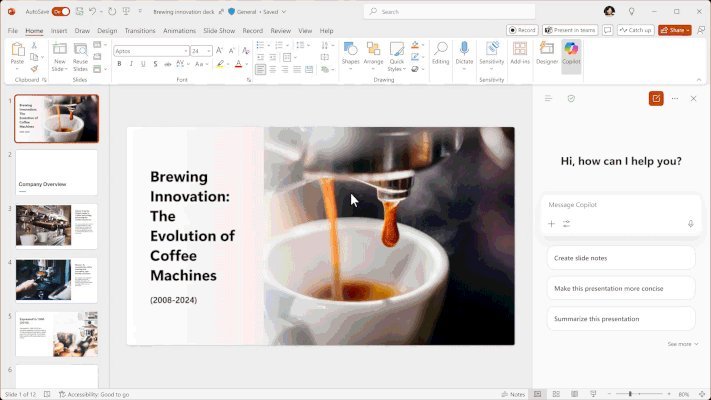 Copilot Chat in action within PowerPoint, demonstrating its contextual assistance.
Rollout Strategy and Enterprise Implications
Starting immediately, the feature is available to eligible users, with automatic installation on Windows devices outside the European Economic Area slated from October through mid-November. IT administrators retain control via the Apps Admin Center to opt out, ensuring flexibility in deployment. This phased rollout coincides with Microsoft's plan to embed Copilot agents into the Edge browser sidebar, broadening AI accessibility.
For developers and tech leaders, this signals a shift toward AI-native productivity tools, where generative features become embedded defaults. Yet, it raises questions about data governance—Copilot Chat's web-only data use may limit its utility for sensitive workflows, while the premium tier's deeper access demands robust security reviews. As enterprises weigh costs, this could accelerate adoption of competing AI tools or spur innovations in custom AI integrations using Microsoft's APIs.
In essence, Microsoft is betting that seamless AI within daily tools will redefine efficiency, but the price of true intelligence may reshape how businesses invest in the future of work.
Comments
Please log in or register to join the discussion