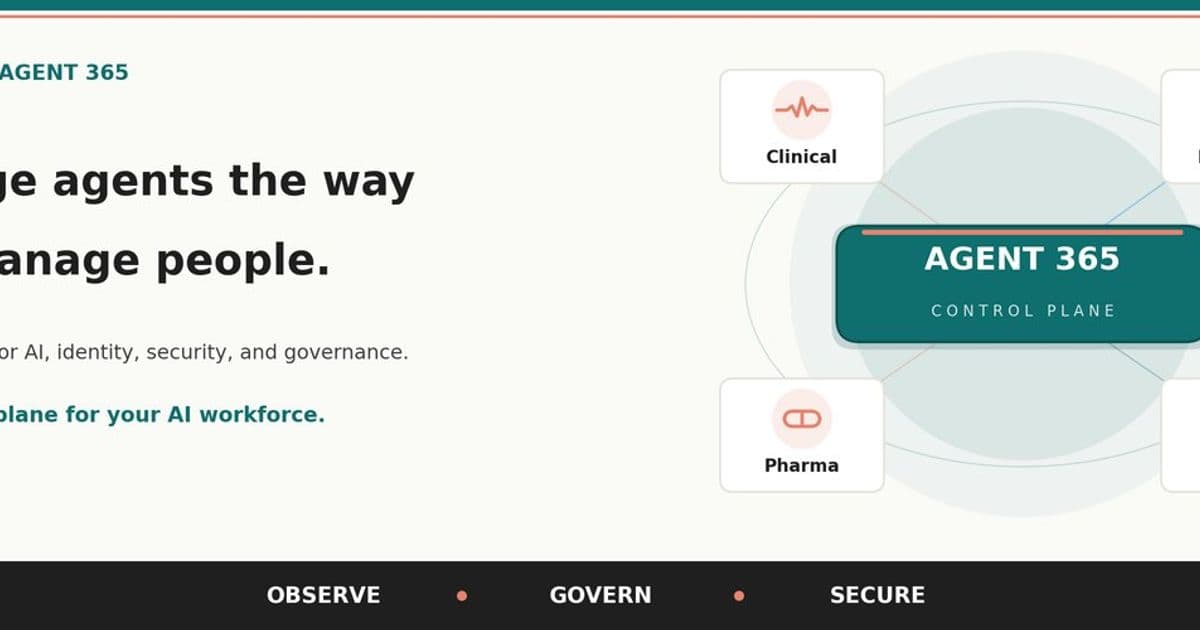
Microsoft's new Agent 365 and Microsoft 365 E7 platform addresses the critical governance gap in AI workforce management, positioning itself as a solution for organizations navigating the complexities of multi-cloud AI deployment while maintaining security and compliance.
The rapid adoption of AI agents across enterprises has created a governance crisis that multi-cloud strategies are now struggling to address. Microsoft has responded with Agent 365 and Microsoft 365 E7, an integrated platform designed to bring visibility, control, and security to the growing population of AI agents operating within organizational environments.
The Agent Sprawl Problem
Healthcare and life sciences organizations are experiencing an unprecedented explosion of AI agents, with KPMG reporting that 88% of organizations are now exploring or piloting AI agents. IDC projects that 1.3 billion agents will be in operation by 2028, creating what Microsoft describes as "agent sprawl" - the defining governance challenge of this decade.
The problem extends beyond healthcare. As organizations adopt multi-cloud strategies, they're deploying AI agents across different cloud platforms, each with varying security postures and governance capabilities. This fragmentation creates blind spots where agents access sensitive data, invoke tools, or interact with other systems without proper oversight.
Microsoft's 2024 Data Security Index found that 84% of organizations lack confidence in their AI data security posture, and 40% have already experienced an AI-related data security incident. These numbers underscore the urgent need for a unified approach to AI agent governance that can span multi-cloud environments.
Microsoft's Integrated Approach
Microsoft 365 E7, announced March 6, 2026 and now generally available, represents the company's answer to the AI governance challenge. Rather than offering point solutions, E7 provides an integrated platform that combines four essential capabilities:
- Microsoft 365 E5 for enterprise productivity, collaboration, and security
- Microsoft 365 Copilot for AI grounded in organizational data
- Microsoft Entra Suite for identity governance and Zero Trust access
- Microsoft Agent 365 as the centralized control plane for AI agents
Agent 365 operates on a simple yet powerful premise: treat AI agents like digital employees. Each agent receives a unique Entra Agent ID, an assigned human owner, explicit access permissions through Conditional Access, and governed interactions through Microsoft Purview's data loss prevention and sensitivity labels.
The platform's three pillars provide comprehensive coverage:
Observe
Complete visibility into every AI agent through:
- Agent Registry: A single inventory of all agents, whether built by Microsoft, internal teams, or partners
- Agent Analytics: Tracks adoption, quality, performance, and business impact
- Agent Map: Visualizes connections between agents, people, tools, and data sources
- Real-time monitoring integrated with Microsoft Defender for anomaly detection
Govern
Full lifecycle control through:
- IT-led onboarding workflows ensuring proper identity and access
- Policy templates for consistent enforcement of data handling rules
- Automated agent management based on rules (retirement, blocking, etc.)
- Ownership enforcement preventing orphaned agents
- Tools Gateway for least privilege access at the action level
Secure
Protection using Microsoft's existing security stack:
- Microsoft Purview for data security posture management and DLP
- Microsoft Entra for identity governance and Conditional Access
- Microsoft Defender for threat detection and blocking
- One-click kill switch for immediate agent disabling
Multi-Cloud Implications
While Microsoft presents E7 as an integrated solution, its approach has significant implications for multi-cloud strategies. The platform's ability to extend Microsoft's existing security and governance infrastructure to AI agents creates a compelling value proposition for organizations already invested in the Microsoft ecosystem.
However, organizations pursuing multi-cloud strategies face a dilemma. While Microsoft's solution provides comprehensive governance within its ecosystem, it doesn't inherently address agents operating on AWS, Google Cloud, or other platforms. This creates a potential governance gap where multi-cloud organizations must either:
- Consolidate AI agent deployment within Microsoft's ecosystem
- Implement complementary governance solutions for other cloud platforms
- Develop custom integrations to bridge different governance frameworks
Microsoft's approach positions the company as a strong contender for organizations seeking a unified AI governance solution, particularly those already heavily invested in Microsoft's cloud and productivity suites. The platform's ability to extend existing security investments to AI agents reduces the friction of adoption while providing enterprise-grade governance.
Competitive Landscape
Microsoft's entry into AI governance comes amid increasing competition from other cloud providers:
- AWS offers Amazon Bedrock with various foundation models and tools for building and deploying AI applications, though lacks the comprehensive agent governance framework of Microsoft's solution
- Google Cloud provides Vertex AI with MLOps capabilities and responsible AI features, but focuses more on model development than agent lifecycle management
- IBM has watsonx with governance capabilities, though with less integration into broader productivity suites
- Specialized startups like Glean, Cohere, and Anthropic are emerging with focused solutions for enterprise AI adoption
What sets Microsoft's approach apart is its integration with existing productivity and security infrastructure. Rather than requiring organizations to adopt entirely new systems, E7 extends the investments they've already made in Microsoft 365, Entra, Defender, and Purview.
Business Impact and ROI
For organizations, the value proposition extends beyond security and compliance. Microsoft commissioned Forrester to conduct a Total Economic Impact study of Microsoft 365 Copilot, which found a 132% three-year ROI with payback in under one year. The study reported 9 hours saved per user per month through automation of routine work and up to 2.6% top-line revenue lift through improved business outcomes.
In healthcare specifically, these gains translate directly to patient care. A 10,000-employee health system could reclaim over one million hours annually through properly governed AI agents, equivalent to hundreds of full-time clinicians returned to direct patient care.
For life sciences organizations, the impact extends to accelerating drug discovery and commercialization. Cutting even three months off a regulatory cycle on a single high-revenue product can mean tens of millions in additional sales, while proper governance ensures compliance with stringent regulatory requirements.
Implementation Strategy
Microsoft recommends a phased approach for organizations adopting Agent 365 and E7:
- Establish: Form a cross-functional team and inventory existing agents
- Configure: Set up identity, DLP, and policy templates
- Pilot: Test with small groups in controlled environments
- Empower: Launch training and establish a Center of Excellence
- Scale: Expand across departments with governance as guardrails
This approach builds expertise and validates governance before full-scale deployment, particularly important in regulated industries.
The Path Forward
As AI agents become integral to business operations, organizations must develop comprehensive governance strategies that balance innovation with security. Microsoft's Agent 365 and Microsoft 365 E7 represent one approach to this challenge, but the broader industry will need to develop standards and best practices for AI agent governance that can span multi-cloud environments.
For organizations already invested in Microsoft's ecosystem, the platform offers a compelling solution to the agent governance challenge. For those pursuing multi-cloud strategies, the decision becomes more complex, requiring careful consideration of how to maintain consistent governance across different platforms while maximizing the benefits of each cloud provider's strengths.
The AI workforce has arrived. The question organizations must answer is whether they will lead it with comprehensive governance or chase it with reactive security measures. Microsoft's latest offerings suggest that the company believes governance is not the brake on AI adoption, but the accelerator that enables organizations to scale AI safely and effectively.
Learn more about Microsoft's AI governance approach:
Comments
Please log in or register to join the discussion