A deep dive into Mistral Document AI's capabilities, comparing it with existing solutions and analyzing its business impact across industries.
Enterprises continue to grapple with the persistent challenge of document processing—mountains of contracts, invoices, reports, and forms trapped in unstructured formats. Traditional optical character recognition (OCR) technologies capture text but often fail to understand context, handle complex layouts, or process multilingual content effectively. This limitation results in inefficient workflows, manual review bottlenecks, and missed insights that could drive business value.
The recent introduction of Mistral Document AI 2512 through Microsoft Foundry represents a significant advancement in document processing technology. This innovative model combines high-end OCR capabilities with intelligent document understanding, transforming unstructured documents into actionable, structured data. Unlike conventional solutions that merely 'read' pages, Mistral Document AI comprehends documents—processing multi-column layouts, handwritten annotations, merged tables, and multilingual content with enterprise-grade speed and precision.
What Changed: The Evolution of Document Processing
Mistral Document AI marks a paradigm shift from simple text extraction to contextual understanding. The model integrates two core components: mistral-ocr-2512 for superior text recognition and mistral-small-2506 for intelligent document analysis. This combination enables processing of both physical documents (scans, photos) and digital files (PDFs, DOCX) into highly structured outputs.
Key differentiators include:
- Enhanced accuracy: Benchmark testing shows Mistral's OCR achieving approximately 95.9% overall accuracy, surpassing alternatives that typically range between 89-91%
- Multilingual proficiency: Demonstrating 99%+ accuracy in language-by-language tests across Russian, French, German, Spanish, Chinese, and other languages
- Layout intelligence: Beyond linear text extraction, the model understands complex document structures including multi-column layouts, tables with merged cells, charts, and images
- Flexible output: Supports structured JSON extraction, Markdown with interleaved images, and other formats that preserve document structure for downstream systems
This evolution addresses a fundamental limitation in document processing—moving beyond mere digitization to true comprehension. Where traditional OCR might output raw text without context, Mistral Document AI identifies document types, extracts relevant information, and understands relationships between elements.
Provider Comparison: Mistral vs. Market Alternatives
The document processing landscape offers several solutions, each with distinct strengths. Understanding how Mistral Document AI compares to existing providers helps organizations make informed decisions.
Mistral Document AI 2512 excels in:
- Complex document handling: Superior performance with multi-column layouts, handwritten content, and mixed document types
- Multilingual processing: Consistently high accuracy across diverse languages without requiring language-specific models
- Structured output: Direct JSON extraction with customizable schemas, reducing post-processing requirements
- Image intelligence: Ability to process charts, signatures, and other visual elements within documents
Azure Document Intelligence, by comparison, offers:
- Enterprise integration: Deep integration with Azure services and Microsoft ecosystem
- Form recognition: Specialized strength in structured form processing
- Regulatory compliance: Built-in compliance features for regulated industries
- Mature deployment: Well-established deployment patterns and extensive documentation
Other market solutions typically focus on:
- Cost-effective OCR: Basic text extraction at lower price points
- Industry-specific models: Specialized solutions for particular document types
- On-premise deployment: Options for organizations with strict data residency requirements
The strategic decision often involves evaluating whether the organization prioritizes superior document understanding (Mistral's strength) or ecosystem integration (Azure's advantage). Many enterprises are adopting a hybrid approach, using different providers for different document types based on specific requirements.
Business Impact and Implementation Considerations
Mistral Document AI delivers tangible business value across multiple dimensions:
Efficiency Gains
Organizations report processing time reductions from days to minutes for document-heavy workflows. Financial services firms, for example, have automated invoice processing cycles that previously required manual review of each document. The time-to-insight accelerates dramatically when documents can be automatically classified, extracted, and made available for analysis.
Data Quality Improvements
The model's 99%+ accuracy significantly reduces errors in extracted data, particularly valuable in compliance-driven industries. Healthcare organizations benefit from cleaner clinical data extraction, while legal firms experience fewer misinterpretations of contract terms.
Cost Optimization
Reducing manual document processing lowers operational costs while redirecting human resources to higher-value tasks. Manufacturing companies have realized substantial savings by automating quality certificate processing, eliminating the need for manual data entry.
Scalability Advantages
Cloud-native deployment enables organizations to handle variable document volumes without infrastructure constraints. Retail enterprises, for instance, process seasonal spikes in supplier documentation without performance degradation.
Industry-Specific Applications
The versatility of Mistral Document AI enables deployment across diverse sectors:
Financial Services
Banks and financial institutions process loan applications, KYC forms, and compliance documents with improved turnaround times. The model's ability to extract and tabulate financial data from various document formats accelerates decision-making while maintaining audit trails.
Healthcare & Life Sciences
Clinical trials, patient records, and insurance claims combine structured and unstructured elements. Mistral's layout understanding ensures accurate extraction of handwritten notes, tabulated results, and multilingual content—creating comprehensive datasets for research and compliance.
Manufacturing & Logistics
Quality certificates, shipping manifests, and supplier documents contain critical operational data. The model extracts production parameters, vendor information, and timestamps at scale, enabling supply chain traceability and quality control improvements.
Legal & Public Sector
Contract analysis and permit processing require consistent interpretation of complex documents. Mistral maintains structural fidelity while dramatically reducing review cycles, allowing legal teams to focus on strategic analysis rather than document parsing.
Retail & Consumer Goods
Global retail operations process supplier invoices and product specifications in multiple languages. The model's multilingual capabilities transform these documents into searchable, analytics-ready data, improving vendor management and product lifecycle insights.
Implementation Strategy with ARGUS
For organizations seeking rapid deployment, the ARGUS solution accelerator provides a comprehensive implementation framework. Available as an open-source repository on GitHub, ARGUS offers a complete pipeline from document ingestion to structured output.
Key implementation considerations include:
Provider Selection
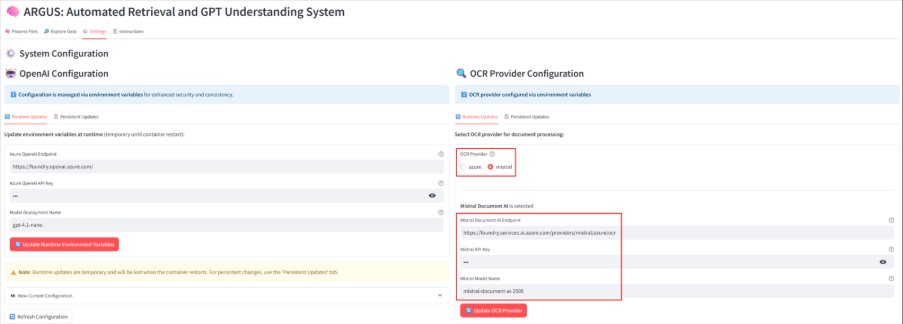
ARGUS now supports multiple OCR providers, allowing organizations to select the optimal engine for specific document types. The configuration enables runtime switching between Azure Document Intelligence and Mistral Document AI through environment variables or a web interface.
Integration Architecture
Organizations should evaluate how document processing integrates with existing workflows. ARGUS demonstrates best practices for:
- Document preprocessing and normalization
- Error handling and exception management
- Schema mapping and output transformation
- Integration with storage and business systems
Migration Path
For organizations with existing document processing solutions, a phased approach typically yields optimal results:
- Pilot with high-volume, well-defined document types
- Compare accuracy and performance against existing solutions
- Gradually expand to additional document categories
- Implement governance and monitoring frameworks
Cost Optimization
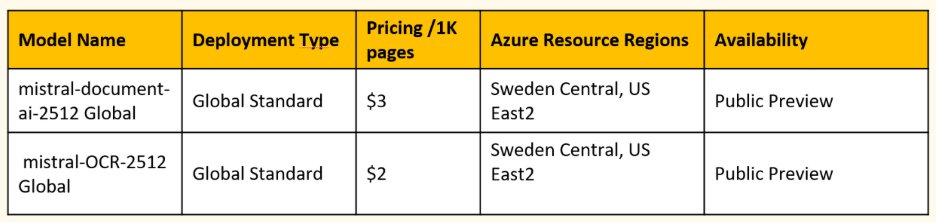
Mistral Document AI's pricing model typically favors high-volume processing scenarios. Organizations should analyze:
- Document volume and processing frequency
- Required accuracy levels by document type
- Integration complexity and development requirements
- Total cost of ownership compared to manual processing
Future Considerations
As document processing technology evolves, organizations should consider several emerging trends:
Hybrid Processing Models
The most effective implementations combine multiple processing approaches—using Mistral for complex documents and specialized solutions for specific document types. This hybrid model optimizes both accuracy and cost.
Continuous Improvement
Document processing systems benefit from feedback loops that refine extraction rules based on actual usage. Organizations should establish mechanisms to capture and incorporate learnings from processing outcomes.
Governance and Compliance
As with any AI system, organizations must implement appropriate governance frameworks for document processing, including:
- Data handling and privacy controls
- Model monitoring and performance tracking
- Audit trails for compliance requirements
- Human oversight for critical decisions
Conclusion
Mistral Document AI represents a significant advancement in document processing technology, moving beyond simple text extraction to true contextual understanding. Its combination of superior accuracy, multilingual capabilities, and layout intelligence makes it particularly valuable for organizations processing complex document volumes across multiple languages and formats.
When implemented through frameworks like ARGUS, organizations can rapidly realize the benefits of automated document processing while maintaining flexibility to select optimal providers for specific use cases. The business impact—measured in efficiency gains, improved data quality, cost optimization, and scalability—demonstrates why document understanding is becoming a strategic imperative rather than a tactical convenience.
For organizations considering document processing modernization, Mistral Document AI offers a compelling option that balances technical capability with practical deployment considerations. As the volume and complexity of digital documents continue to grow, the ability to truly understand—not merely digitize—documents will increasingly separate competitive leaders from followers.
Comments
Please log in or register to join the discussion