MIT expands its Science Bowl involvement by hosting a regional competition for New England high schools, creating new opportunities for students to qualify for the national tournament in Washington.
On a crisp Saturday morning in February, the halls of MIT buzzed with more than just the usual academic energy. Students from across New England, dressed in matching dark green T-shirts, filed into a spacious auditorium, their conversations a mix of nervous excitement and scientific curiosity. The 2026 MIT Science Bowl High School Regional was about to begin.
This marked a significant expansion of MIT's involvement in the National Science Bowl, a fast-paced academic competition sponsored by the U.S. Department of Energy. While the Institute has hosted the national high school competition for eight years, this regional event created a new qualifying pathway for New England schools vying for a place at the National Science Bowl in Washington.
The Competition Structure
The day unfolded in rounds of rapid-fire questions covering complex topics in biology, chemistry, physics, and mathematics. Some questions stretched well beyond the scope of regular high school classes, challenging students to apply their knowledge in creative ways. The competition followed a round-robin format, with 26 teams from 14 schools across Massachusetts, New Hampshire, and Rhode Island facing off in a battle of scientific knowledge.
"Guys, have the buzzers been tested?" echoed through the auditorium as volunteers, including many MIT students who had competed in Science Bowl themselves, rushed to ensure everything was ready. The atmosphere was electric, with the distinctive sound of buzzers cutting off moderators mid-question becoming the soundtrack of the day.
The Final Countdown
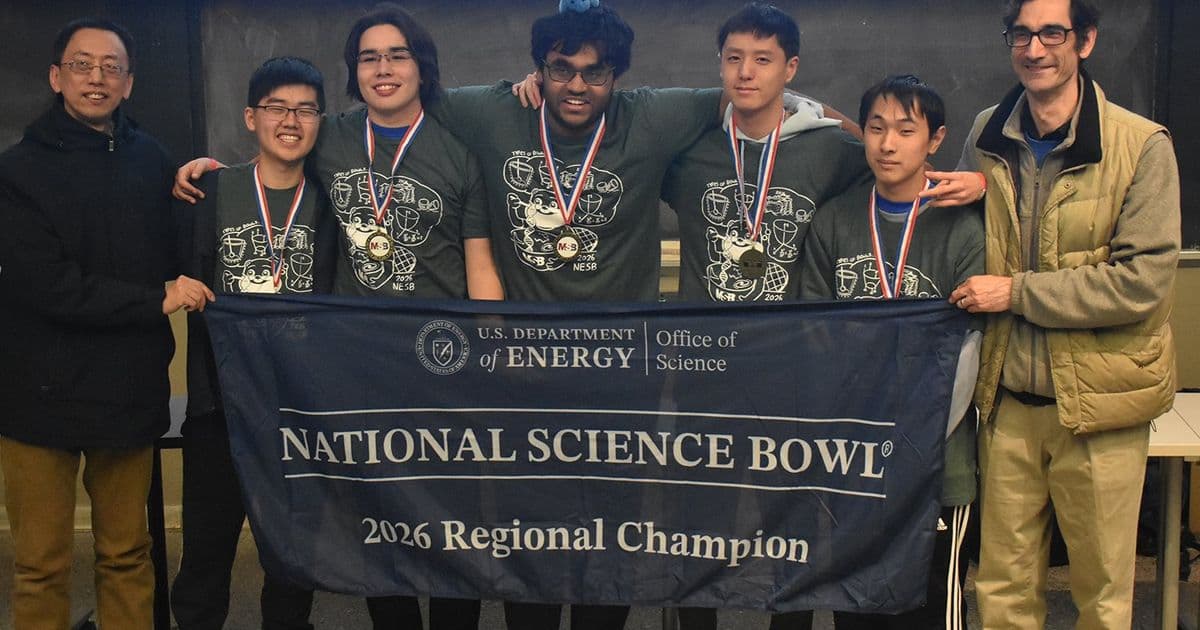
As the competition progressed, the auditorium pulsed with tension. By late afternoon, the final match between Lexington High School Team 1 and Philips Exeter Team 1 had spectators on the edge of their seats. The score stood at 148 to 52 when Lexington sealed their victory with a correct answer about lysosomes in patients with Tay-Sachs disease.
The room erupted as students vaulted from their seats, rushing to hug and congratulate their teammates. Jerry Xu, one of the winning team members, captured the sentiment: "I think I can speak for all of us when I say we feel ecstatic. It's been a long-term collaborative effort, we've been practicing for many years. We've worked together as a team for so long, it's just such a great feeling to be here with my friends."
Beyond the Competition
For many participants, the Science Bowl represented more than just a chance to win. Vritti Mehra from Portsmouth High School in New Hampshire came simply because "I wanted to be on a science team just because I like science, and my experience has been pretty amazing."
Katherine Wang from Lexington High School Team 3, who has been competing since sixth grade, spoke about representation: "I'm proud to be a girl in this tournament because as you can see, there are not a lot of females here. But I'm very glad that I'm part of this community because of the friendliness, the competition, and this fostered a love for science for me. My mom has a PhD, so she really inspires me to become the best."
Nicholas Gould, the Lexington High School team's coach and physics teacher, emphasized the journey over the destination: "The whole team put immense effort into learning about science, enjoying themselves, having fun, and trusting the process. It's not about the win, it's the process of getting there, the experiences they take with them and what they learn about themselves and each other."
A Full Circle Moment
For Gideon Tzafriri, the president of the Science Bowl and an MIT senior, the event carried special significance. Having competed in Science Bowl himself during high school, he found himself on the other side of the moderator's table, helping to create the same opportunities that shaped his own academic journey.
"It's nice to finally finish off something that I started in high school," Tzafriri reflected. His experience mirrored that of many volunteers who had been involved in Science Bowl since middle school, making this event feel like a culmination of years of dedication.
Looking Forward
As the winning team posed for photos with their golden medals glistening under fluorescent lights, the broader implications of the event became clear. For Lexington's seniors, this victory sends them to Washington for the national competition. For MIT, it signals a continuous investment in young scientists and a commitment to encouraging a future full of possibility.
Jiaxing Wang, one of the event's organizers, explained the motivation behind MIT's expanded involvement: "I get to help kids have fun with science and actively participate in science. The Science Bowl is something I discovered in my junior year of high school: It was very late in the cycle, so I want to be able to help kids like me to compete and have the experience they deserve and desire."
The 2026 MIT High School Regional Science Bowl represents more than just a new competition format. It's a bridge between MIT's world-class resources and the next generation of scientists, creating opportunities for students who might one day walk these same halls as undergraduates. As the final buzzers fell silent and students began their journeys home, one thing was certain: the questions raised during this competition were just the beginning of much larger scientific conversations to come.
For more information about the National Science Bowl and future MIT-hosted events, visit the official Science Bowl website.
Related Coverage:
Comments
Please log in or register to join the discussion