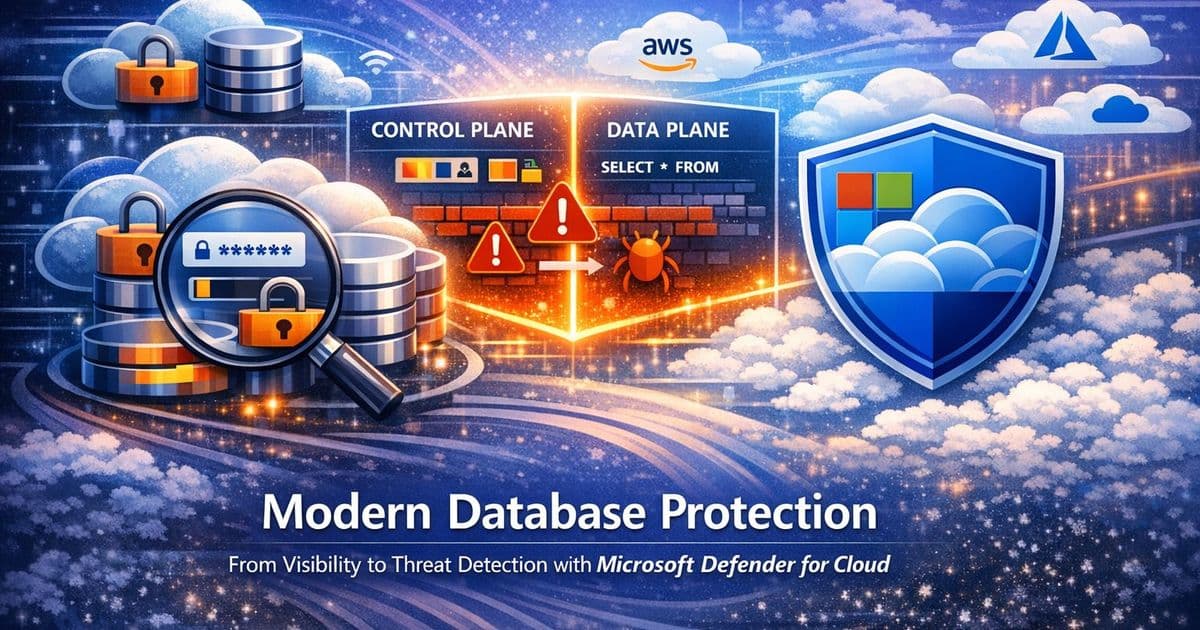
Microsoft Defender for Cloud provides unified database protection across hybrid and multicloud environments, addressing the growing complexity of database security in modern architectures.
As organizations embrace multi-cloud and hybrid architectures, database sprawl has become a critical security challenge. Databases sit at the heart of modern businesses, supporting everything from everyday applications to AI tools, yet they've become increasingly difficult to track, manage, and secure. This complexity creates a massive security gap, especially since databases store organizations' most valuable data—login credentials, credit card numbers, and social security information—making them prime targets for threat actors.
The Modern Database Security Challenge
Today's database environments are fragmented across deployment models, ownership structures, and teams. Databases run across both IaaS (Infrastructure as a Service) and PaaS (Platform as a Service), span control and data planes, and exist in multiple cloud environments. This fragmentation means protection is often pieced together from disconnected point solutions, leaving dangerous blind spots.
The challenge is compounded by the fact that databases can be deployed in two main ways: on-premises or IaaS setups where you manage the underlying server, and PaaS scenarios where cloud providers handle the infrastructure. In either case, you need to secure both the database host and the database itself. Additionally, you must distinguish between a database's control plane (external settings like network firewall rules) and data plane (information and queries inside the database). Attackers can exploit weaknesses in either plane—whether through a weak firewall setting or stolen credentials used to run malicious queries.
Microsoft Defender for Cloud's Unified Approach
Microsoft Defender for Cloud addresses these challenges through a cloud-native application protection platform (CNAPP) that provides unified, cloud-native database protection. The solution brings together discovery, posture management, and threat detection across SQL (both IaaS and PaaS), open-source relational databases, and Cosmos DB databases.
Defender for Cloud uses both agent-based and agentless solutions to protect database resources across on-premises, hybrid, multi-cloud, and Azure environments. A lightweight agent-based solution enables deeper inspection for SQL servers on Azure virtual machines or those hosted outside Azure, while an agentless approach provides seamless protection for managed databases in Azure or AWS RDS resources.
Pre-Breach Visibility and Posture Management
The value of database security in Defender for Cloud begins with pre-breach visibility. Vulnerability assessment and data security posture management help security administrators understand their database security posture. By following Defender for Cloud's recommendations, teams can proactively harden their environment.
Vulnerability assessments scan for configurations that don't follow industry best practices, providing remediation steps for issues like enabling encryption for data at rest or restricting public access to database servers. Data security posture management automatically helps prioritize the riskiest databases by discovering sensitive data and surfacing related exposure and risk.
When databases are associated with certain risks, Defender for Cloud provides findings through three channels: risk-based security recommendations, attack path analysis with Defender CSPM, and the data and AI dashboard. The risk level is determined by context related to the resource, such as internet exposure or the presence of sensitive information. This approach gives security administrators a solid understanding of their database environment before any breach occurs, along with a prioritized list of resources to remediate based on risk or posture level.
Post-Breach Threat Detection and Response
While hardening the environment is crucial, breaches can still occur. Timely post-breach response is equally important. Threat detection capabilities within Defender for Cloud identify anomalous activity in near real-time, allowing security operations center (SOC) analysts to take immediate action to contain attacks.
Defender for Cloud monitors both the control and data planes for anomalous activity indicative of threats, from brute force attack detections to access and query anomalies. The solution natively integrates with the Microsoft Defender Portal, bringing signals from Defender for Cloud to provide a single cloud-agnostic security experience.
The Defender Portal equips security teams with tools like secure score for security posture, attack paths, and incidents and alerts. When anomalous activities occur, security teams have the context and tools needed to investigate database resources in both the control plane and data plane, enabling quick remediation and mitigation of future attacks.
A Comprehensive Security Ecosystem
Defender for Cloud and the Defender Portal together create a security ecosystem that allows SOC analysts to investigate, correlate activities and incidents with alerts, and respond appropriately. This unified approach is essential because modern database environments demand more than isolated controls or point solutions.
As databases span hybrid and multiple clouds, security teams need a unified approach that delivers visibility, context, and actionable protection where the data lives. Microsoft Defender for Cloud provides organizations with visibility into all their databases through a centralized Defender Portal, using unique control and data plane findings to help security teams identify misconfigurations, prioritize them based on cloud-context risk-based recommendations, and proactively identify attack scenarios using attack path analysis.
This comprehensive approach ensures that SOC analysts can investigate alerts and act quickly when threats emerge, closing the dangerous database blind spot that has plagued organizations as they've adopted increasingly complex, distributed database architectures.
For organizations looking to strengthen their database security posture, Microsoft Defender for Cloud offers a path forward that addresses both the visibility gaps and the threat detection needs of modern database environments. The solution's ability to provide unified protection across diverse database types and deployment models makes it a critical tool for organizations navigating the complexities of today's multi-cloud reality.
Comments
Please log in or register to join the discussion