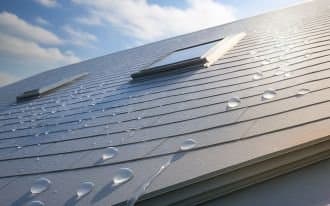
Researchers at the University of Sydney and Dewpoint Innovations have created a paint-like coating that reflects 97% of sunlight to passively cool surfaces and harvest atmospheric water. This breakthrough could slash energy use in buildings while providing decentralized water sources in drought-stricken regions. With real-world trials confirming its durability, the technology offers a scalable solution to urban heat islands and global water scarcity.
The Dual-Purpose Innovation Tackling Heat and Thirst
In a world grappling with intensifying urban heat islands and water crises, a nanoengineered paint developed by the University of Sydney and startup Dewpoint Innovations emerges as a game-changer. This polymer-based coating—applied like ordinary paint—achieves two critical feats simultaneously: cooling surfaces up to 6°C below ambient temperature and harvesting drinkable water directly from the air. Tested rigorously over six months on the roof of the Sydney Nanoscience Hub, the technology promises to transform buildings into passive climate-resilient infrastructures.
How the Science Works: Beyond Traditional Paints
Unlike conventional white paints that rely on UV-reflective pigments like titanium dioxide, this coating uses a porous structure of polyvinylidene fluoride-co-hexafluoropropene (PVDF-HFP) to reflect 97% of sunlight. The material radiates heat efficiently, creating a surface cooler than the surrounding air. This temperature differential triggers atmospheric water vapor to condense, much like steam on a bathroom mirror. Dr. Ming Chiu, CTO of Dewpoint Innovations and lead author of the study published in Advanced Functional Materials, explains:
"Our design achieves high reflectivity through its internal porous structure, delivering durability without the environmental drawbacks of pigment-based coatings. By removing UV-absorbing materials, we overcome traditional limits in solar reflectivity while avoiding glare."
{{IMAGE:3}}
Experimental tiles with the cooling paint undergoing testing on the Sydney Nanoscience Hub roof. (Credit: University of Sydney)
Real-World Impact: Water Yields and Energy Savings
During outdoor trials, the coating harvested dew 32% of the year, yielding up to 390 mL of water per square meter daily—enough to meet one person's drinking needs from a 12m² surface. Critically, it performed reliably under harsh Australian sun with no degradation, outperforming similar technologies. Professor Chiara Neto, who led the research, emphasizes its versatility:
"This isn’t about replacing rainfall but supplementing it. Dew forms even in arid regions when night-time humidity rises, making this a decentralized water source for agriculture, livestock, or hydrogen production."
The cooling effect alone could reduce urban temperatures, cutting reliance on energy-intensive air conditioning. In cities, widespread adoption might mitigate heat islands while supplementing rainwater tanks—already used in over two million Australian homes.
From Lab to Rooftop: Commercialization and Future Horizons
Dewpoint Innovations is refining a water-based formulation for application via rollers or sprayers, aiming for seamless integration into existing infrastructure. CEO Perzaan Mehta notes:
"We’re transforming rooftops into reliable, energy-free water sources—addressing urgent global challenges."
As climate change accelerates, this innovation exemplifies materials science converging with sustainability. Licensing the patent in 2022, the team envisions deployments in remote communities, horticulture, and industrial cooling, proving that sometimes, the simplest coatings hold profound solutions.
Source: Research supported by the University of Sydney Nano Institute and Dewpoint Innovations, with data from Advanced Functional Materials (DOI: 10.1002/adfm.202519108).
Comments
Please log in or register to join the discussion