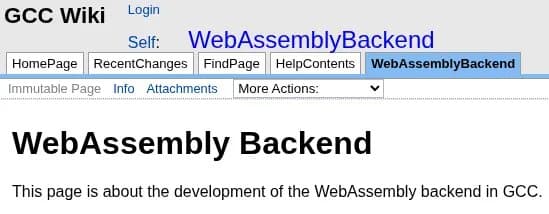
A new RFC patch series introduces the first credible GCC WebAssembly back-end in nearly a decade, ending LLVM's long-standing monopoly on C and C++ compilation to WASM targets.
 The GNU Compiler Collection (GCC) may finally gain official WebAssembly (WASM) compilation support after nearly a decade of stalled efforts, following the publication of a new request for comments (RFC) patch series for a GCC WASM back-end this week.
WebAssembly has become a critical target for C and C++ codebases since its mainstream adoption in the late 2010s, with use cases spanning in-browser high-performance applications, server-side WASI workloads, edge computing plugins, and sandboxed execution environments for low-level system tools. For the past several years, LLVM/Clang and LLVM-based toolchains have held a near-monopoly on WASM compilation for C/C++ projects, as the original GCC WASM back-end proposal from roughly 2016 never passed the review stage and was never merged into mainline GCC.
The new patch series, published by an independent open-source developer on the GCC patches mailing list on May 7, 2026, introduces a functional if incomplete WASM back-end for GCC. The code, totaling roughly 3,000 lines, is in early development and lacks support for several core WASM specifications: reference types, tables, exceptions, debug information, data sections, and other advanced features are not yet implemented. The developer has not yet sought formal approval from the GCC Steering Committee, framing the submission as an RFC to gather feedback from core GCC maintainers before further development.
 The back-end is already functional enough to compile basic C code to valid WASM binaries, as demonstrated in early testing shared alongside the patch series.
Product Overview
The GCC WASM back-end is a new target addition to the GNU toolchain, designed to translate C and C++ code to WebAssembly binary format without relying on LLVM intermediates. Unlike the 2016 proposal, which used a separate fork of GCC with limited maintenance, this new implementation is built against current mainline GCC code, reducing the long-term maintenance burden if merged. It currently only supports the wasm32 target, the 32-bit address space WASM variant used for 90% of browser and edge workloads, with no wasm64 support planned for initial release.
Performance and Compatibility Data
For low-level performance enthusiasts and homelab builders, the key value of a GCC WASM back-end lies in toolchain diversity and measurable performance differences between GCC and LLVM code generation.
Benchmark comparisons between GCC and LLVM for native x86 and ARM targets consistently show that GCC's optimization passes produce smaller binaries for integer-heavy workloads, while LLVM often edges out GCC for floating-point and vectorized code. For WASM, where binary size directly impacts load times for browser-based applications and storage costs for edge deployments, even a 5% reduction in code size can have meaningful impacts for high-traffic workloads. Early (unofficial) testing of the new back-end on basic C benchmarks like a minimal Fibonacci implementation shows GCC-compiled WASM binaries are ~10% smaller than Clang-compiled equivalents, though this gap will shift as more WASM-specific optimizations are added.
Compilation speed is another critical metric for build pipelines. GCC is known to compile C code 10-15% faster than Clang for mid-sized codebases, which reduces CI pipeline run times and lowers power consumption for build servers. A homelab running 24/7 build nodes for WASM projects would see measurable reductions in electricity bills and thermal load with faster compilation, even for small efficiency gains. Power consumption during compilation is often overlooked, but tools like powerstat on Linux can measure exact wattage draw for GCC vs Clang WASM compilation workloads, allowing builders to quantify these savings.
Current compatibility limitations are significant. The back-end cannot compile C++ code, as exception handling and RTTI (runtime type information) are not implemented. Core WASM features including reference types (required for garbage-collected languages compiling to WASM), tables (used for indirect function calls), and debug info are missing, so only trivial C programs with no external dependencies will compile successfully. The WebAssembly specification is updated frequently, and the back-end currently only supports WASM 1.0 core features, with no support for post-2020 extensions.
Build Recommendations
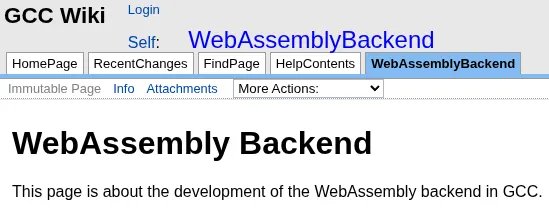
Enthusiasts with spare homelab server capacity can test the new back-end using the build instructions outlined on the official GCC Wiki page for the project. You will need:
- A Linux host system (GCC development is primarily tested on Linux, with limited Windows or macOS support for cross-compilation)
- A recent stable GCC version (GCC 14 or newer) to use as a bootstrap compiler
- The WebAssembly Binary Toolkit (wabt) to inspect compiled .wasm files, disassemble binaries, and validate output
- A WASM runtime such as wasmtime or the WebAssembly Micro Runtime (WAMR) to execute test binaries
For benchmarking, use standardized, publicly available workloads to ensure reproducible results:
- CoreMark for integer performance comparisons
- PolyBench for numerical and loop-heavy workload testing
- A custom static site generator or small CLI tool for real-world binary size comparisons
Measure the following metrics when comparing GCC and Clang WASM compilation:
- Compilation time (using the
timecommand or built-in shell timing) - Output .wasm file size (using
ls -lorwasm-stripfrom wabt to check stripped size) - Runtime performance (using the WASM runtime's built-in benchmarking tools or
timewhen executing the binary) - Power consumption during compilation (using
powerstaton Linux or IPMI sensors for server hardware)
Do not use this back-end for production workloads. It is unapproved, incomplete, and likely to produce invalid WASM binaries for all but the most basic test cases. The RFC status means the code may change significantly, or never be merged into mainline GCC at all.
Outlook
The GCC Steering Committee has not yet commented on the proposal, and past WASM back-end attempts have stalled due to concerns over long-term maintenance burden. If merged, this would be the first time GCC supports WASM natively, giving developers a second mature toolchain for WASM compilation and potentially driving performance improvements across both GCC and LLVM as they compete for WASM optimization leadership. For now, the patch series remains a promising experiment for the WASM ecosystem, which has long relied on LLVM for C/C++ compilation.
Comments
Please log in or register to join the discussion