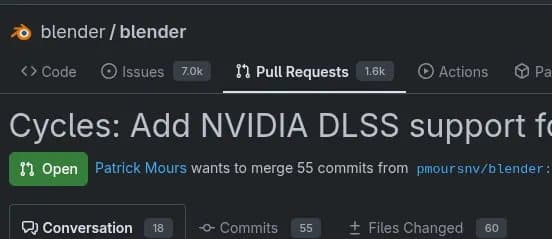
NVIDIA's DLSS integration for Blender is under review, with impressive results but licensing concerns blocking its inclusion in the main branch.
NVIDIA's push to bring Deep Learning Super Sampling (DLSS) to Blender has reached a critical juncture, with the pull request now open but facing significant licensing hurdles that could prevent its inclusion in the popular open-source 3D creation suite.
DLSS Integration Progress
The journey began with a demonstration at SIGGRAPH several months ago, showcasing Blender with DLSS integration. Now, NVIDIA has submitted a pull request to integrate DLSS into Blender's Cycles rendering engine, with an initial focus on viewport denoising using NVIDIA DLSS Ray Reconstruction.
According to the pull request documentation, the implementation follows a similar approach to OptiX integration. The DLSS SDK provides type definitions, while the actual implementation is loaded through the system-level NVIDIA driver. The NVIDIA driver contains the NGX driver component (_nvngx.dll or libnvidia-ngx.so.1), which is dynamically loaded in denoiser_dlss.cpp and queried for all necessary NGX API entry points.
Technical Implementation Details
The current implementation has specific requirements and constraints:
- Minimum NVIDIA driver version 590+
- CUDA devices required for DLSS support
- DLSS implementation library (nvngx_dlssd.dll or libnvidia-ngx-dlssd.so.*) must be installed in the application path
- The NGX driver internally looks for this library and prefers to load and communicate with it
- On systems without proper DLSS support, the option is greyed out and denoising is disabled
The pull request notes that this API will return DLSS as unsupported unless the appropriate library version is installed, creating a dependency that has raised concerns within the Blender development community.
Blender Development Community Concerns
During today's Blender Render & Cycles Meeting, developers expressed significant reservations about shipping DLSS with the current mechanism. The minutes reveal that while "the results are very impressive," there are persistent concerns about the distribution method and licensing.
The primary issue centers on the requirement to place DLL files next to the Blender executable, which conflicts with Blender's open-source philosophy and distribution model. The development team stated they "do not feel comfortable shipping it with the current mechanism" and suggested that ideally, this functionality would be part of the NVIDIA driver without requiring additional DLLs.
Potential Alternative Solutions
Blender developers are considering several approaches:
- Merging the Blender-side implementation without shipping it
- Waiting for alternative solutions that better align with open-source principles
- Exploring cross-vendor options that don't create vendor lock-in
The meeting minutes indicate that the team may consider merging the implementation already but not shipping it, with further discussion needed to determine the best path forward.
Intel's Open Image Denoise 3 as a Potential Alternative
Looking toward the future, Blender developers are hopeful about Intel's Open Image Denoise 3, expected to ship later in 2026. This solution offers several advantages:
- Open-source licensing
- Cross-vendor compatibility
- Expected improved high-performance denoiser
- No vendor lock-in concerns
However, there are uncertainties about whether Open Image Denoise 3 will match DLSS in terms of performance and quality. The release is still 6 months or more away, and its capabilities remain to be proven in real-world scenarios.
Industry Context and Implications
The tension between NVIDIA's proprietary technology and Blender's open-source ecosystem reflects broader challenges in the 3D graphics industry. While DLSS offers impressive performance gains and quality improvements, the licensing and distribution model creates friction with projects that prioritize open standards and cross-platform compatibility.
This situation mirrors similar debates in other areas of graphics technology, where proprietary solutions often outperform open alternatives but face adoption barriers due to licensing restrictions and vendor lock-in concerns.
What's Next for DLSS in Blender?
The future of DLSS in Blender remains uncertain. The development team must balance the impressive technical results against philosophical and practical concerns about licensing and distribution. Several outcomes are possible:
- Conditional Merge: The code could be merged but not enabled by default, requiring users to manually configure the system
- Wait for Alternatives: Blender might delay DLSS integration until Open Image Denoise 3 proves competitive
- Modified Implementation: NVIDIA and Blender developers could collaborate on a distribution model that addresses licensing concerns
- Rejection: The pull request could be rejected if no acceptable compromise is reached
Technical Performance Considerations
While specific benchmark data isn't available in the current documentation, the development team's acknowledgment that "the results are very impressive" suggests significant performance gains. DLSS Ray Reconstruction typically offers:
- Faster denoising times
- Improved image quality
- Better performance in complex scenes
- Reduced noise in rendered outputs
These benefits could be particularly valuable for Blender users working with complex animations or high-resolution renders where denoising time significantly impacts workflow efficiency.
Community Impact and User Perspective
For Blender users, this development represents a potential performance boost but also highlights the ongoing tension between proprietary and open-source solutions in creative software. Professional users might be willing to navigate the additional complexity of DLSS installation for performance gains, while others may prefer solutions that integrate more seamlessly with Blender's existing ecosystem.
The outcome of this integration effort could influence how other open-source projects approach similar proprietary technologies, potentially setting precedents for future collaborations between hardware vendors and open-source communities.
Conclusion
The NVIDIA DLSS pull request for Blender represents an exciting technical achievement but faces significant hurdles due to licensing and distribution concerns. While the performance benefits are clear, the Blender development team must carefully consider how to maintain the project's open-source principles while potentially offering users access to cutting-edge technology.
As the industry waits for Intel's Open Image Denoise 3 and other alternatives, the Blender community will be watching closely to see how this balance between proprietary innovation and open-source philosophy is resolved. The decision could have lasting implications for how 3D rendering software evolves in an increasingly complex technological landscape.
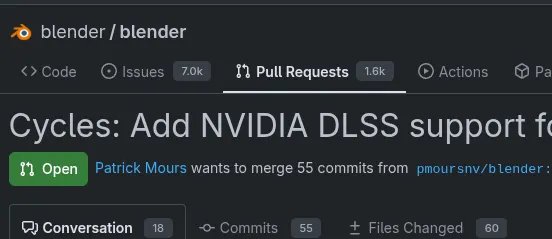
The integration of DLSS into Blender's Cycles engine represents a significant technical achievement, but licensing concerns may prevent its inclusion in the main branch. The pull request is currently under review, with developers weighing the impressive performance benefits against philosophical and practical concerns about distribution and open-source principles.
Comments
Please log in or register to join the discussion