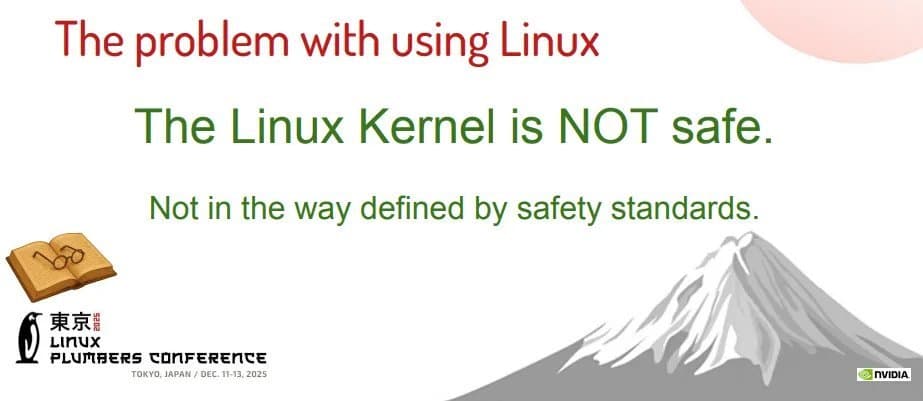
At the Linux Plumbers Conference, NVIDIA outlined its approach to achieving automotive safety certifications for the Linux kernel without burdening upstream developers. Their strategy focuses on non-invasive changes to meet ASIL-B requirements for critical systems like self-driving vehicles and industrial robots.
NVIDIA Engineers Chart Path to Safety-Certified Linux for Automotive and Robotics
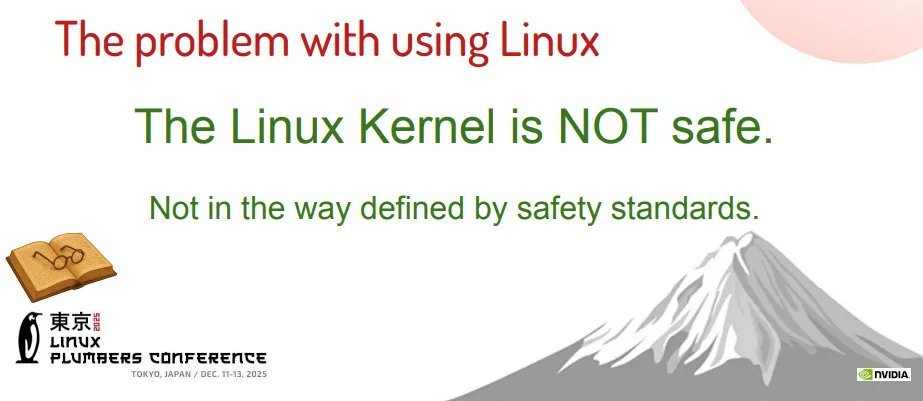
At the Linux Plumbers Conference (LPC) 2025, NVIDIA engineer Igor Stoppa unveiled the company's ambitious efforts to adapt the Linux kernel for safety-critical environments like autonomous vehicles and robotics. The presentation addressed the fundamental tension between open-source development practices and rigorous safety certifications required for automotive systems.
Stoppa articulated NVIDIA's guiding principle: "Unlike the typical path chosen for attempting to use Linux in safety applications, the approach developed by NVIDIA strives to avoid placing any burden on upstream maintainers and developers." This philosophy acknowledges that kernel maintainers shouldn't need to become functional safety experts, nor should the kernel codebase be overloaded with exhaustive safety documentation.
The initiative specifically targets Automotive Safety Integrity Level (ASIL) B certification—a mandatory requirement for automotive components under ISO 26262 standards. ASIL-B represents substantial integrity requirements where system failures could result in severe injuries. NVIDIA's technical approach involves:
- Selective Hardening: Modifying only critical kernel subsystems directly involved in safety functions
- Boundary Definition: Creating clear separation between certified and non-certified components
- Upstream Compatibility: Designing changes to minimize disruption to mainline kernel development
"We want to start a discussion about how we achieve this, and how it can coexist with upstream processes," Stoppa emphasized. This reflects NVIDIA's acknowledgment that forcing safety requirements onto the entire kernel codebase—much of which doesn't require certification—would be impractical and counterproductive.
The engineering challenges are substantial. Safety certification demands exhaustive documentation, fault injection testing, and formal verification of failure modes—processes foreign to traditional Linux development. NVIDIA's solution involves layered safety mechanisms and targeted kernel hardening rather than wholesale rewrites, preserving the agility of upstream development while meeting automotive industry requirements.
This balancing act represents a critical evolution for open-source in regulated industries. As Linux becomes embedded in systems where failures could endanger lives, NVIDIA's work may establish a blueprint for leveraging open-source innovation without compromising safety—potentially accelerating adoption in automotive, medical devices, and industrial automation.
Comments
Please log in or register to join the discussion