Nvidia announces record-breaking financial results while fundamentally restructuring its reporting framework to emphasize artificial intelligence over traditional graphics segments, signaling a major shift in the company's market focus.
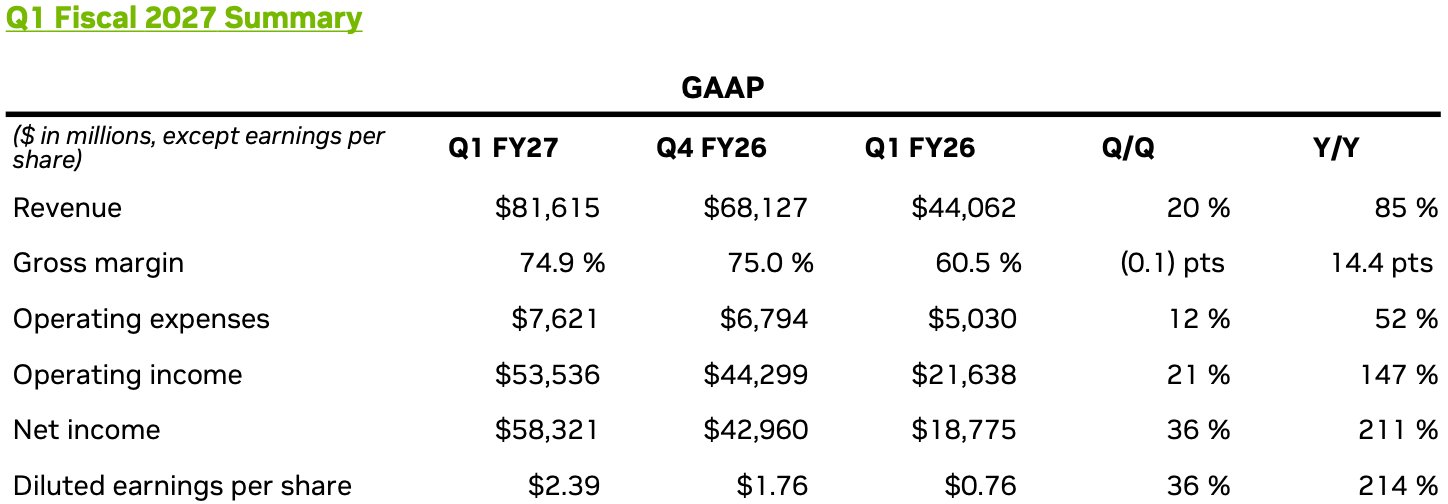
Nvidia has announced its financial results for the first quarter of fiscal year 2027, posting an unprecedented $81.615 billion in revenue, marking its best quarter ever. The company's financial performance demonstrates the extraordinary growth driven by artificial intelligence platforms, prompting a significant restructuring of how Nvidia reports its earnings going forward.
The most notable aspect of Nvidia's announcement is its decision to cease reporting sales of consumer graphics cards—whether for gaming or professional workloads—as separate product categories. This strategic shift underscores the company's transformation from a graphics-focused enterprise to an AI computing powerhouse.
Record Financial Performance
For the quarter ending April 28, 2027, Nvidia's GAAP revenue reached $81.615 billion, representing a 20% increase sequentially and an 85% jump compared to the same quarter in the previous year. The company's net income topped $58.321 billion, a staggering 211% year-over-year growth, with gross margins reaching 74.9%.
Breaking down these results, sales of Nvidia's Compute & Networking hardware hit $74.55 billion, an all-time record. Meanwhile, sales of graphics hardware totaled $7.065 billion, up 20% sequentially and 85% year-over-year.
New Reporting Framework
The decision to stop reporting gaming GPU sales as a separate segment reflects Nvidia's evolving business model. Instead of traditional product categories, the company will now split its revenue based on deployment markets, establishing two main platforms: Data Center and Edge Computing.
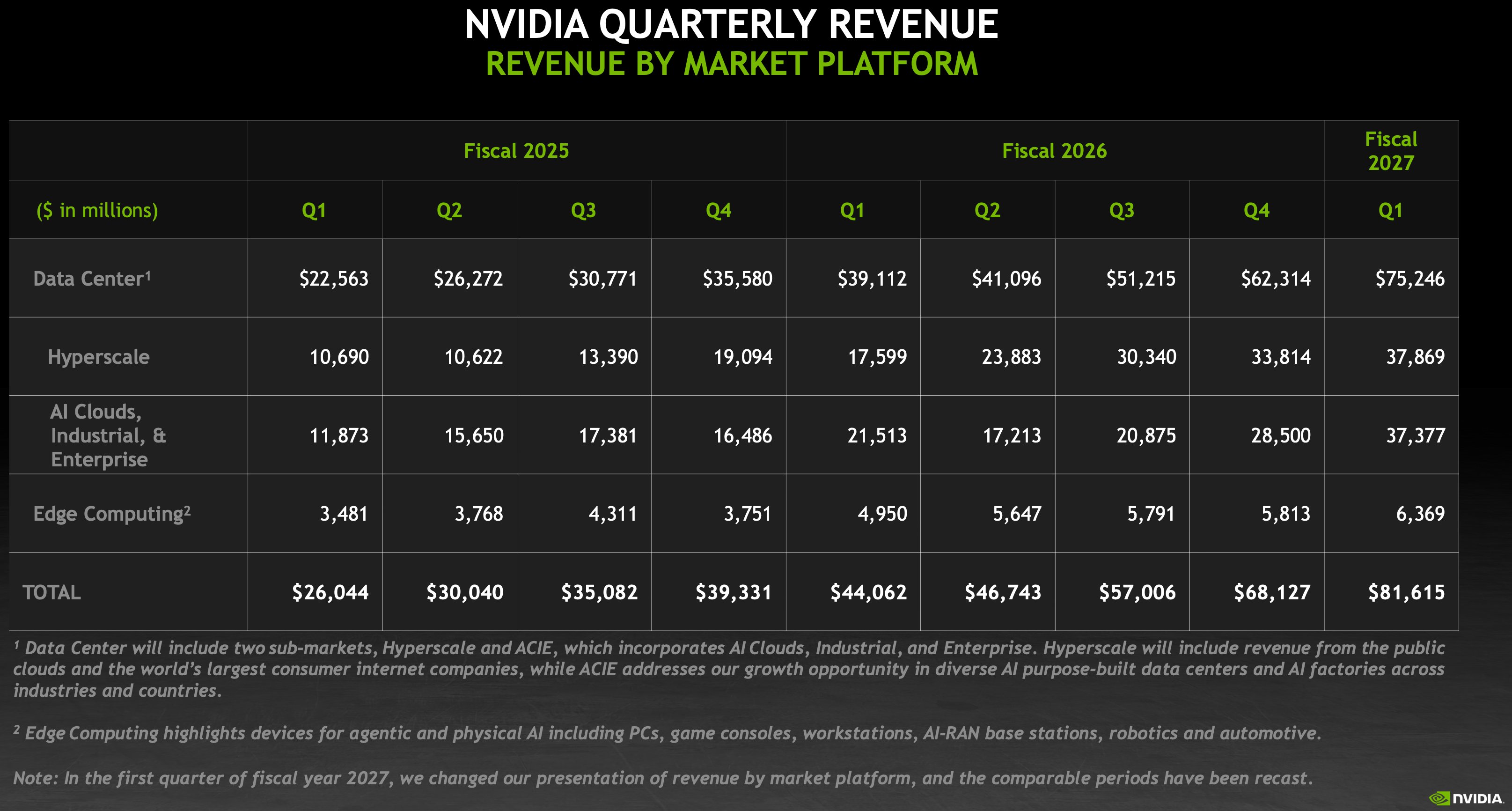
Within the Data Center category, Nvidia has created two major sub-segments:
- Hyperscale: Includes hyperscale cloud providers and large internet companies such as AWS, Google, Meta, and Microsoft
- ACIE (AI Clouds, Industrial, and Enterprise): Covers enterprise AI factories, industrial deployments, sovereign AI deployments, supercomputing, and other deployments not controlled by hyperscalers
The Edge Computing category will encompass PCs, workstations, robotics, automotive, gaming consoles, and telecom infrastructure.
This restructuring makes strategic sense for Nvidia. Hyperscalers tend to deploy custom silicon or use AI accelerators from competitors, limiting Nvidia's growth potential in this segment. In contrast, the ACIE category includes thousands of participants who can benefit from Nvidia's rack-scale platform-based approach and virtually none of whom can afford custom silicon development, representing limitless growth potential.
As CEO Jensen Huang has emphasized, the ACIE category is expected to eventually surpass the hyperscale segment simply because AI is becoming ubiquitous across thousands of companies and industries.
Market Performance Analysis
When re-reporting results across the new market platforms for previous fiscal years, an interesting pattern emerges. The ACIE segment outperformed the hyperscale segment until Q2 FY2026, when large cloud service providers began deploying Nvidia's GB300 platform for inference, spending tens of billions of dollars per quarter. Now, the ACIE platform has nearly caught up.

In Q1 FY2027, hyperscalers purchased $37.869 billion worth of hardware from Nvidia, while the ACIE segment generated $37.377 billion in revenue. Edge computing hardware sales totaled $6.369 billion.
Notably, while the bulk of Nvidia's revenue comes from compute and networking hardware, the company still sells graphics processors worth $7.065 billion in Q1 FY2027—exceeding edge computing segment sales. This suggests that Nvidia now considers graphics as part of multiple newly established market platforms rather than a standalone category.
Future Outlook
Looking ahead, Nvidia expects second-quarter fiscal 2027 revenue of approximately $91 billion ± 2%. The company does not anticipate shipping any AI hardware to China during this period. Gross margins are projected to remain around 74.9% on a GAAP basis, with operating expenses expected to be roughly $8.5 billion.
These figures indicate that Nvidia is rapidly approaching $100 billion in quarterly revenue, a milestone few companies in any industry have achieved. The company's continued growth trajectory demonstrates the expanding market for AI computing infrastructure and Nvidia's dominant position within it.
The restructuring of Nvidia's reporting framework serves as a clear signal to investors and the industry that the company's future lies in AI computing rather than traditional graphics processing. This shift reflects broader trends in the semiconductor industry, where AI accelerators have become the primary growth driver, outpacing traditional computing segments.
As Nvidia continues to invest heavily in AI research and development, expand its product portfolio, and build partnerships across industries, the company is positioning itself to capitalize on what it believes will be an era of ubiquitous AI deployment across virtually every sector of the economy.
Comments
Please log in or register to join the discussion