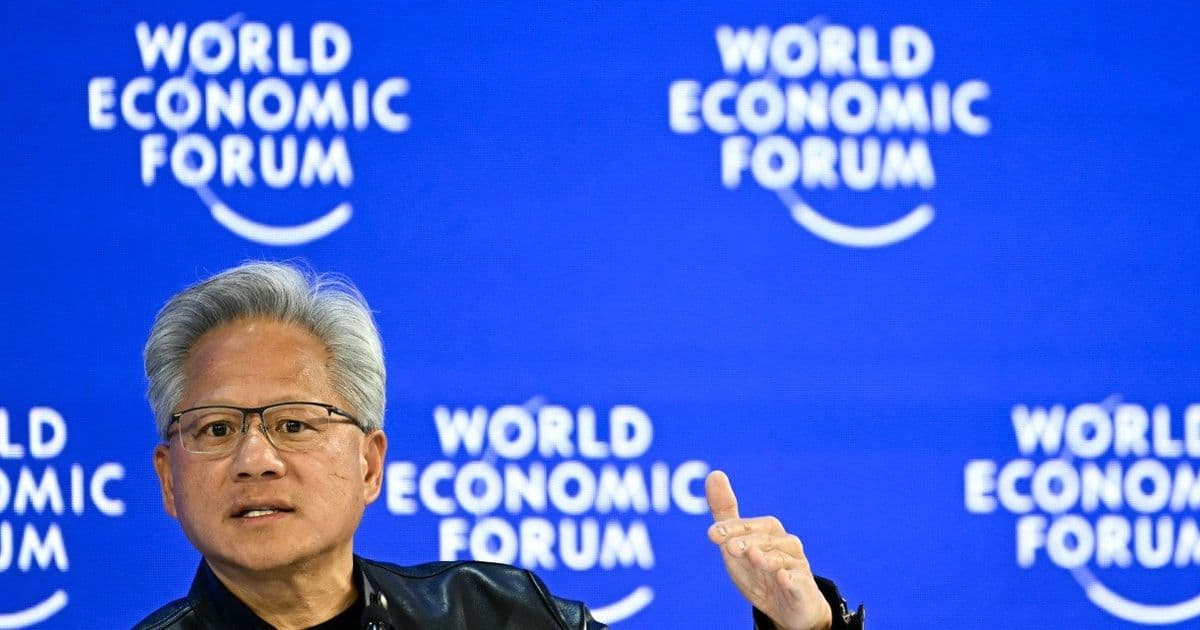
At the World Economic Forum, NVIDIA CEO Jensen Huang argued that AI is already delivering tangible economic benefits, but requires sustained, large-scale investment to reach its full potential across global economies. He acknowledged that such massive capital deployment carries inherent risks of creating market bubbles.
NVIDIA's Jensen Huang took the stage at Davos this week with a message that was both optimistic and cautionary. He told attendees that artificial intelligence is already generating measurable economic value, but that the path to widespread adoption requires continued, substantial investment. His comments come as the AI industry navigates a period of intense scrutiny regarding its financial sustainability and technological maturity.
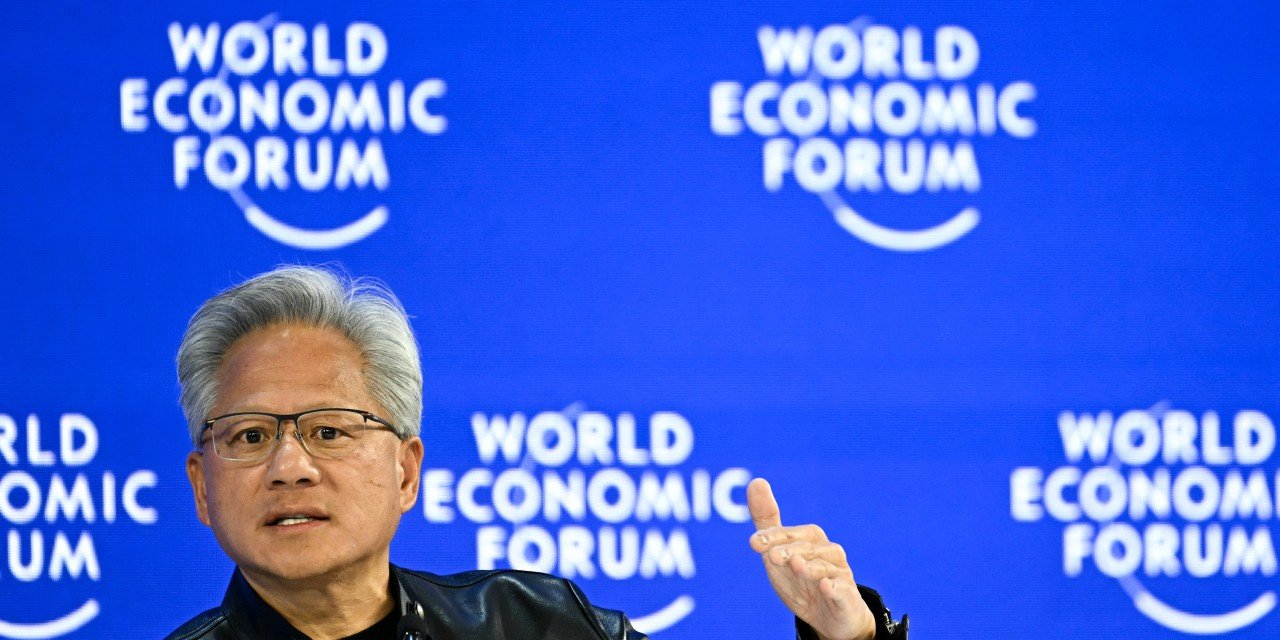
Featured image: NVIDIA CEO Jensen Huang speaking at the World Economic Forum in Davos.
The Claim: AI is Already Working
Huang's core argument is that the economic benefits of AI are not a future promise but a present reality. He cited the rapid deployment of AI infrastructure and the integration of AI models into enterprise workflows as evidence that the technology is moving beyond research labs and into production environments. This aligns with observable trends in the market, where companies are increasingly allocating budget to AI-driven projects, from customer service automation to drug discovery.
The NVIDIA CEO specifically pointed to the need for this technology to spread across both developed and emerging economies. This suggests a vision where AI becomes a foundational layer for economic activity, similar to electricity or the internet, rather than a niche tool for tech giants. The implication is that the current level of investment, while historic, is insufficient for this broader transformation.
The Reality: Investment is the Engine
The practical reality behind Huang's statement is that AI progress is inextricably linked to capital expenditure. The training of state-of-the-art models requires massive clusters of GPUs, which in turn require significant power and cooling infrastructure. Companies like NVIDIA, OpenAI, and Microsoft are investing billions in data centers specifically designed for AI workloads. This isn't speculative spending; it's the necessary hardware to run the models that are already being used.
For example, the recent announcement of the Stargate project—a joint venture between OpenAI, Oracle, and SoftBank—plans to invest up to $500 billion over four years for AI infrastructure. NVIDIA's own revenue, which has skyrocketed, is a direct reflection of this investment cycle. Huang's call for more investment is essentially a call to continue this build-out, which he sees as the only way to unlock the next wave of AI capabilities and applications.
The Limitation: The Bubble Risk
Huang did not shy away from the risks associated with this level of capital deployment. He explicitly stated that an "AI bubble comes about because the investments are large." This is a critical acknowledgment. A bubble forms when asset prices are driven by speculation far beyond their intrinsic value. In the context of AI, this could manifest as overvaluation of startups, overestimation of near-term profitability, or the construction of data center capacity that outpaces actual demand.
The risk is not theoretical. The dot-com bubble of the late 1990s was fueled by massive investment in internet infrastructure, much of which was justified in the long term but led to a painful crash in the short term. The AI industry is currently experiencing a similar investment frenzy. While the underlying technology is more mature than the early internet, the financial dynamics are comparable. Investors are pouring money into AI companies at valuations that assume rapid, sustained growth and eventual profitability, which is not guaranteed.
Connecting the Dots: Investment vs. Utility
The tension in Huang's message is between the necessity of investment and the danger of over-investment. The economic benefits he cites are real but are currently concentrated in specific areas: cloud computing, semiconductor manufacturing, and a handful of large-scale enterprise applications. The broader, transformative impact on productivity across all sectors of the economy is still in its early stages.
This creates a potential mismatch. The capital markets are pricing in a future where AI has revolutionized everything, while the current economic output from AI is still a fraction of the global economy. If the pace of real-world adoption and value creation lags behind the pace of investment, a correction is inevitable. Huang's warning is a reminder that the technology is still developing, and its ultimate economic footprint is not yet defined.
The Broader Context
Huang's comments at Davos are part of a larger conversation about the sustainability of the AI boom. Other leaders at the forum, such as Google DeepMind's Demis Hassabis, have also discussed the economic and ethical dimensions of AI. The focus is shifting from pure capability demonstrations to questions of cost, efficiency, and real-world impact.
The investment required is not just financial. It's also about energy, talent, and regulatory frameworks. Building a 200MW AI hub, as planned in the UAE, requires significant energy resources. Training the next generation of models requires scarce engineering talent. And deploying AI at scale requires navigating complex regulatory landscapes. Huang's call for investment implicitly includes these broader resource requirements.
Conclusion
Jensen Huang's message from Davos is a balanced one for the AI industry. He affirms that the technology is delivering value now, which justifies the ongoing investment. However, he also injects a dose of reality by acknowledging that the sheer scale of this investment carries the classic hallmarks of a potential bubble. For practitioners and investors, the takeaway is clear: the economic benefits of AI are real and growing, but the path forward requires careful, measured growth that aligns investment with tangible utility, rather than speculative fervor.
Related Links:
- NVIDIA Investor Relations for financial results and corporate updates.
- World Economic Forum Davos Agenda for more context on the discussions at the event.
- The Stargate Project for details on large-scale AI infrastructure investment.
Comments
Please log in or register to join the discussion