AMD's Anush Elangovan used AI to create a Python-based Radeon compute driver that bypasses ROCm layers to interact directly with the Linux kernel GPU driver, demonstrating a novel debugging approach rather than replacing production drivers.
An unusual development in AMD's Linux graphics ecosystem has caught the attention of the open-source community. Anush Elangovan, a corporate vice president at AMD, has published a small experimental Radeon compute driver written entirely in Python, with the code produced using Anthropic's Claude Code AI assistant. The project represents an interesting technical exercise rather than a practical replacement for AMD's existing driver stack.
What Makes This Different
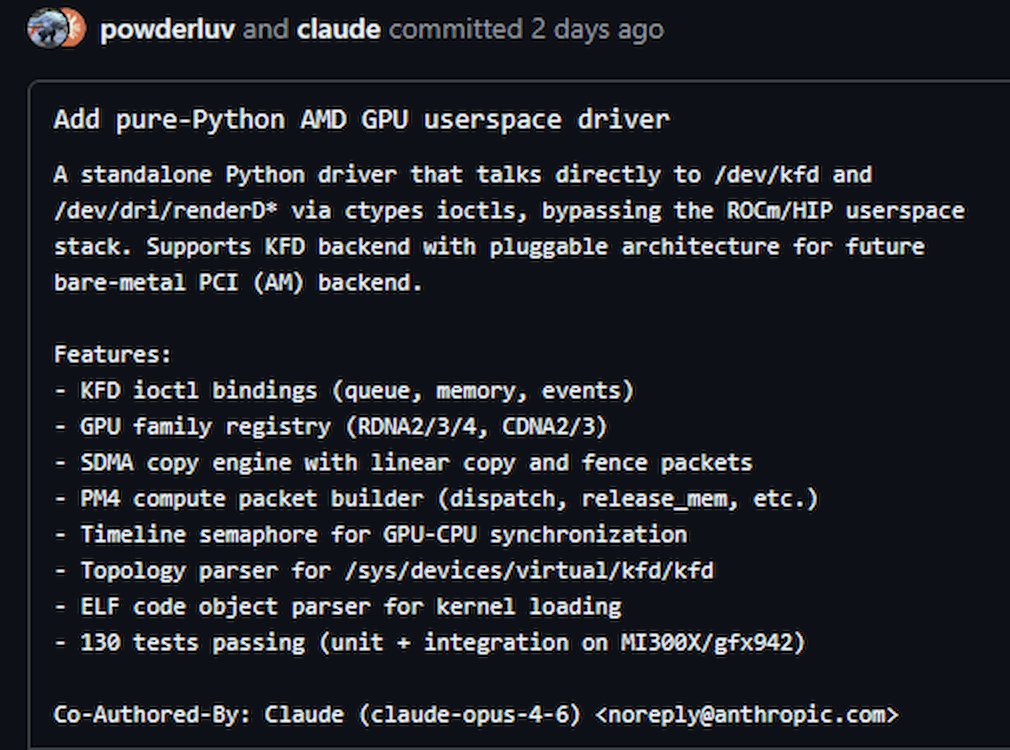
The Python driver takes a unique approach by cutting through the traditional ROCm software stack. On Linux systems, Radeon GPUs typically run through multiple layers: applications communicate with ROCm libraries, which interface with user-space runtimes, eventually reaching the kernel's AMDGPU driver. Elangovan's project bypasses most of these layers, communicating directly with the kernel driver through device nodes like /dev/kfd and /dev/dri/render*.
This direct communication enables the Python code to allocate GPU memory, create compute queues, submit command packets, and synchronize CPU and GPU operations. The approach reaches down to the lowest public layer of AMD's compute interface, though it's important to note that the kernel driver still performs the heavy lifting. The Python layer essentially constructs command packets and sends them through existing kernel APIs.
Practical Applications
While the project won't replace production drivers, it serves valuable purposes for debugging and experimentation. Engineers can use this approach to isolate bugs in ROCm or test specific GPU features without compiling large C++ projects. The lightweight nature of Python makes the code small and easily modifiable, ideal for testing scenarios where quick reproduction of hardware behavior is needed.
The prototype already handles several real-world tasks including command-queue creation, memory allocation, compute-dispatch packets, and GPU synchronization primitives. This functionality makes it a useful diagnostic tool for developers working on GPU-related features.
Future Possibilities
Interestingly, the code mentions a "pluggable architecture for future bare-metal PCI (AM) backend." This suggests potential expansion beyond the current approach. A bare-metal backend would bypass even the kernel driver and communicate directly with the GPU over PCI. Such setups are typically used for hardware bring-up, diagnostics, or extremely low-level testing environments rather than consumer software.
However, bare-metal approaches would break features provided by kernel drivers, including multitasking, virtual GPU memory, and DRM (Direct Rendering Manager) functionality. This limitation reinforces that the current Python driver is best suited for specialized testing rather than everyday use.
The AI Angle
Elangovan's claim that he "didn't open the editor once" highlights the growing role of AI coding assistants in software development. Using Claude Code to generate the entire codebase demonstrates how these tools can accelerate prototyping and experimentation. The project serves as a proof of concept for AI-assisted development in specialized technical domains.
Why It Matters
This experiment demonstrates that AMD's Linux kernel interface is open and modular enough to allow scripting from high-level languages. For developers and researchers, this opens new possibilities for GPU interaction and testing. The project also showcases how AI tools can assist in creating specialized software components that might otherwise require significant manual coding effort.
While everyday Linux users won't be switching to Python drivers anytime soon, the project represents an interesting exploration of GPU driver architecture and the potential for AI-assisted development in complex technical domains. It's a reminder that even in mature software ecosystems, there's always room for experimentation and new approaches to old problems.

The development has sparked discussions in the open-source community about the future of GPU driver development and the role of AI in creating specialized software tools. Whether this particular project evolves further or remains a proof of concept, it demonstrates the ongoing innovation in GPU computing and the potential for new approaches to hardware interaction.
Comments
Please log in or register to join the discussion