
OpenAI has rolled out a limited preview of a personal‑finance add‑on for ChatGPT Pro users in the United States. The feature lets users link accounts via Plaid, view a dashboard, and ask context‑aware questions. While the integration showcases GPT‑5.5’s improved reasoning and a solid internal benchmark, the service remains a prototype with privacy trade‑offs, limited institution coverage, and no substitute for professional advice.
OpenAI’s claim
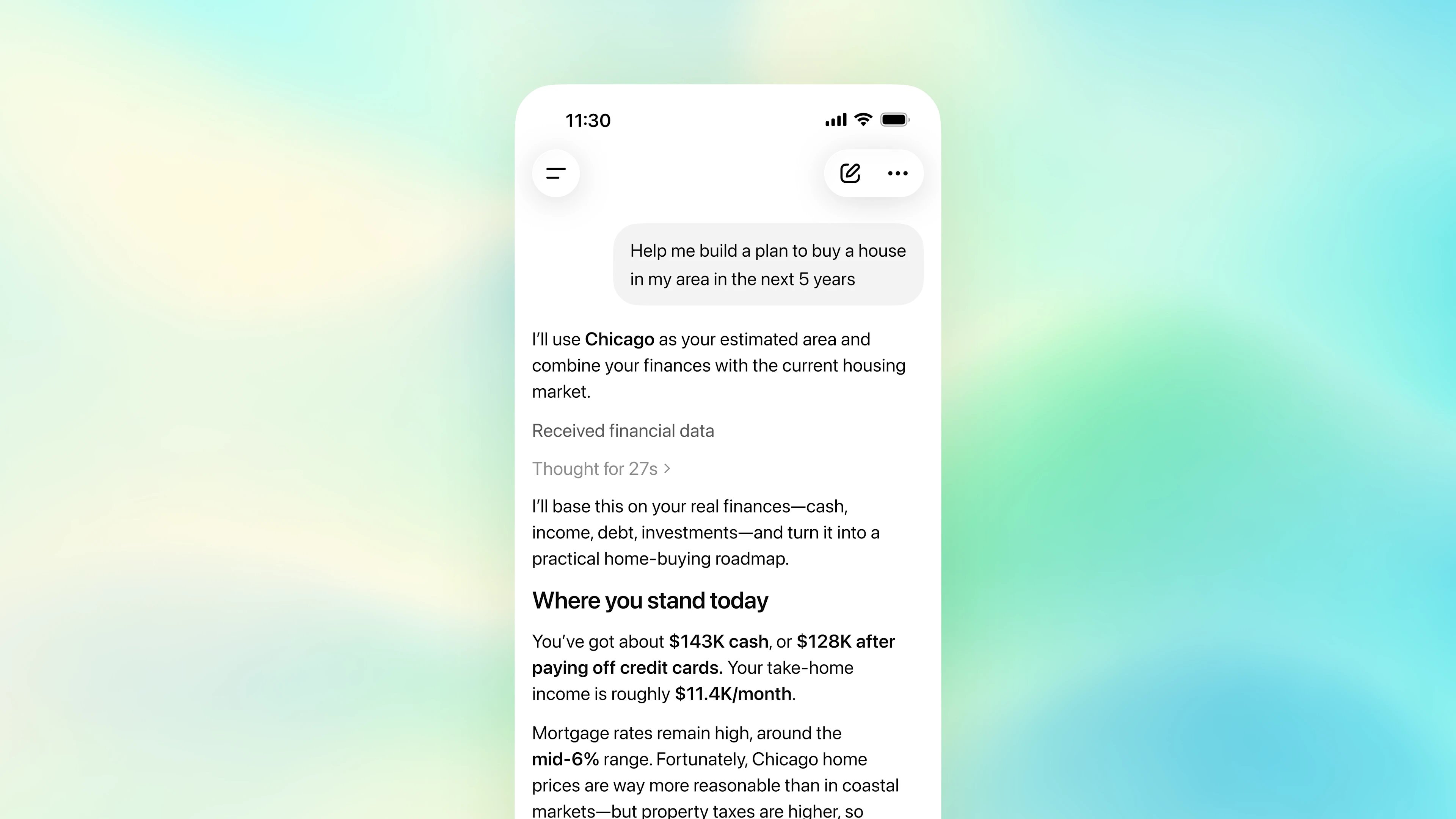
OpenAI announced a preview of a personal‑finance experience inside ChatGPT for Pro users in the U.S. The rollout promises:
- Secure account linking through Plaid (with Intuit support coming later).
- A unified dashboard that aggregates balances, spending categories, subscriptions, upcoming bills, and portfolio performance.
- The ability to embed personal goals (“saving for a car”, “repaying a family loan”) as Financial memories that inform future queries.
- Responses generated by the new GPT‑5.5 Thinking model, which OpenAI says scores 79/100 on an internal finance benchmark (GPT‑5.5 Pro reaches 82.5/100).
- A focus on privacy: no full account numbers are stored, users can disconnect at any time, and data is deleted within 30 days.

What’s actually new?
| Feature | Prior art | New element |
|---|---|---|
| Account aggregation | ChatGPT could already fetch data from external APIs if a developer built a custom plugin. | Built‑in, one‑click Plaid integration for any of ~12,000 institutions, exposed directly in the UI (sidebar → Finances). |
| Dashboard view | Users had to manually paste transaction CSVs into a conversation. | Auto‑generated, categorized view with spend breakdowns, subscription detection, and upcoming payment alerts. |
| Financial memories | ChatGPT could retain user‑provided context within a single session. | Persistent, user‑editable memory objects that survive across sessions, scoped to the finance app only. |
| Model | GPT‑4‑Turbo powered most ChatGPT features. | GPT‑5.5 Thinking, a reasoning‑oriented model tuned on finance‑specific prompts and evaluated with a 50‑expert benchmark. |
| Privacy controls | General data‑control settings applied to all conversations. | Dedicated Finances settings (disconnect, delete memories) and MFA recommendation. |
The most tangible technical step is the tight coupling of Plaid’s token‑exchange flow with OpenAI’s backend, allowing real‑time transaction streaming into the model’s context window. This eliminates the need for a separate “plugin” layer and reduces latency compared with the earlier plugin‑based approach.
How the benchmark works (and why it matters)
OpenAI built a composite score that blends two dimensions:
- Expert‑graded response quality – 50 finance professionals rated answers on relevance, completeness, and risk disclosure.
- Accuracy of quantitative output – e.g., correct calculation of debt‑to‑income ratios, projected savings, or tax implications.
The resulting 79/100 for GPT‑5.5 Thinking indicates the model is above average on the internal test set but still makes noticeable mistakes. In the public preview, users have reported occasional:
- Mis‑classification of merchant categories (e.g., a grocery purchase flagged as a “subscription”).
- Over‑optimistic cash‑flow projections when recent income spikes are not smoothed.
- Failure to flag regulatory nuances (e.g., tax‑advantaged account contribution limits).
These gaps are unsurprising given the inherent difficulty of personal‑finance reasoning: the model must combine noisy transaction data, user‑provided goals, and a wide variety of jurisdiction‑specific rules.
Practical limitations today
- Coverage is U.S.-centric – The preview is limited to U.S. Pro users and relies on Plaid’s institution list. International banks, credit unions without Plaid support, or crypto‑only wallets are out of scope.
- No transactional actions – ChatGPT can read balances but cannot initiate transfers, pay bills, or execute trades. The workflow remains advisory.
- Data residency & compliance – While OpenAI deletes data within 30 days, the service still processes PII in OpenAI’s cloud. Organizations with strict data‑locality requirements may need to wait for an on‑prem or private‑cloud offering.
- Model hallucinations – Even with GPT‑5.5, the model can fabricate numbers when asked for projections beyond the available data. Users must verify any suggested amounts.
- Limited goal‑tracking automation – Users can set “Financial memories,” but there is no built‑in reminder or progress‑tracking UI beyond the static dashboard.
Where the feature could be useful now
- Quick “what‑if” scenarios – Ask “If I cut my dining out budget by $200 a month, how long until I can afford a $20k down payment?” and get a rough timeline.
- Subscription cleanup – The dashboard highlights recurring charges, making it easier to spot forgotten services.
- Goal‑centering conversation – By storing a mortgage payoff goal, users can ask “What extra payment each month would let me retire the loan two years early?” and receive a concrete figure.
What still needs work
| Area | Current state | Desired next step |
|---|---|---|
| Actionability | Advisory only | Secure API to initiate transfers or schedule payments (with explicit user consent). |
| Regulatory awareness | Basic US tax hints | Integration with tax‑software APIs (e.g., Intuit) for accurate filing estimates. |
| Cross‑account insights | Separate dashboards per account type | Unified net‑worth view that reconciles checking, credit cards, loans, and investment accounts in real time. |
| Explainability | Model outputs a single answer | Option to request a step‑by‑step breakdown of the calculation and data sources used. |
| Privacy guarantees | 30‑day deletion | Formal third‑party audit and SOC‑2 compliance report for the finance pipeline. |
Bottom line
OpenAI’s Finances preview is a solid engineering effort that moves personal‑finance assistance from a series of ad‑hoc prompts to a semi‑structured, data‑driven conversation. The integration of Plaid, the new GPT‑5.5 reasoning model, and persistent financial memories are genuine advances over the previous plugin‑only approach.
However, the service is still a prototype: it works best for high‑level budgeting advice and simple “what‑if” calculations, but it does not replace a certified financial planner or a dedicated budgeting app. Users should treat the output as suggestions, verify any numbers, and remain aware of the data‑privacy trade‑offs.
For developers and early adopters, the preview offers a useful sandbox to explore how LLMs can reason over real financial data. For the broader market, the next iteration will need tighter regulatory compliance, actionable integrations, and stronger guarantees around data handling before it can be considered a mainstream personal‑finance tool.
Further reading
- OpenAI’s official announcement: https://openai.com/blog/finances-preview
- Plaid integration docs: https://plaid.com/docs/
- GPT‑5.5 model card (restricted): https://openai.com/research/gpt-5-5
- Privacy & data‑control settings in ChatGPT: https://help.openai.com/en/articles/1234567-data-controls
Comments
Please log in or register to join the discussion