IDC projects 11.3% drop in PC shipments for 2026 amid component shortages, while market value rises 1.6% to $274 billion due to sustained price increases.
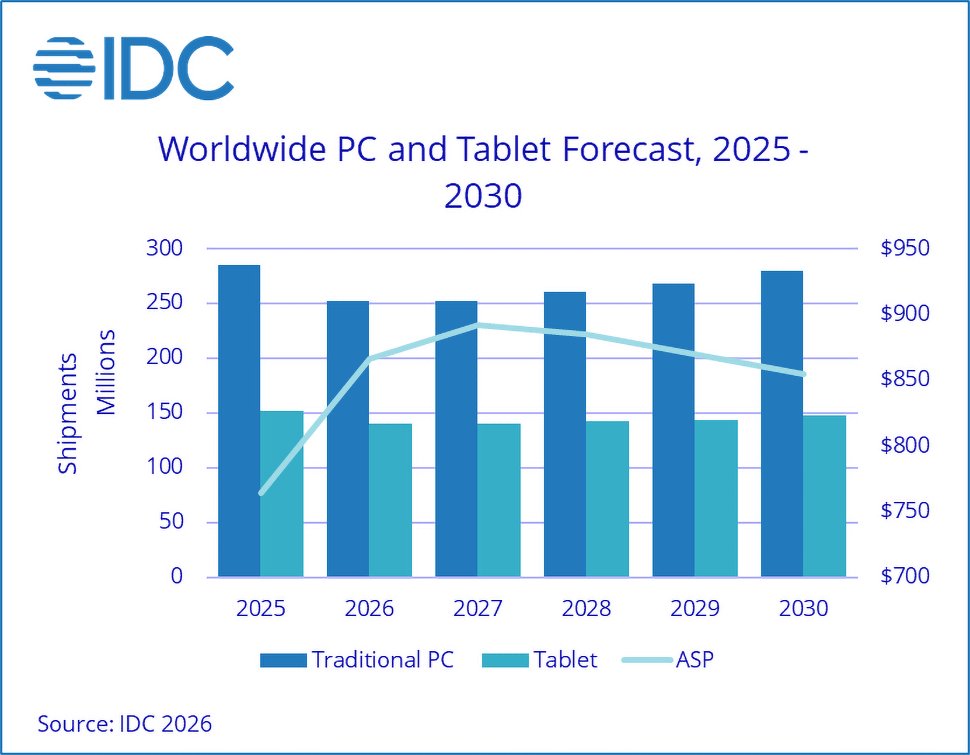
The global PC market is heading for a significant contraction in 2026, with shipments expected to fall 11.3% year-over-year to 252.53 million units, according to a new forecast from International Data Corporation (IDC). The sharp revision comes as memory shortages, rising component costs, and supply chain disruptions continue to plague the technology sector.
Memory Shortages Drive Market Contraction
IDC's latest projections represent a dramatic shift from earlier forecasts. Just months ago, the firm anticipated a modest 2.4% decline in PC shipments for 2026. By January, that projection had worsened to an 8.9% drop. The current 11.3% forecast reflects mounting pressures on the supply chain, particularly in memory components.
To put the scale of decline in perspective: the 32.17 million unit drop in PC shipments equals more than the total annual shipments of major manufacturers. Apple shipped 25.6 million computers last year, while Dell moved 41.1 million systems. The combined output of these two industry leaders falls short of the projected market contraction.
Tablet Market Also Contracts
Tablets face similar headwinds, with IDC forecasting a 7.6% decline in shipments. After growing 5% to 151.9 million units in 2025, the tablet market is expected to shrink by 11.54 million units to 140.36 million in 2026. Apple maintained its dominance in the tablet space, selling 17.1 million iPads in Q4 2025, compared to Samsung's 6.4 million units.
Rising Prices Offset Volume Declines
Despite the volume contraction, the PC market's total value is projected to increase by 1.6% to $274 billion in 2026. Tablets will see an even stronger value growth of 3.9%, reaching $66.8 billion. This counterintuitive trend stems from sustained price increases across the industry.
"The era of bargain-priced PCs and tablets is behind us for now, as rising ASPs and component costs shift the market's balance of power," said Jitesh Ubrani, research manager for IDC's Worldwide Mobile Device Trackers. "Memory shortages will persist well into 2027. While we anticipate some easing of prices beginning in 2028, the market is unlikely to return to the pricing levels seen in 2025."
Supply Chain Pressures Mount
The memory shortage driving these changes affects multiple components. Prices for 3D NAND, DRAM, and other critical parts have all increased, forcing manufacturers to raise their prices. These cost increases come at a time when the AI sector boom is intensifying demand for specialized components, further straining supply chains.
IDC noted that its forecast was compiled before the recent escalation of conflict in the Middle East, suggesting the situation could deteriorate further. The analysts acknowledged the possibility of downward revisions as new geopolitical risks emerge.
Industry Uncertainty Persists
The broader technology sector faces unprecedented challenges, according to Ryan Reith, group vice president of Devices and Consumer at IDC. "The overall tech industry, as well as many others, continues to face uncontrollable headwinds that, when compounded, result in massive disruption," Reith said. "The lists of industry and geopolitical events that continue to grow is making decision-making — and even survival in some sectors — nearly impossible."
Reith emphasized the difficulty of predicting when these pressures might subside, describing the current uncertainty as a "trillion-dollar question" rather than a million-dollar one.
Long-Term Market Transformation
The forecast suggests a fundamental shift in the PC and tablet markets. Rather than returning to previous pricing levels, IDC expects a "new normal" characterized by structurally higher average selling prices. This transformation could have lasting effects on consumer behavior and market dynamics.
As manufacturers adapt to higher component costs and constrained supplies, the industry appears to be entering a period where premium pricing becomes the standard rather than the exception. This shift may accelerate the trend toward higher-end devices with advanced features, as manufacturers seek to justify the increased prices to consumers.
The combination of reduced unit volumes and increased market value represents a significant restructuring of the PC industry, one that could reshape competitive dynamics and product strategies for years to come.
Comments
Please log in or register to join the discussion