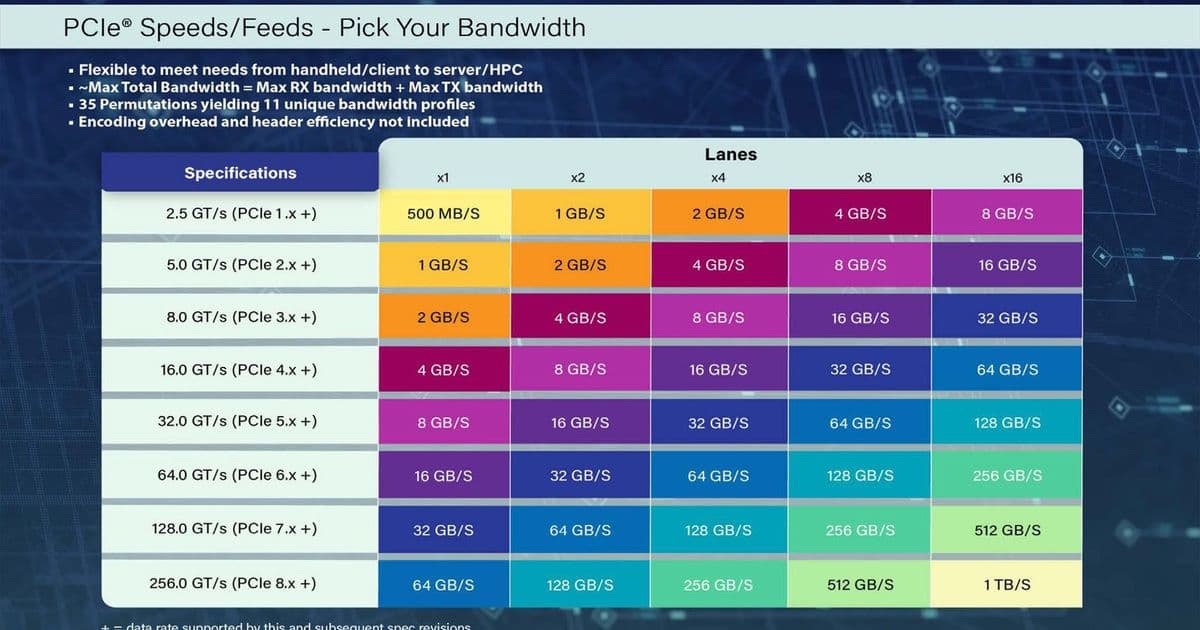
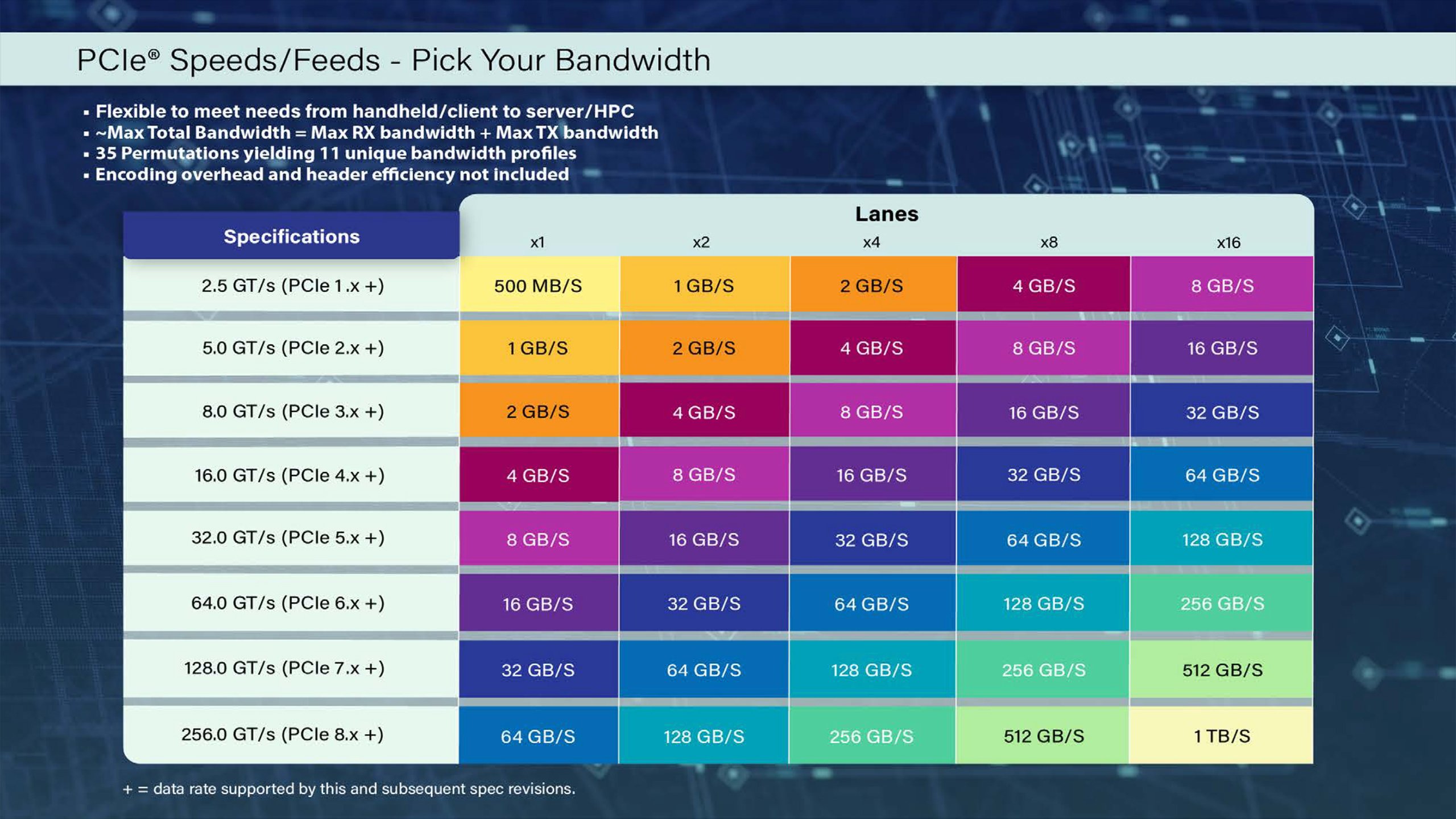
The PCI-SIG has released PCIe 8.0 Draft 0.5, establishing the architectural foundation for the next-generation interconnect standard featuring 256 GT/s transfer rates and 1 TB/s bi-directional bandwidth. The specification introduces PAM4 signaling with FEC and Flit Mode encoding while addressing physical layer challenges through new connector technologies.
The PCI-SIG, the organization overseeing development of PCIe standards, has announced a significant milestone with the release of the PCIe 8.0 specification Draft 0.5. This draft establishes the architectural requirements for the next-generation interconnect, enabling PCI-SIG members to begin prototyping and final proposal submissions. The specification targets a transfer rate of 256 GT/s, which translates to up to 1 TB/s of bi-directional bandwidth when configured with x16 lanes. 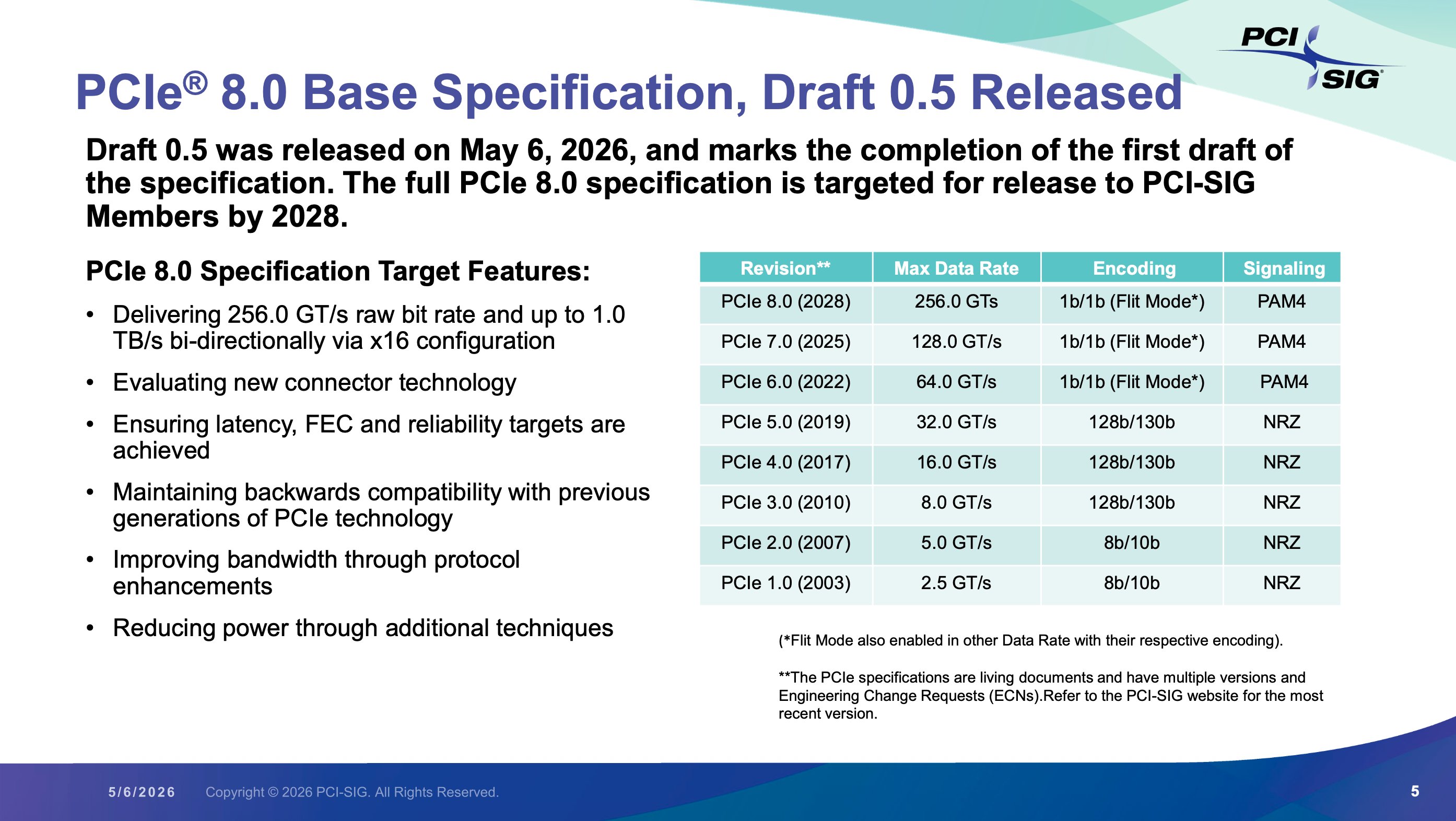
The PCIe 8.0 Draft 0.5 represents the first complete version of the specification that locks in key conceptual targets and mechanisms. It comprehensively outlines all major aspects of the architecture, including electrical characteristics, logical operations, compliance requirements, and software interfaces. This foundational document maintains several critical technical decisions: a target bit rate of 256 GT/s; PAM4 (Pulse Amplitude Modulation 4) signaling combined with Forward Error Correction (FEC) and Flit Mode encoding; protocol enhancements designed to improve bandwidth efficiency; backward compatibility with previous generations; and the evaluation of new connector technologies.
The progression of PCIe standards reveals an accelerating pattern of bandwidth increases. PCIe 3.0 introduced 8 GT/s, PCIe 4.0 doubled this to 16 GT/s, PCIe 5.0 reached 32 GT/s, and PCIe 6.0 achieved 64 GT/s. PCIe 8.0 represents another doubling to 256 GT/s, maintaining the historical pattern of approximately one generation per two years since PCIe 3.0's introduction in 2011. This exponential growth continues to drive advancements in computing systems, enabling higher performance for data centers, AI workloads, and high-performance computing applications.
One of the most significant technical challenges addressed in PCIe 8.0 involves the physical layer limitations of copper interconnects. As data rates increase, issues such as signal loss, crosstalk, and reflections become increasingly problematic. These constraints have already been evident in PCIe 5.0 and 6.0, but with PCIe 8.0's 256 GT/s bit rate—unprecedented for copper-based standards—these challenges intensify substantially. At these speeds, traditional edge connectors and motherboard routing struggle to maintain acceptable signal integrity without excessive power consumption for equalization or increased latency from FEC mechanisms.
Consequently, PCI-SIG is actively evaluating new connector technologies to address these challenges. Potential solutions include redesigning PCIe slots with improved materials and tighter manufacturing tolerances, further shortening electrical paths, and increasing the number of redrivers per link. However, maintaining backward compatibility with existing PCIe implementations remains a priority, which limits the extent of possible connector redesign. The organization must balance innovation with compatibility, ensuring that new hardware can interface with legacy systems while pushing performance boundaries.
The availability of Draft 0.5 marks a critical transition point where hardware designers—including major players like AMD, Intel, and Nvidia, along with specialized IP and PHY vendors—can begin early prototyping and architectural work. While some electrical parameters and protocol optimizations may still be refined in future drafts, the specification is now mature enough to allow for meaningful development efforts. Companies will likely develop their implementations with contingency plans for potential changes, but the fundamental architecture is now established.
The timeline for PCIe 8.0 continues toward final ratification expected in 2028. This extended development period allows for thorough testing, validation, and refinement of the specification. Historically, the period between draft specification and final ratification has been crucial for identifying and resolving implementation challenges, ensuring that the final standard is robust and ready for widespread adoption.
From a market perspective, PCIe 8.0's introduction comes at a time when data-intensive applications continue to proliferate. The demand for higher bandwidth interconnects stems from several key trends: the growth of artificial intelligence and machine learning workloads, increasing requirements for data center connectivity, the expansion of high-performance computing applications, and the proliferation of high-resolution displays and graphics-intensive applications. PCIe 8.0 will provide the necessary bandwidth to support these evolving requirements while maintaining the compatibility that has made PCIe the dominant interconnect standard in computing systems.
The development of PCIe 8.0 also reflects broader industry trends in semiconductor interconnect technology. As individual processor cores approach their frequency limits, system architects increasingly focus on improving interconnect bandwidth and efficiency. PCIe 8.0's combination of higher data rates and improved encoding schemes exemplifies this approach, squeezing more performance from existing physical technologies while preparing for future innovations.
For system integrators and end users, PCIe 8.0 promises several benefits beyond raw bandwidth increases. The inclusion of Forward Error Correction should improve signal integrity in challenging environments, while protocol enhancements may reduce overhead and improve efficiency. These improvements translate to better real-world performance, particularly in applications sensitive to latency or data integrity issues.
The PCIe ecosystem has consistently demonstrated its ability to scale while maintaining compatibility, and PCIe 8.0 appears poised to continue this tradition. As development work begins based on the Draft 0.5 specification, the industry will likely see early implementations emerge in high-end applications before gradually filtering down to mainstream computing systems over the coming years.
For more information about the PCIe specification and its development, readers can refer to the PCI-SIG website, which provides access to specifications, white papers, and other resources related to PCIe and related interconnect standards.
Comments
Please log in or register to join the discussion