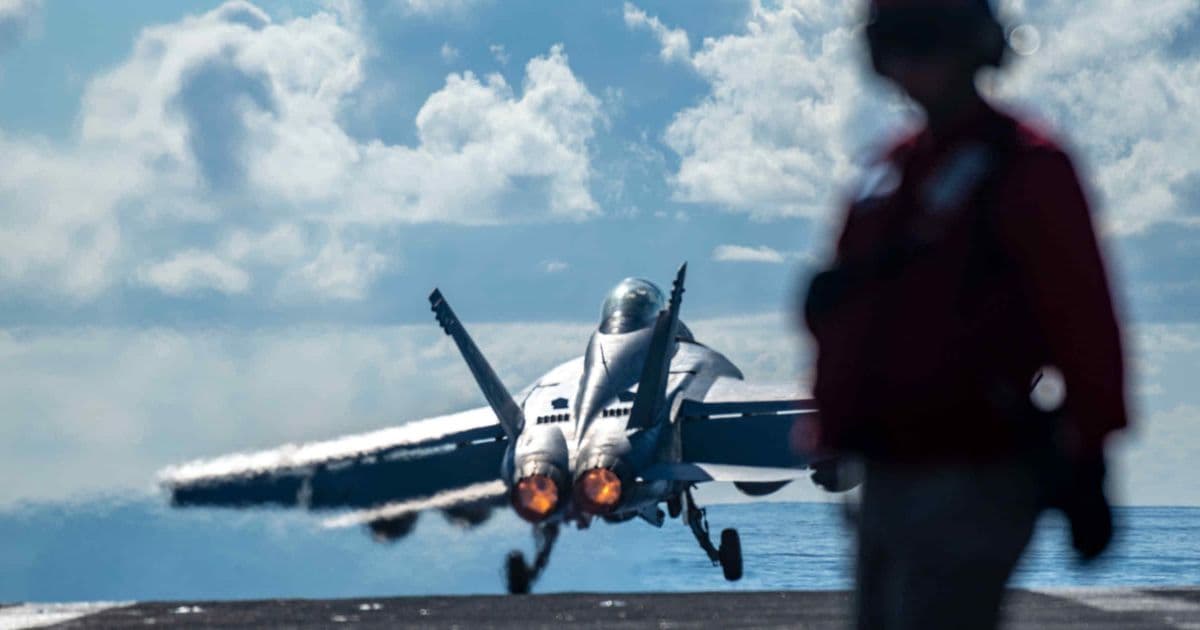
The U.S. Department of Defense's 2026 National Defense Strategy outlines a focus on maintaining strategic stability in the Indo-Pacific through strength-based deterrence rather than confrontation, explicitly avoiding direct references to Taiwan while emphasizing limited North Korea engagement.
The U.S. Department of Defense released its 2026 National Defense Strategy on January 24, 2026, outlining a nuanced approach to Indo-Pacific security that prioritizes long-term competition with China through deterrence rather than direct confrontation. The document explicitly states the U.S. goal is to prevent China from achieving regional dominance, diverging from previous frameworks centered on denying specific military actions like a potential Taiwan invasion.
Central to the strategy is the concept of "strategic stability with Beijing," achieved through sustained military modernization and alliance strengthening. Notably, the 128-page document avoids any explicit mention of Taiwan—a deliberate omission signaling Washington's preference for ambiguity amid heightened cross-strait tensions. Instead, it frames U.S. objectives around maintaining a "free and open Indo-Pacific" where no single power dominates security or economic architectures.
The strategy concurrently defines a "limited" U.S. role regarding North Korea, focusing on missile defense coordination with Japan and South Korea rather than regime-change scenarios. This calibrated approach acknowledges resource constraints as the Pentagon balances simultaneous challenges in Europe and the Middle East.
Financial implications are significant: The stance reinforces record $842 billion defense budget requests emphasizing Indo-Pacific capabilities, including hypersonic weapons development and distributed logistics networks. Taiwan's own recently proposed $19 billion defense budget—aimed at building asymmetric "porcupine" defenses—faces implementation challenges amid political uncertainty in Taipei. Meanwhile, China's naval expansion continues unabated, with projections indicating its carrier fleet could outnumber the U.S. Pacific Fleet by 2035.
Industry analysts note the strategy implicitly pressures allies to increase defense spending. Japan faces delays in its F-X fighter program with the UK and Italy due to London's budget constraints, while the Philippines recently signed new security agreements with Tokyo. Commercial impacts ripple through supply chains: Taiwan's semiconductor firms report contingency planning for potential disruptions, and U.S. defense contractors anticipate increased orders for long-range precision munitions and surveillance systems.
The document's avoidance of Taiwan-specific scenarios suggests a calculated effort to manage escalation risks without conceding strategic ground. However, it leaves unresolved questions about response thresholds should China initiate coercive actions against the island—a gap that regional allies will scrutinize closely during upcoming military exercises.
Comments
Please log in or register to join the discussion