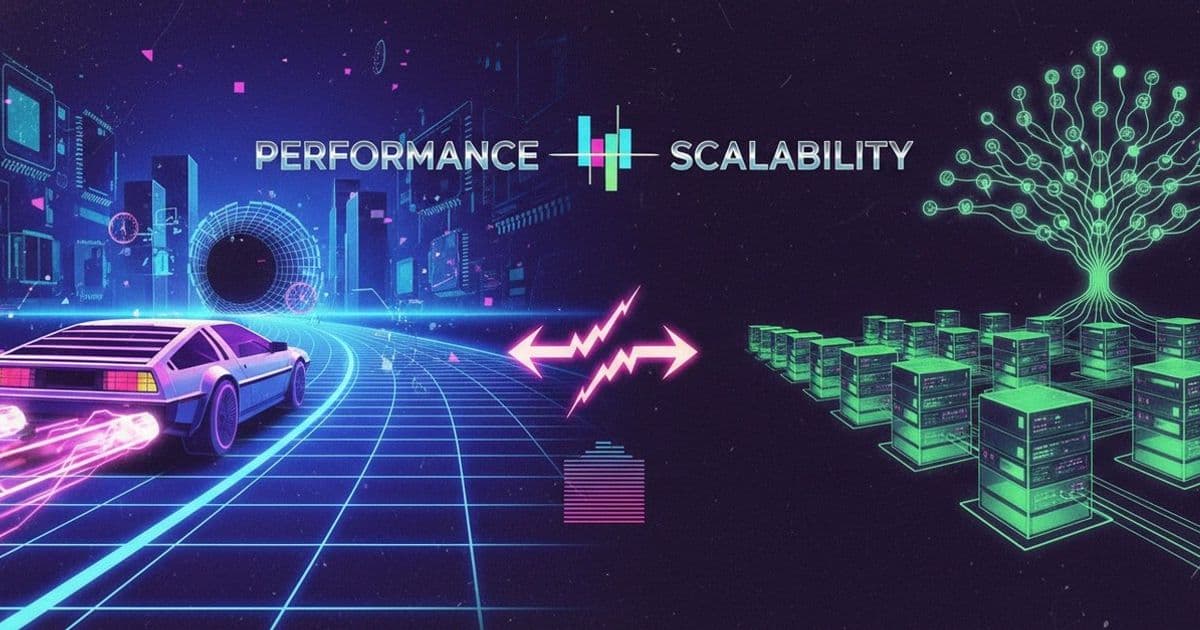
Understanding the critical difference between making individual requests fast and making systems handle growth is essential for building robust applications.
When building software systems, two concepts dominate architectural discussions: performance and scalability. Yet these terms are often used interchangeably, leading to costly design mistakes. Understanding their distinct meanings—and how they interact—is crucial for building systems that not only respond quickly but can handle growth without breaking.
The Fundamental Distinction
Performance is about speed for a single request. If your API takes 2 seconds to respond, that's a performance problem—and it would still be 2 seconds even if only one person was using it. You fix performance issues by optimizing code, adding database indexes, implementing caching strategies, or reducing I/O operations.
Scalability is about what happens as load increases. A perfectly performant system can still be unscalable—if adding 100× more users causes it to crash or slow to a crawl, that's a scalability problem. You fix scalability by redesigning how the system distributes work across resources.
Consider this common scenario: a system that returns a database query in 50ms with one user, but takes 8 seconds with 10,000 concurrent users. This isn't a performance failure—it's a scalability failure. The code isn't inherently slow; the architecture can't handle concurrent demand.
Performance Deep Dive
Performance optimization targets the critical path of a single request. The key metrics are:
Latency is the time from request to response. You reduce latency by:
- Caching hot data in Redis or similar in-memory stores
- Using CDNs for static assets to serve from edge locations
- Adding database indexes to eliminate full table scans
- Avoiding N+1 query problems through eager loading or JOINs
- Optimizing algorithms and data structures
Throughput is how many requests per second your system can handle before degrading. You increase throughput with:
- Async I/O frameworks (Node.js, Netty, asyncio)
- Connection pooling to reuse expensive connections
- Batching writes to reduce transaction overhead
- Database read replicas to distribute query load
The gold standard metric is p99 latency—the worst 1% of requests. Optimizing average latency hides tail latency spikes that real users experience. A system with 100ms average latency but 10-second p99 is failing real users regularly.
Scalability Deep Dive
Scalability is about maintaining performance characteristics as load grows. The two primary approaches are:
Vertical scaling (scale up) means giving a single machine more CPU, RAM, or faster storage. It's simple to implement but has hard limits—you can only make one machine so big. It also creates a single point of failure.
Horizontal scaling (scale out) means adding more machines behind a load balancer. It's more complex but nearly unlimited—this is how companies like Google, Amazon, and Netflix operate. For horizontal scaling to work, your services must be stateless. If a server holds session data in memory, requests must always go to the same server, preventing free distribution.
The solution is to push state to external stores like Redis or databases. This enables request routing to any available server.
Sharding applies horizontal thinking to databases—splitting data across multiple database nodes so no single node becomes the bottleneck. Each shard handles a subset of the data, and requests are routed accordingly.
Message queues (Kafka, RabbitMQ, SQS) decouple producers from consumers, letting you absorb traffic spikes without dropping requests. They act as buffers between system components, smoothing out demand variations.
The Dangerous Intersection
The most common mistake is optimizing for performance at the expense of scalability. Consider these scenarios:
| Performance | Scalability | Outcome |
|---|---|---|
| ✅ Fast single request | ❌ Collapses at 1k users | System fails under load |
| ❌ Slow single request | ✅ Handles 1M users | Users wait but system survives |
| ✅ Fast and handles millions | ✅✅ Ideal | System succeeds |
| ❌ Slow and collapses | ❌❌ Failure | System fails completely |
Some optimizations actually hurt scalability. Storing session state in-memory is fast but prevents horizontal scaling. Using database transactions for every operation is safe but doesn't scale. These are the performance/scalability trade-offs that system designers constantly navigate.
Real-World Implications
The distinction matters because the solutions are different. Performance problems are often solved with better algorithms, caching, or hardware. Scalability problems require architectural changes—stateless services, distributed databases, message queues, and load balancers.
A system that's fast for one user but crashes under load isn't just slightly broken—it's fundamentally unscalable. Conversely, a system that scales well but has high latency for individual requests provides a poor user experience even if it doesn't crash.
The best systems optimize for both: fast responses for individual users AND the ability to handle growing demand. This requires understanding both domains and making intentional trade-offs based on your specific requirements, user base, and growth projections.
The key insight is that performance and scalability are complementary but distinct concerns. Mastering both is what separates systems that work in development from systems that work at scale.
Comments
Please log in or register to join the discussion