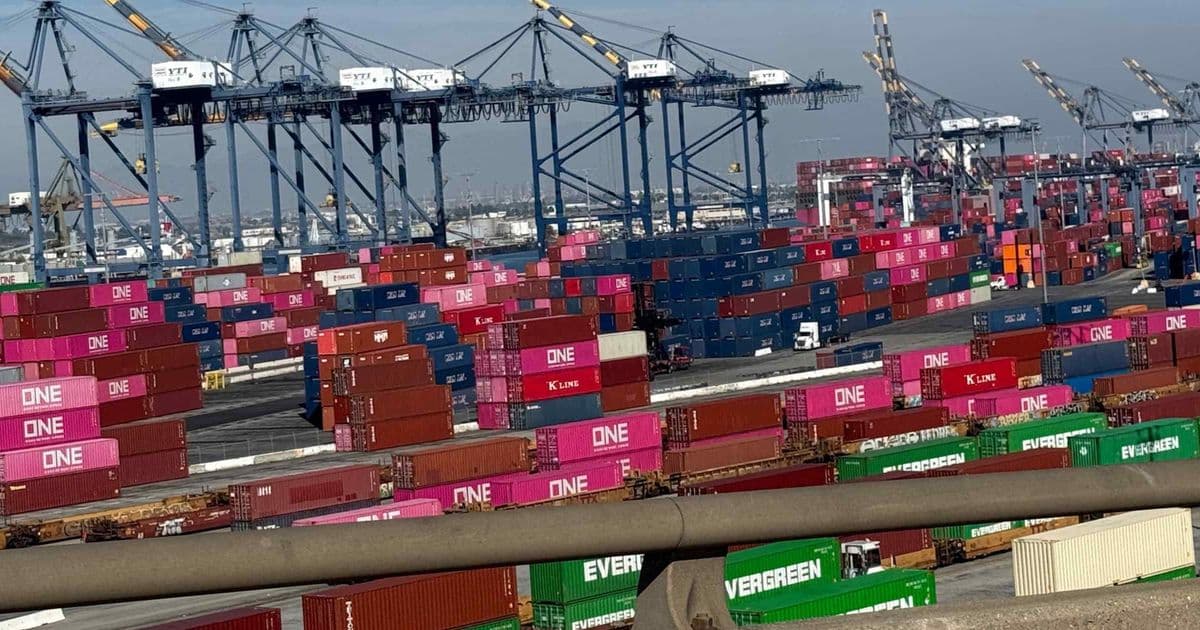
The Port of Los Angeles recorded its third-highest annual volume in 2025, reaching over 10.2 million TEUs, even as China's share of imports fell from 60% to approximately 40%. Executive Director Eugene Seroka attributes the resilience to aggressive marketing partnerships and new shipping routes from Southeast Asia, while noting the ongoing impact of Trump-era tariffs on small businesses and consumer prices.
The Port of Los Angeles, the primary U.S. gateway for Asian goods, achieved its third-strongest performance in 2025, processing over 10.2 million twenty-foot equivalent units (TEUs). This milestone comes despite significant trade disruptions from President Donald Trump's tariff policies and a marked decline in cargo originating from China.
Executive Director Eugene Seroka, in an interview with Nikkei Asia, attributed the port's resilience to strategic diversification and relationship management. "We've been very aggressive in marketing and very aggressive in partnerships," Seroka stated. "Shipping lines have put in new direct services from Southeast Asia, so the cargo still gets here very fast, which keeps us in a good position in the market."
Shifting Trade Geography
China's dominance at the port has diminished substantially. Its share of imports dropped to about 40% in 2025, down from 60% in 2018 before the first round of Trump tariffs. Seroka projects this percentage will continue to decline as China exports not only finished products but also manufacturing expertise to Southeast Asian nations.
"China is now exporting manufacturing expertise, so they are investing in places like Vietnam, Indonesia, Malaysia, Thailand, with their expertise in how to make products," Seroka explained. This shift has enabled the port to maintain volume growth even as Chinese-origin cargo decreased.
The port's marketing efforts have focused on reinforcing relationships with key trading partners. Seroka made multiple trips to Japan in 2025, visiting Tokyo, Osaka, and Kobe to reassure customers of the port's continued commitment to their business.
Impact of Tariff Policies
The Trump administration's tariff announcements created significant volatility throughout 2025. Seroka noted over 110 trade announcements from Washington, causing cargo volumes to spike and plummet rapidly. "We've seen cargo go very high and then sometimes really drop very quickly after hard policy was announced," he said. March saw a volume peak, followed by low volumes in April and May, before overall volumes stabilized.
The repeal of the de minimis tariff exemption for packages valued under $800 has had less impact than anticipated. "Even with that loophole removed, shipments out of China are still very steady," Seroka observed. "Even with de minimis packages, you have to pay but it's not crazy. So, better than some people thought."
Small Business Strain
The tariffs have disproportionately affected small and medium-sized import-based businesses. Seroka cited daily examples of companies struggling to absorb tariff costs while competing against larger corporations.
One auto parts company near the port continues to pay 97% of the tariffs on its imports while supplying major automotive manufacturers in Michigan. The company faces a critical decision: absorb doubled product costs or risk losing factory lines at Detroit plants, where shutdowns can cost $2-4 million per hour. These smaller firms must deplete savings to maintain relationships with large customers.
Consumer Price Effects
American consumers are experiencing tangible price increases. Coffee prices have risen 15%, while bananas—a key traffic driver for grocery stores—have increased nearly 20%. These increases reflect the tariffs' pass-through to retail markets.
Seroka noted emerging discussions about a "K-shaped economy," where certain economic segments grow while others decline, influenced by income levels and job backgrounds. "Just because the stock market does well, it doesn't mean that middle America does well," he cautioned.
Recent Developments
October's U.S.-China summit brought some easing of tensions. A one-year pause on ship fees for foreign-made carriers docking in U.S. ports provides temporary relief. However, companies had already front-loaded inventory to mitigate tariff impacts, creating a temporary glut in the system.
Seroka highlighted the legal uncertainty surrounding tariffs, noting that if the Supreme Court rules them unlawful, companies might resume bulk purchasing at lower prices to rebuild stock.
The port's ability to maintain record volumes amid these disruptions demonstrates the flexibility of modern supply chains and the effectiveness of strategic diversification. As Southeast Asian manufacturing capacity grows and shipping routes adapt, the Port of Los Angeles appears positioned to continue its role as a critical U.S. trade gateway, albeit with a fundamentally different geographic trade profile than in previous years.
Comments
Please log in or register to join the discussion