postmarketOS's participation in FOSDEM 2026 and their subsequent hackathon yielded significant advancements in mobile Linux, from hardware CI improvements to strategic planning for the project's future.
The postmarketOS community recently concluded another highly productive and engaging FOSDEM and Hackathon experience, marked by significant advancements in mobile Linux technology and strategic planning for the project's future. The event, held in Brussels, Belgium, brought together developers, enthusiasts, and industry partners to discuss, demonstrate, and collaborate on the future of open-source mobile operating systems.
FOSDEM 2026 Stand and Exhibition
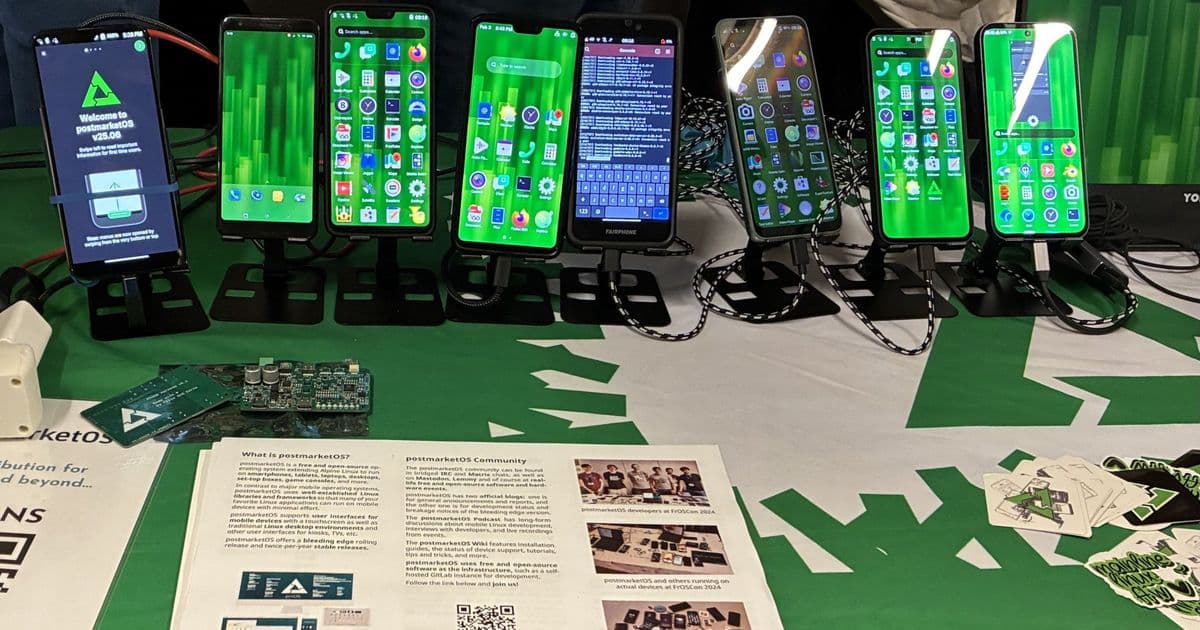
The postmarketOS stand at FOSDEM 2026 was a hub of activity, featuring an impressive array of phones, external screens, and the newly arrived version v0.3 of their phone-harness PCB. This hardware, designed for continuous integration testing, generated considerable excitement among attendees. The stand was well-equipped with proper phone stands, branded shirts (26 of which were given away to donors), namecards, and a QR code linking to the donation page.
One particularly memorable interaction, as recounted by Mat on social media, involved a visitor who handed over their phone for an update and ended up with Bhushan nearly getting the microphone working on it. This anecdote encapsulates the hands-on, collaborative spirit of the event.
FOSS on Mobile Devroom Talks
The FOSS on Mobile devroom was a focal point of the conference, featuring a series of postmarketOS-related talks that drew consistently full audiences. The talks covered a wide range of topics, including:
- "postmarketOS: Reliability in 2026" by Oliver
- "Mainline kernel for Fairphones - 2026 update" by Luca
- "Phosh: What's new and where are we going?" by Evangelos
- "Snapdragon 8 Gen 3 Mainline: From Day-1 Patches to Product Reality" by Neil
- "Running mainline Linux on the Unisoc-based Jolla C2" by Affe
- "The Linux Phone App Ecosystem (2026)" by Peter
- "Photos and Video Recording on Mobile Phones" by Pavel M.
- "UnifiedPush - Push notifications. Decentralized and Open Source" by Daniel G. and S1m
- "Collabora Office Can Finally Run on Mobile Linux" by Skyler
These presentations, all of which are available as recordings, showcased the breadth and depth of postmarketOS's contributions to the mobile Linux ecosystem.
Podcast Recording and Community Engagement
In keeping with tradition, the postmarketOS team recorded a podcast on Sunday, this time in an outdoor setting with several special guests from other projects. The podcast, which will be edited and released in the coming weeks, serves as a valuable resource for the community to stay informed about the latest developments and discussions.
Hackathon: Intensive Collaboration and Innovation
The hackathon that followed FOSDEM was a three-day intensive session of collaboration, problem-solving, and strategic planning. The event was structured with a schedule created using post-it notes, allowing for flexibility and spontaneous discussions. The hackathon featured parallel sessions, evening activities, and ample time for informal discussions and hacking.
Key Discussions and Outcomes
Reliability and Hardware CI
The team spent considerable time discussing the new requirements for the main category (PMCR 0009), which will include hardware CI. The goal is not only to indicate that a specific feature set is working but also to have the postmarketOS team endorse devices in this category and maintain them for an extended period. This will result in high hurdles for devices to enter the main category and will require dedicated teams for each device.
AI Policy
The team discussed their current AI policy, which does not explicitly forbid the use of generative AI in postmarketOS. They decided to update the policy to clearly state that they do not want generative AI to be used in the project. Additionally, they recognized the need to split the policy into the actual policy and a separate document explaining the reasoning behind it.
Financial Review and Budget Approval
The team approved a new budget, with plans for a separate blog post to detail the financial review and budget approval process.
Security Discussions
Ariadne from Alpine Linux presented on vulnerability monitoring in Alpine, highlighting the importance of knowing exactly which vulnerabilities are open to fix them quickly. The team discussed how postmarketOS could join this effort in the future.
PipeWire for Audio
Various discussions took place to move the Switch to PipeWire milestone forward, aiming to improve audio functionality on mobile devices.
Legal Entity and Power Delegation
The team discussed the possibility of establishing a legal entity for postmarketOS, with Pablo presenting research on an AISBL (International Non-Profit Association) with an e.V. (registered association) as a backup plan. They also discussed power delegation and teams, considering how to organize themselves better and how this fits with soon having a legal entity.
Fairphone 5 Call Audio
Bhushan and Luca worked on getting speaker audio in calls with the Fairphone 5, a feature that was not working yet. They were successful and created a short video illustrating the feature.
BPO Redesign
The team discussed finding a successor to build.postmarketos.org, their packages and images building service.
Patch for Upstream Review Service
Henrik proposed offering a service for pre-reviewing patches from the postmarketOS community before they get sent to the kernel mailing list to help with fixing common mistakes.
Alpine TSC Process
The team looked into defining the election/appointment process for the Technical Steering Committee (TSC) and Council in Alpine Linux.
Installer / First Boot Setup
The team discussed the first boot setup process, concluding that they don't want to do it in the initramfs but rather in the UI. They also identified the need to add a step to re-encrypt LUKS volumes in these first boot UIs.
Requiring DCO
The team discussed whether to require contributors to sign off on the Developer Certificate of Origin (DCO) for their contributions and decided to require this for all projects except pmaports in the near future.
Dogfooding Reboot
Federico, who is daily driving a Pixel 3a with postmarketOS, encouraged others at the hackathon to consider using postmarketOS on their phones more, not just on laptops.
OEM/Reseller Relationships
The team discussed reaching out to OEMs/resellers for selling phones with postmarketOS pre-installed. They currently have a relationship with Sendero Linux and decided to keep this small-scale for now, allowing them to gain experience before potentially expanding to a larger scale.
Hardware CI and Documentation
The team had a video call with Martin R. from CI-tron, who showed them how to bring up new CI-tron hosts. They discussed where to put the documentation and decided to put an overview in docs.postmarketos.org and in-depth docs in pmaports and the phone-harness repository.
Package Repo Consistency
Casey proposed making snapshots of Alpine's repositories when main and community are consistent, allowing for consistent installs and easy bisection of issues with previous packages.
Async Decision Making
The team brainstormed on how to make decisions between team meetings instead of making them in the team meetings, allowing for more involvement from Trusted Contributors in different time zones.
pmbootstrap Discussion
The team discussed whether to move forward with a significant change to pmbootstrap and later discussed ideas for a new pmbootstrap-like tool from scratch with improved features and abstraction layers.
Hardware CI Advancements
Outside of the scheduled sessions, Federico, Aelin, Casey, and Pablo put significant work into the hardware CI. As a result, they were able to test firmware written by Martin R. in more scenarios, uncovering and fixing multiple bugs. They also made modifications to make it work with devices with other voltages. In the end, they were able to get a gateway working with two phone harnesses and devices connected, a OnePlus 6T and Casey's original OnePlus 6, which worked flawlessly.
Community and Collaboration
The hackathon was not just about technical discussions and coding sessions. It was also a time for the community to come together, share meals, and build relationships. Luca and Federico once again cooked delicious meals that kept all the hackers going, and the team expressed gratitude for the donations that made the event possible.
Looking Ahead
The postmarketOS team is excited about the progress made during FOSDEM 2026 and the subsequent hackathon. They plan to continue working on the discussed topics, with several blog posts and updates expected in the near future. The team is committed to improving the reliability and usability of postmarketOS, expanding its ecosystem, and fostering a strong community of developers and users.
The success of these events underscores the importance of in-person collaboration in open-source projects. The ability to put faces to nicknames, have spontaneous discussions, and work together in real-time on complex problems is invaluable. As postmarketOS continues to grow and evolve, events like FOSDEM and the hackathon will remain crucial for driving innovation and building a strong, engaged community around mobile Linux.
For those interested in supporting the project, postmarketOS welcomes contributions through their OpenCollective page. The team's dedication to creating a truly open and sustainable mobile Linux ecosystem is evident in their work, and community support is essential for continuing this important mission.
As the mobile landscape continues to be dominated by closed, proprietary systems, projects like postmarketOS offer a compelling alternative. By providing a fully open-source mobile operating system that can run on a wide range of devices, postmarketOS is not just creating software – it's fostering a movement towards digital freedom and user empowerment in the mobile space.
The advancements and discussions from FOSDEM 2026 and the hackathon demonstrate that postmarketOS is not only alive and well but also pushing the boundaries of what's possible in mobile Linux. As the project moves forward with its plans for improved reliability, expanded hardware support, and a more structured organizational framework, the future looks bright for this innovative open-source initiative.
For those interested in following the project's progress, the postmarketOS website, GitHub repository, and social media channels provide regular updates and opportunities for community engagement. Whether you're a developer, an enthusiast, or simply someone interested in the future of open mobile computing, postmarketOS offers a fascinating glimpse into what's possible when a dedicated community comes together to challenge the status quo of mobile technology.
Comments
Please log in or register to join the discussion