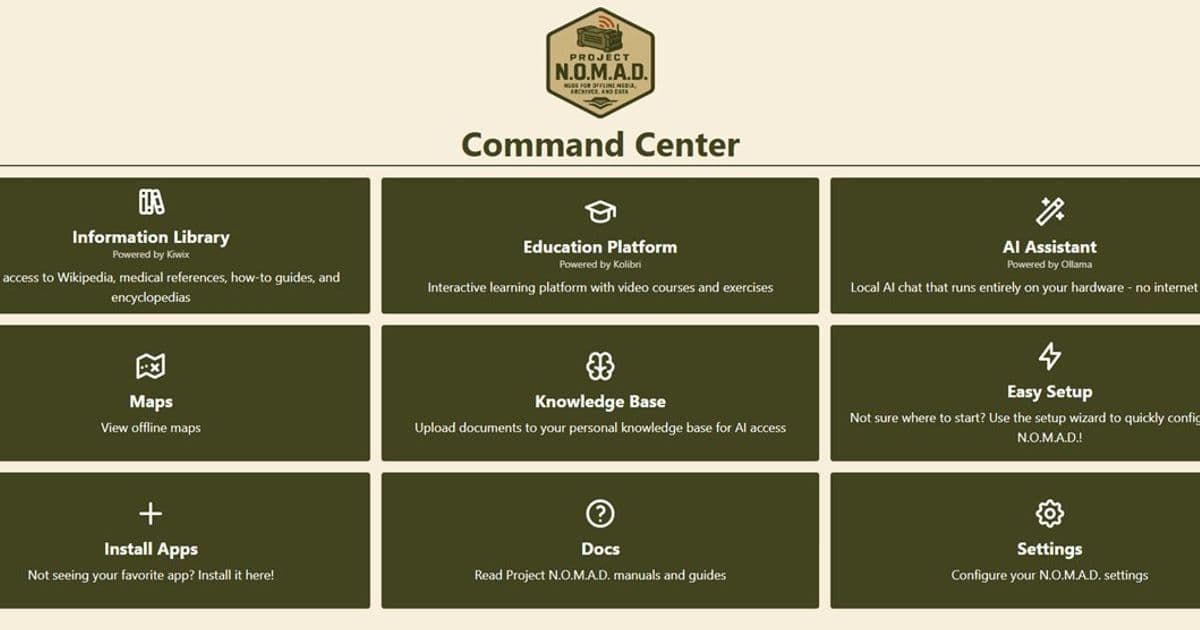
Project NOMAD offers a completely free, open-source solution for offline knowledge access, AI capabilities, and educational resources, challenging commercial alternatives that cost hundreds of dollars.
Project NOMAD has emerged as a compelling alternative to expensive offline knowledge systems, offering a comprehensive suite of tools that includes Wikipedia access, local AI capabilities, offline maps, and educational resources—all completely free and open-source. The project, which stands for Node for Offline Media, Archives, and Data, addresses a growing need for digital independence in an increasingly connected world.
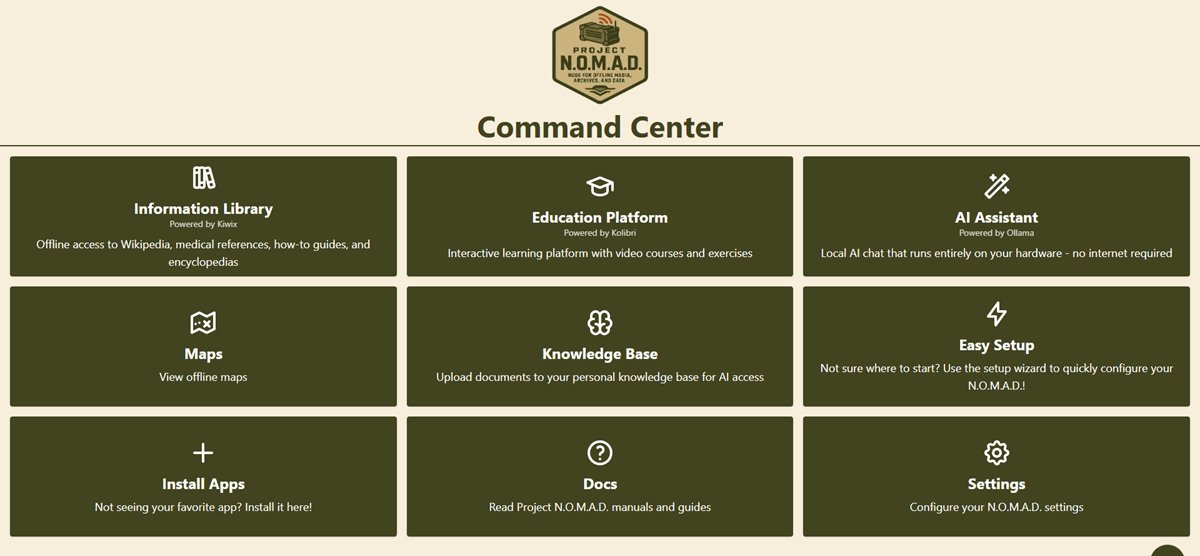
The core appeal of Project NOMAD lies in its ability to provide terabytes of human knowledge and AI capabilities without requiring an internet connection. This makes it particularly valuable for emergency preparedness, off-grid living, and situations where connectivity is unreliable or unavailable. Unlike commercial alternatives that can cost hundreds of dollars, Project NOMAD runs on any standard computer hardware, with support for GPU acceleration for more demanding AI tasks.
"Other offline products charge hundreds and lock you into specific hardware," the project's documentation states. "Project NOMAD runs on any PC you choose—with GPU-accelerated AI—for free."
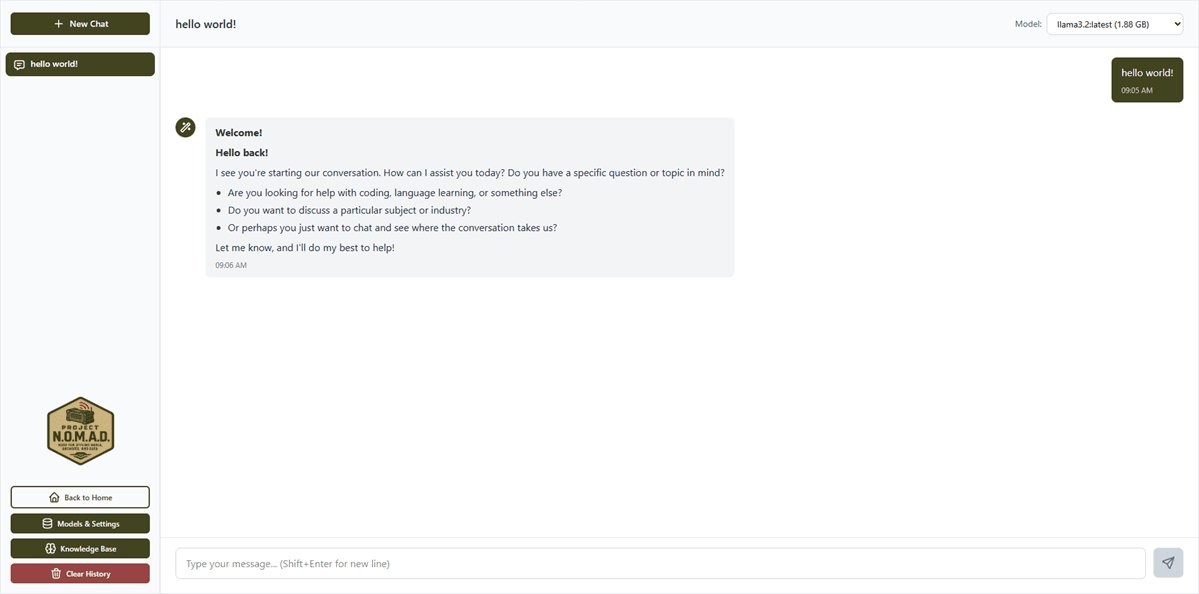
The system bundles several best-in-class open-source tools into a cohesive platform. The Information Library, powered by Kiwix, provides access to offline Wikipedia, Project Gutenberg, medical references, and repair guides. 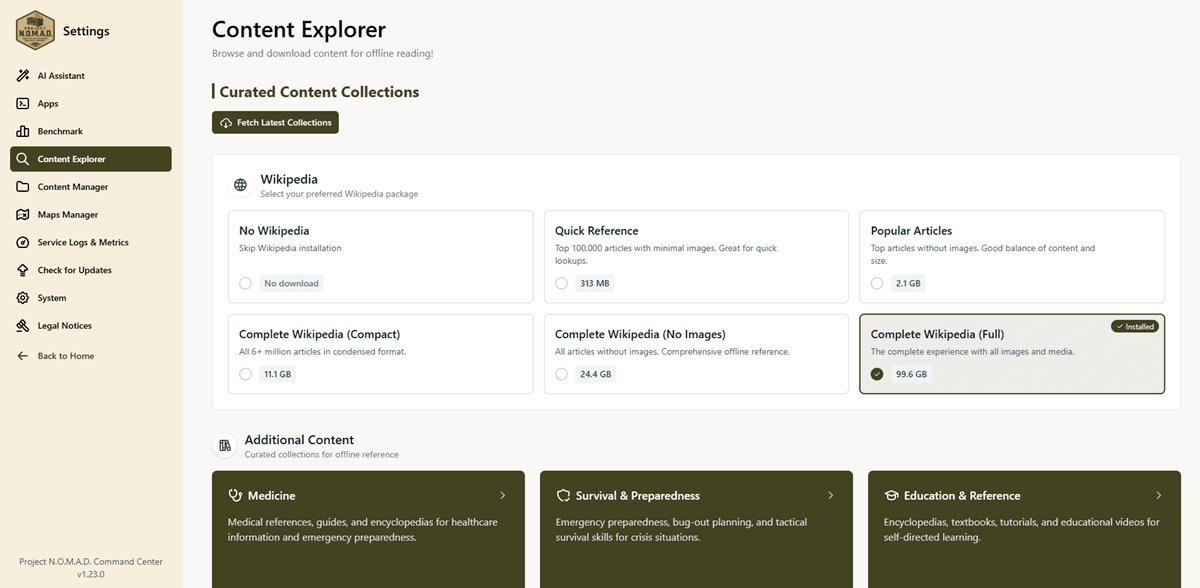 The AI Assistant, powered by Ollama, enables users to run large language models completely offline, allowing for chat, writing assistance, analysis, and coding without sending data anywhere.
  Offline Maps uses OpenStreetMap data for full offline mapping capabilities,
 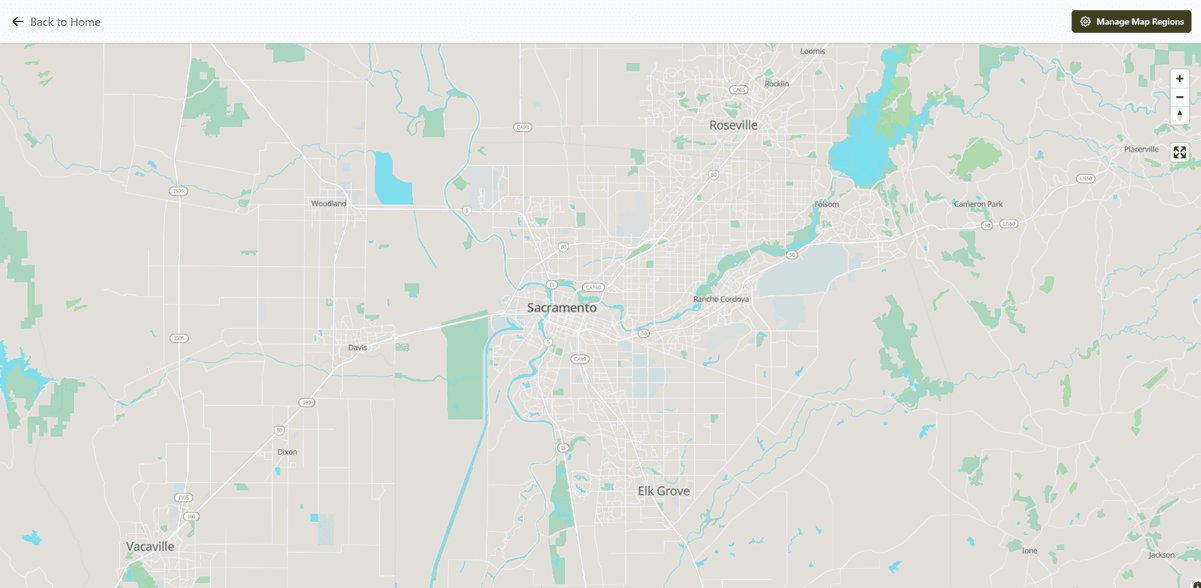 while the Education Platform, powered by Kolibri, offers Khan Academy courses and educational content.
Project NOMAD targets several key user segments. For emergency preparedness, the system provides critical resources when infrastructure fails. For off-grid living—whether in a cabin, RV, or sailboat—it offers a complete library, AI assistant, and offline maps. Tech enthusiasts appreciate the ability to run local LLMs and self-host knowledge bases, while educators benefit from comprehensive learning resources available anywhere, even without connectivity.
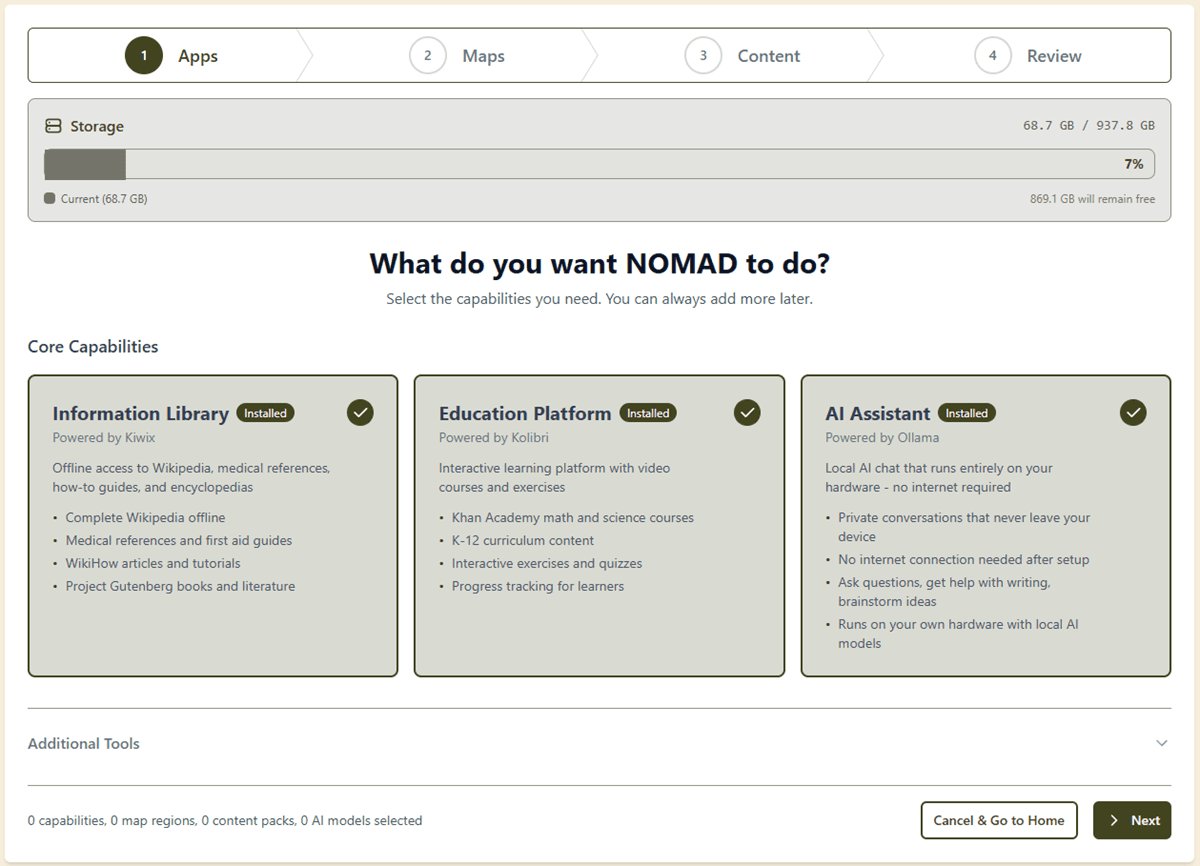
The technical implementation supports Ubuntu or Debian-based Linux systems, with Windows support via Docker Desktop. Installation is streamlined to two commands on compatible systems, making it accessible to users with moderate technical skills. The project recommends hardware with at least an AMD Ryzen 7 with Radeon graphics or Intel i7+ processor, 32GB RAM, and 1TB SSD for optimal performance.
In comparison to commercial alternatives like PrepperDisk ($199-$279), Doom Box ($699), and R.E.A.D.I. ($499), Project NOMAD offers significantly more capabilities, better hardware flexibility, and true openness. While competitors lock users into Raspberry Pi hardware with limited AI capabilities, NOMAD supports GPU-accelerated inference on more powerful hardware.
The project is funded entirely by the community through platforms like Ko-fi, with no subscriptions or paywalls. This community-supported approach aligns with the project's open-source ethos and commitment to keeping the software freely available.
As digital privacy concerns grow and internet connectivity becomes increasingly unreliable in various regions, solutions like Project NOMAD represent an important shift toward self-hosted, offline knowledge systems. The project demonstrates how open-source collaboration can create powerful alternatives to commercial products while respecting user freedom and data ownership.
For users interested in exploring Project NOMAD, the project provides comprehensive documentation, hardware guides, and a benchmark system to help users determine their system's capabilities. The installation process is designed to be straightforward, with the entire system deployable in minutes via a simple command.
Project NOMAD's emergence comes at a time when offline access to information and AI capabilities is becoming increasingly valuable, not just as a convenience but as a necessity for many users worldwide. By providing these capabilities freely and openly, the project is democratizing access to knowledge and computational power in an era where both are increasingly controlled by commercial entities.
The project's GitHub repository serves as the central hub for development, with community contributions driving ongoing improvements and expansion of content libraries. As the project continues to evolve, it may play an increasingly important role in how individuals and communities access information and computational resources outside traditional internet infrastructure.
Comments
Please log in or register to join the discussion