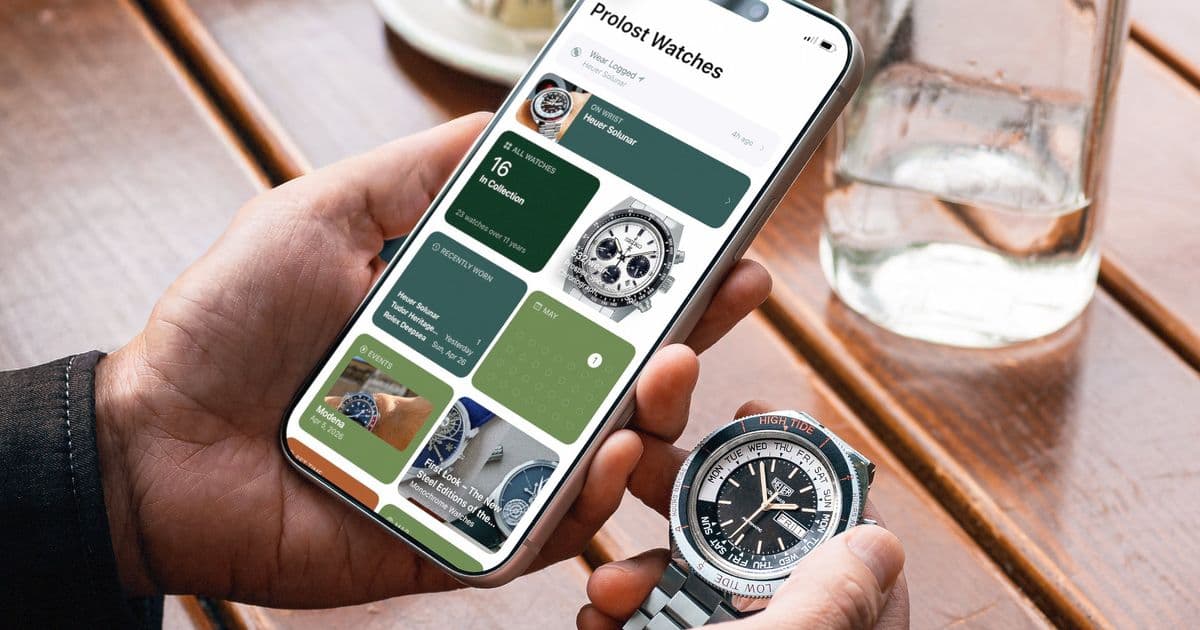
A recent reader comment on Prolost’s Prolost Watches page requests Apple Watch support for the custom watch face tool, a request that highlights persistent gaps between user expectations and platform-specific restrictions in the wearable ecosystem.
Smartwatch users continue to push for cross-platform availability of niche apps, even when platform policies make ports unfeasible. This pattern appears again in a recent comment on Prolost’s long-running Prolost Watches project, where a reader asks for an Apple Watch version of the tool.
Prolost, the design studio founded by Stu Maschwitz, launched Prolost Watch in 2014 as a customizable watch face app for Android Wear, the predecessor to modern Wear OS. The app let users upload personal photos, add text overlays, and adjust layout elements to create unique watch faces, a feature set that stood out against the limited stock options available at the time. The project built a dedicated audience among early smartwatch adopters, many of whom still use it on older Wear OS devices. You can find more about Prolost’s work at prolost.com, and the original app was available on Google Play at Prolost Watch.
The only recent engagement on the Prolost Watches page is a comment from J. Peterson, posted 8 hours ago, noting, “I can't help but think this should be an iWatch app as well.” The comment is brief, but it reflects a common request from users of indie smartwatch tools, why can’t a popular app on one platform make its way to the other?
This request ignores key differences in how Apple and Google handle third-party watch face functionality. Google’s Wear OS allows full custom watch faces from third-party developers, which is why Prolost Watch could exist in its current form. Apple’s watchOS, by contrast, does not permit third-party custom watch faces on the App Store. The watchOS Human Interface Guidelines explicitly state that only Apple can create watch faces, and third-party developers are limited to building complications, app integrations, or companion tools that run alongside stock faces.
A Prolost Watch app for Apple Watch could not include the core custom watch face functionality that defines the original tool. Prolost could build a companion app to let users design layouts on their iPhone and sync elements to a stock Apple Watch face via complications, but this would be a significantly stripped-down version of the Wear OS app. For a small studio like Prolost, the development time required to build this limited version may not justify the effort, especially given that the resulting app would not match the functionality that made Prolost Watch popular in the first place.
This tension between user demand and platform restrictions is not unique to Prolost Watch. Indie developers of wearable tools frequently face similar choices, either build for the more open Wear OS and reach a smaller but more flexible user base, or navigate Apple’s stricter policies to access a larger audience at the cost of reduced functionality. Some developers choose to launch on both platforms with different feature sets, but this requires doubling development resources, a challenge for small teams.
The Prolost Watches comment also points to a broader trend of users expecting seamless cross-platform experiences for niche tools, even when those tools rely on platform-specific features. As wearable adoption grows, these gaps between user expectations and ecosystem realities will likely persist, forcing developers to balance user requests with technical and policy constraints.
Comments
Please log in or register to join the discussion