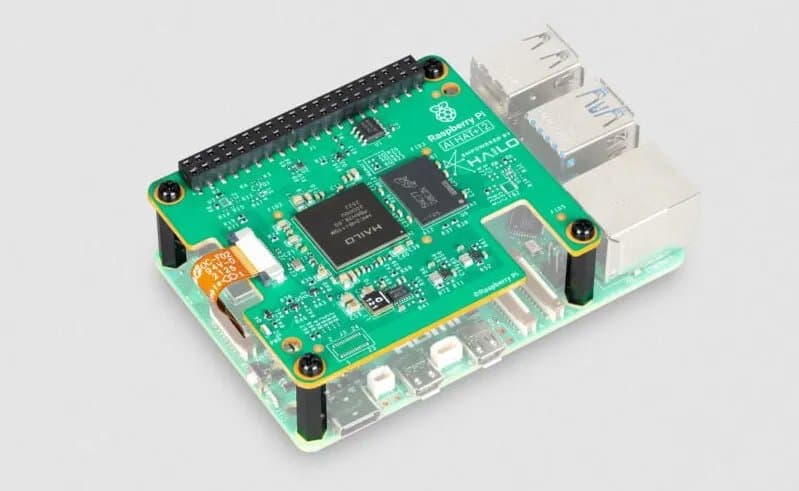
Raspberry Pi has unveiled the AI HAT+ 2, a new compute module that pairs its single-board computers with a Hailo-10H neural network accelerator capable of 40 TOPS for INT4 operations and includes 8GB of dedicated RAM, enabling it to run generative AI models up to 1.5B parameters like Llama 3.2 1B and DeepSeek R1-Distill 1.5B for $130.
Raspberry Pi has announced the AI HAT+ 2, a significant upgrade to its AI accelerator add-on board designed to bring generative AI capabilities to its ecosystem of single-board computers. This new module, priced at $130, moves beyond the original AI HAT+'s 26 TOPS performance by integrating the Hailo-10H neural processing unit (NPU) and adding 8GB of dedicated onboard memory, a critical addition for handling larger language models (LLMs) that were previously out of reach.
The core of the AI HAT+ 2 is the Hailo-10H accelerator, a chip specifically engineered for edge AI workloads. While the original AI HAT+ used the Hailo-8, the 10H is a more advanced part. Its headline figure is 40 TOPS (Tera Operations Per Second) for INT4 precision. This is a measure of raw computational throughput for neural network inference, where INT4 (4-bit integer) quantization is increasingly used to reduce model size and power consumption with minimal accuracy loss. For context, the previous model's 26 TOPS was based on INT8 precision. The shift to INT4 allows the new chip to handle more complex operations per second, which is essential for the sequential, token-by-token generation required by LLMs.
The most critical hardware addition, however, is the 8GB of LPDDR4X RAM. Generative AI models are memory-intensive; even a "small" 1.5B parameter model requires significant memory for both the model weights and the intermediate calculations during inference. The original AI HAT+ lacked this dedicated memory, relying on the Raspberry Pi's main system RAM, which is shared with the CPU, the OS, and other applications. This often created a bottleneck, limiting the size and number of models that could run simultaneously. By integrating 8GB of fast, dedicated memory directly on the HAT, the AI HAT+ 2 can load and run models entirely on the accelerator, freeing the Raspberry Pi's main CPU for other tasks and ensuring consistent performance.
This hardware configuration enables the board to target a specific class of generative AI models. Raspberry Pi's announcement explicitly lists compatibility with Llama 3.2 1B, DeepSeek R1-Distill 1.5B, and Qwen2 1.5B. These are all relatively compact LLMs, typically in the 1.5 billion parameter range. For comparison, a model like GPT-3.5 has over 175 billion parameters. The 1.5B models are chosen for their balance of capability and size, making them feasible for edge deployment. They can perform tasks like text generation, summarization, and basic question-answering. The performance claim is that the AI HAT+ 2 can run these models, though specific tokens-per-second (TPS) rates for generation will depend on the model's architecture and the precision used.
The market implications for this release are targeted. The original AI HAT+ was positioned for computer vision tasks—object detection, image classification, and pose estimation—where TOPS are a good metric for performance. The AI HAT+ 2 expands this into the realm of on-device language processing. This is relevant for developers building applications that require local, private, or low-latency AI without a constant cloud connection. Examples include smart home assistants that process voice commands locally, industrial automation systems that generate reports from sensor data, or educational tools that provide interactive tutoring.
The $130 price point, a $20 increase over the original AI HAT+, reflects the added silicon (the Hailo-10H vs. Hailo-8) and the significant cost of the 8GB of LPDDR4X memory. It positions the AI HAT+ 2 as a premium accessory for the Raspberry Pi 5, which itself costs $60-$80. A complete system (Raspberry Pi 5 8GB + AI HAT+ 2) would run approximately $190-$210, plus storage and power supply. This is a substantial investment for a single-board computer but remains far cheaper than a dedicated GPU or even some x86-based edge AI platforms.
The release highlights a broader trend in the semiconductor and embedded systems market: the democratization of AI acceleration. Companies like Hailo, Google (with the Edge TPU), and Intel (with Movidius) are creating specialized NPUs for edge devices. Raspberry Pi's role is to integrate these into a familiar, accessible platform. By providing a straightforward PCIe interface (the AI HAT+ connects via the Raspberry Pi's PCIe 2.0 lane) and robust software support through the Raspberry Pi OS, they lower the barrier to entry for developers and hobbyists.
For developers, the key will be the software ecosystem. Raspberry Pi provides drivers and libraries to interface with the Hailo-10H, typically through frameworks like TensorFlow Lite or ONNX Runtime. Running a model like Llama 3.2 1B will require converting the model to a format compatible with the Hailo-10H's compiler, which optimizes the network graph for the NPU's architecture. This process can involve trade-offs in precision and performance. The 8GB of RAM simplifies this by allowing the full model to be loaded, avoiding the need for complex memory management or model sharding.
The introduction of the AI HAT+ 2 also signals Raspberry Pi's commitment to the AI acceleration market. The original AI HAT+ was a first step, but the +2 model shows a clear response to developer feedback regarding memory limitations for generative AI. It suggests that future Raspberry Pi products may continue to integrate more specialized silicon directly onto their boards or as official accessories, further blurring the line between general-purpose computing and dedicated AI hardware.
In summary, the Raspberry Pi AI HAT+ 2 is a purpose-built upgrade for running generative AI models on the edge. Its 40 TOPS Hailo-10H accelerator and 8GB of dedicated RAM provide the necessary computational and memory resources for models up to 1.5B parameters. While not a replacement for high-end GPU-based AI training, it represents a significant step in making on-device, private, and low-latency generative AI accessible for a wide range of embedded applications, from hobbyist projects to industrial prototypes.
For more technical specifications and ordering information, visit the official Raspberry Pi AI HAT+ 2 product page.
Comments
Please log in or register to join the discussion