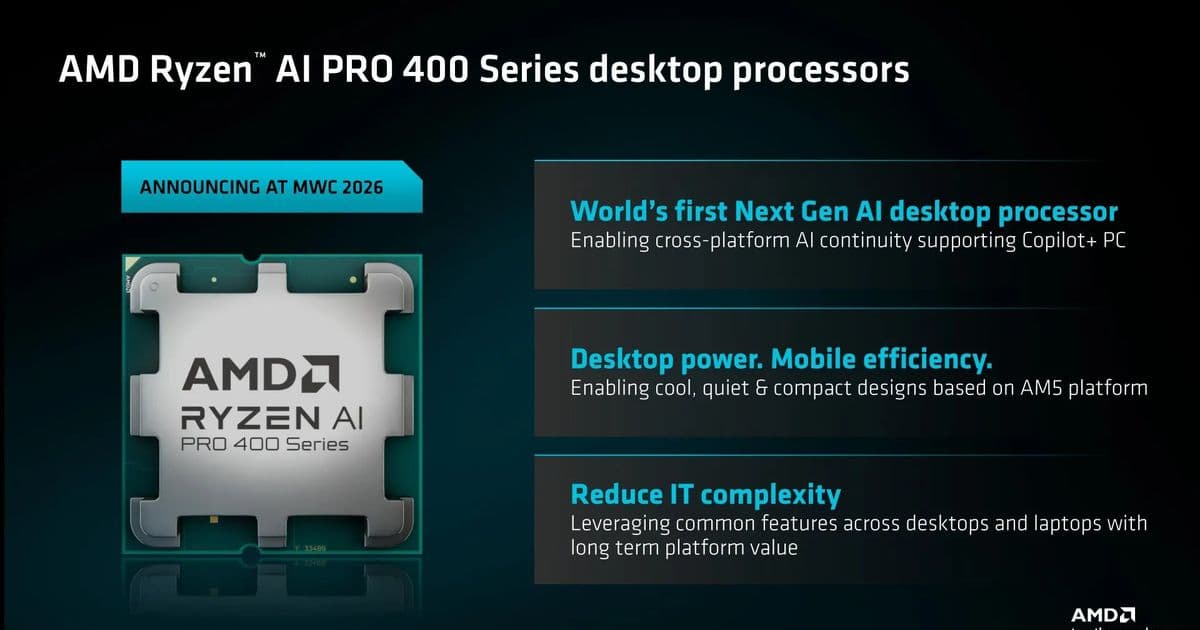
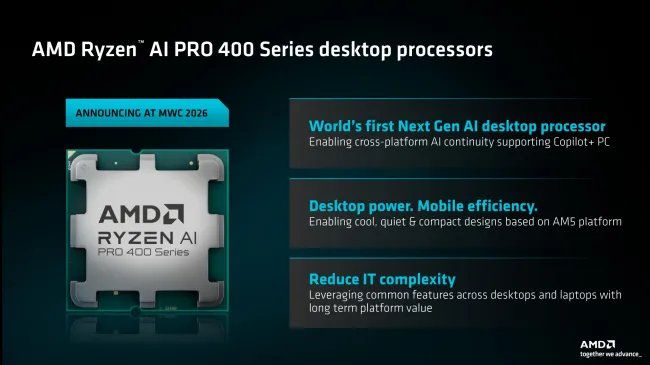
AMD unveiled Ryzen AI PRO 400 Series desktop processors at MWC 2026, featuring Zen 5 cores, RDNA 3.5 graphics, and 50 TOPS XDNA 2 NPUs for local AI acceleration.
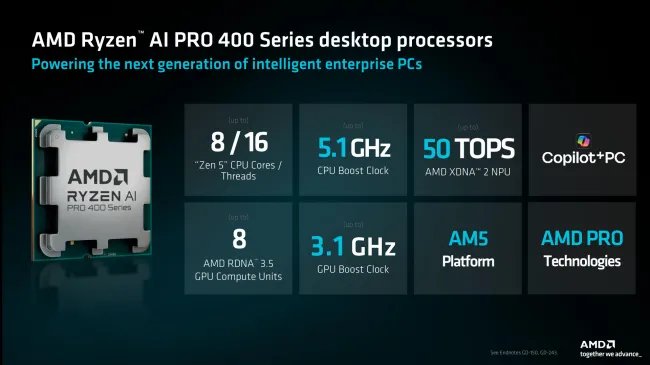
AMD has unveiled its Ryzen AI PRO 400 Series desktop processors at Mobile World Congress 2026, marking a significant expansion of its AI-capable CPU lineup for commercial and enterprise markets. The new processors combine AMD's latest Zen 5 architecture with integrated RDNA 3.5 graphics and a powerful XDNA 2 Neural Processing Unit (NPU) capable of delivering up to 50 TOPS (Trillions of Operations Per Second) for local AI inference workloads.
Product Lineup and Specifications
The Ryzen AI PRO 400 Series desktop lineup includes five SKUs designed to balance performance, power efficiency, and AI capabilities:
| Model | Cores/Threads | TDP | NPU | Graphics | Target Market |
|---|---|---|---|---|---|
| Ryzen AI 7 PRO 450G | 8C/16T | 65W | 50 TOPS | 8 CUs | High-end workstations |
| Ryzen AI 5 PRO 440G | 6C/12T | 65W | 50 TOPS | 7 CUs | Mainstream workstations |
| Ryzen AI 5 PRO 440GE | 6C/12T | 35W | 50 TOPS | 7 CUs | Low-power systems |
| Ryzen AI 5 PRO 435G | 6C/12T | 65W | 50 TOPS | 5 CUs | Budget workstations |
| Ryzen AI 5 PRO 435GE | 6C/12T | 35W | 50 TOPS | 5 CUs | Ultra-low power |
All models feature the same 50 TOPS XDNA 2 NPU, ensuring consistent AI acceleration capabilities across the product stack. The G suffix denotes standard 65W parts, while GE variants offer 35W power envelopes for thermally constrained environments.
Architecture and AI Capabilities
The Ryzen AI PRO 400 Series builds upon AMD's proven Zen 5 microarchitecture, delivering the performance improvements and efficiency gains expected from the latest generation. What sets these processors apart is the integration of the XDNA 2 NPU, which represents a significant leap in local AI processing capabilities.
The 50 TOPS NPU rating positions these CPUs to handle demanding AI workloads without relying on cloud processing. This includes:
- Local inference for large language models - Running smaller LLMs directly on the desktop for privacy-sensitive applications
- Real-time video analysis - AI-powered video conferencing features, background blur, and content creation tools
- Automated workflows - AI-assisted productivity applications that can process data locally
- Security enhancements - On-device threat detection and biometric authentication
Commercial Focus and Market Positioning
AMD is positioning the Ryzen AI PRO 400 Series specifically for commercial and enterprise environments where security, manageability, and long-term support are critical. The PRO branding indicates these processors include features tailored for business use:
- Enhanced security features - Hardware-based security capabilities for enterprise environments
- Commercial BIOS support - Extended firmware support and stability for business deployments
- ISV certification - Optimized for professional applications and workflows
- Manageability features - Remote management capabilities for IT administrators
The timing of this announcement aligns with the growing demand for AI-capable hardware in enterprise settings, where data privacy concerns and latency requirements make local processing increasingly attractive.
Linux Compatibility and Software Ecosystem
For Linux users and the open-source community, the introduction of Ryzen AI PRO 400 Series presents both opportunities and challenges. AMD has made significant strides in Linux support for its hardware, but the AI acceleration story remains incomplete.
Currently, the XDNA 2 NPU support in Linux is limited compared to Windows, where AMD has partnered with Microsoft to optimize AI workloads through Windows Studio Effects and other features. The Linux ecosystem for AI acceleration on AMD hardware is still developing, with key questions remaining:
- Driver support - Will AMD provide open-source drivers for the XDNA 2 NPU, or will it remain proprietary?
- Framework integration - How well will popular AI frameworks like TensorFlow, PyTorch, and ONNX Runtime support AMD's NPU?
- Developer tools - What tools and libraries will AMD provide for Linux developers to leverage the NPU?
- Performance optimization - Can AMD deliver competitive AI performance on Linux compared to Windows?
The success of Ryzen AI PRO 400 Series in Linux environments will largely depend on AMD's commitment to open-source software development and the broader community's adoption of AMD's AI acceleration technologies.
Availability and Market Impact
AMD expects Ryzen AI PRO 400 Series commercial designs to appear in Q2 2026, targeting system integrators and OEMs building workstations and small form factor systems for enterprise customers. The processors will likely be available through traditional commercial channels rather than direct consumer retail.
This launch represents AMD's most comprehensive push into AI-capable desktop processors, potentially challenging Intel's Core Ultra series and Apple's M-series chips in the enterprise AI acceleration market. The combination of Zen 5 performance, RDNA 3.5 graphics, and 50 TOPS NPU creates a compelling package for businesses looking to future-proof their hardware investments.
Looking Ahead
The Ryzen AI PRO 400 Series announcement signals AMD's commitment to making AI acceleration a standard feature across its product lineup. As AI workloads become increasingly common in both consumer and enterprise applications, having capable local processing becomes essential.
For Linux users, the real test will be how quickly the software ecosystem adapts to leverage these new capabilities. AMD's track record with open-source graphics drivers suggests potential for strong Linux support, but the specialized nature of AI acceleration hardware means success will require coordinated effort between AMD, software developers, and the broader Linux community.
The coming months will reveal whether AMD can deliver on the promise of the Ryzen AI PRO 400 Series, particularly in Linux environments where the company has historically enjoyed strong support but faces stiff competition in the AI acceleration space.
Phoronix will provide detailed Linux benchmarks and analysis once hardware becomes available for testing in Q2 2026.
Comments
Please log in or register to join the discussion