
FriendlyElec refreshes its NanoPi M6 with the RK3588S SoC, offering 8-core performance, 6 TOPS AI acceleration, and 8K HDMI output for $172.
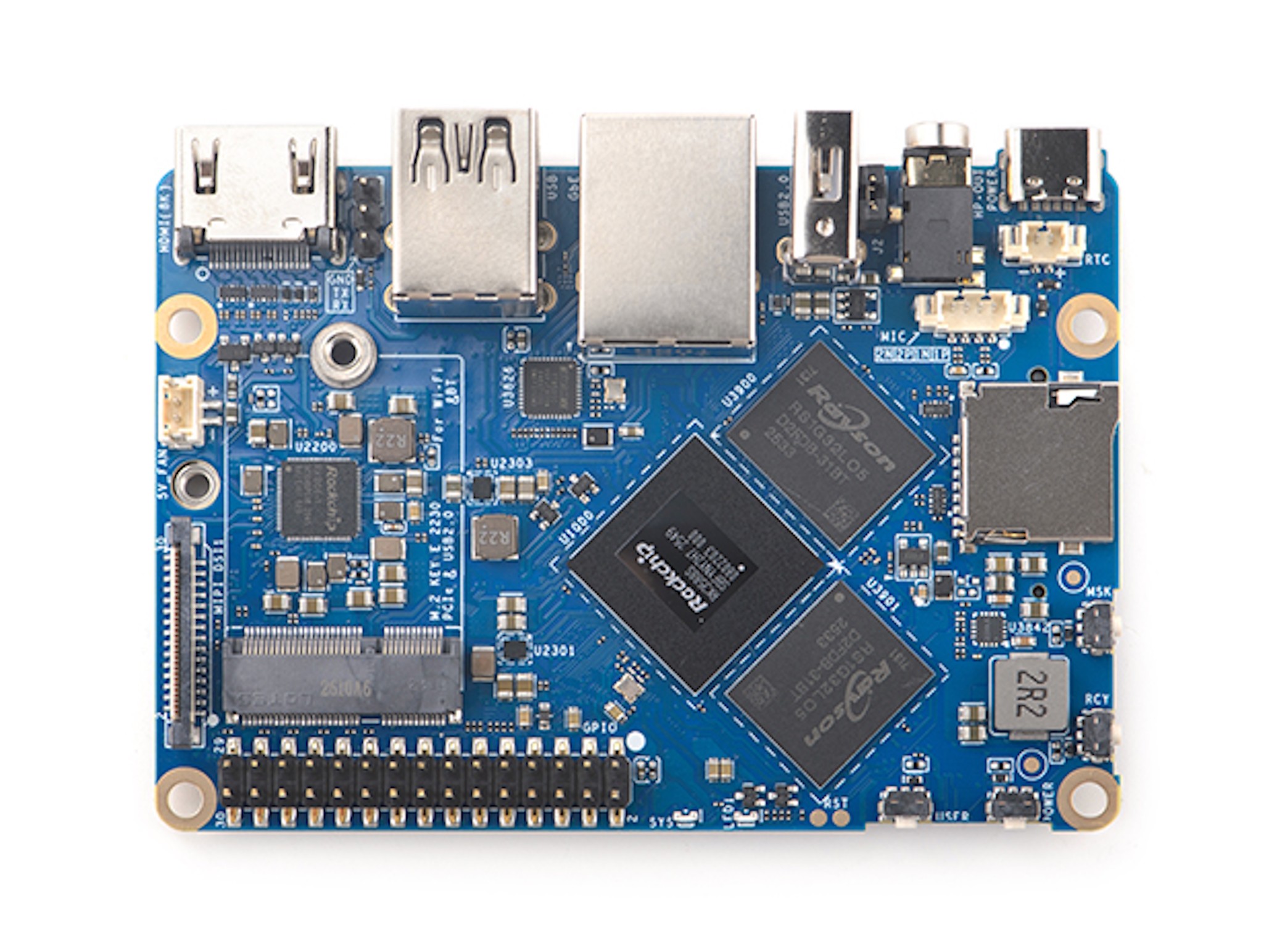
FriendlyElec has quietly released the NanoPi M6V2, a refreshed single-board computer that positions itself as a direct competitor to the Raspberry Pi at a price point of $172. The V2 designation indicates this is a revision of the earlier NanoPi M6, but the changes are meaningful enough to warrant attention from anyone shopping for a compact computing platform.
Rockchip RK3588S: The Heart of the Matter
At the core of the NanoPi M6V2 sits Rockchip's RK3588S system-on-chip, an octa-core processor pairing four Cortex-A76 performance cores with four Cortex-A55 efficiency cores. The SoC is paired with 8 GB of LPDDR5 RAM, which provides enough headroom for multitasking, containerized workloads, and moderate development environments.
The headline spec is the 6 TOPS (trillion operations per second) neural processing capability built into the RK3588S. That throughput is sufficient for real-time object detection, image classification, and other edge AI inference tasks, though it falls short of what you would need to run larger language models locally. For makers and developers working on computer vision projects, the NPU integration means you can offload inference from the CPU cores entirely, keeping the main cores free for application logic.
Connectivity and Expansion
The board delivers a surprising number of ports and connectors for its 62 x 90 mm footprint:
- Video output: HDMI 2.1 supporting resolutions up to 7680 x 4320 at 60 Hz
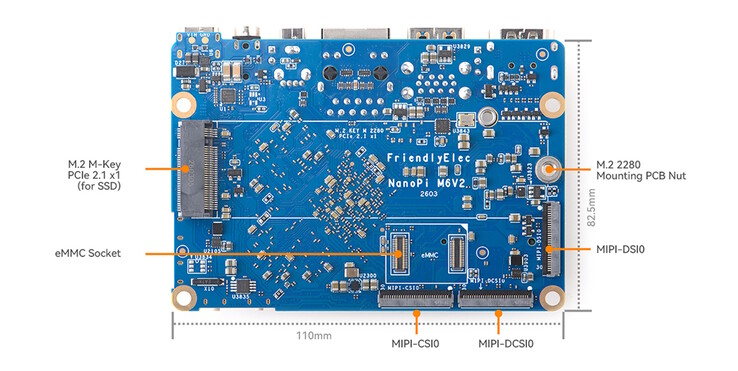
- Storage: M.2 2280 slot via PCIe 2.1, eMMC module support, and a microSD card slot
- Camera interfaces: MIPI-CSI connector, plus USB 3.0 and USB 2.0 ports
- Display interfaces: Two MIPI-DSI ports for panel connections
- Networking: Gigabit Ethernet (built-in), Wi-Fi and Bluetooth via optional M.2 2230 module
- GPIO: 30-pin header for sensors and actuators, plus an integrated IR receiver
The dual M.2 slot arrangement is particularly notable. The M.2 2280 slot accepts standard NVMe SSDs over PCIe 2.1, giving you storage speeds that dwarf what any microSD card can deliver. The M.2 2230 slot, while smaller, opens the door to wireless connectivity options without occupying a full-size slot. This two-slot design is something the Raspberry Pi 5 simply cannot match without additional carrier boards.
How It Stacks Up Against the Raspberry Pi 5
The comparison to the Raspberry Pi 5 is inevitable, so let us address it directly. The Raspberry Pi 5 starts at around $60 for the 2 GB variant and climbs to roughly $80 for the 8 GB model. At $172, the NanoPi M6V2 commands a significant premium. But that price buys you several things the Pi 5 does not offer out of the box:
- Built-in NVMe support: The Pi 5 requires an HAT or adapter board for M.2 storage. The M6V2 has it integrated.
- 8K HDMI output: The Pi 5 maxes out at 4Kp60. The M6V2 pushes to 8K.
- Higher NPU performance: The RK3588S delivers 6 TOPS versus the Pi 5's roughly 1-2 TOPS (when using the AI HAT).
- More RAM: 8 GB LPDDR5 standard, whereas the Pi 5 tops out at 8 GB as well, but at a comparable price point for that configuration.
The trade-off is software maturity. The Raspberry Pi ecosystem benefits from years of community development, official OS images, and broad software support. FriendlyElec provides official images based on Debian and Ubuntu, but the community around NanoPi boards is considerably smaller. If you need a board where every peripheral "just works" with minimal configuration, the Raspberry Pi still has the edge. If you need raw performance and expansion options, the M6V2 makes a strong case.
Who Should Buy This
The NanoPi M6V2 targets a specific buyer: someone who needs more expansion capability than a Raspberry Pi provides, and who is comfortable configuring hardware at the Linux command line. The combination of PCIe NVMe storage, 8K video output, and a 6 TOPS NPU makes it well-suited for:
- Edge AI deployments where real-time inference matters more than community support
- Media centers or digital signage that benefit from 8K output resolution
- Development boards for testing RK3588S-based products before committing to custom hardware
- NAS or storage projects where the integrated M.2 slot eliminates the need for adapter boards
The $172 price tag is steep compared to a Raspberry Pi, but it is competitive when you factor in what would be required to add similar capabilities to a Pi via HATs and adapters. A Raspberry Pi 5 with an AI HAT and an NVMe HAT quickly approaches the same price range while adding physical bulk and complexity.
Availability and Accessories
The NanoPi M6V2 is available directly from FriendlyElec for $172. A metal case designed specifically for the board can be added for an additional $15, bringing the total to $187. The case includes appropriate cutouts for all ports and connectors, and the metal construction helps with passive heat dissipation under sustained workloads.
For developers who want to prototype with the RK3588S platform before committing to a custom PCB, the M6V2 offers a practical starting point. The combination of established SoC, reasonable pricing, and solid expansion options makes it one of the more compelling Raspberry Pi alternatives currently available.
Jacob Fisher is a translator and contributor at Notebookcheck, covering single-board computers and compact hardware platforms.
Comments
Please log in or register to join the discussion