Red, a Rebol-inspired language, combines high-level scripting with low-level systems programming through native compilation and domain-specific dialects. Still in alpha, it promises sub-1MB dependencies-free executables and cross-platform support, targeting concurrency and multi-core CPUs. This deep dive explores how Red's unique approach simplifies complexity while empowering developers.
In an era dominated by bloated dependencies and fragmented toolchains, the Red programming language emerges as a bold counterproposal. Born from Rebol's philosophy but engineered for modern demands, Red compiles directly to native code, enabling everything from embedded systems programming to rich GUI applications—all within a single, cohesive ecosystem. Currently in alpha (32-bit only), Red's ambition is clear: to unify development layers without sacrificing performance or simplicity.
Why Red Stands Apart
Red isn't just another language—it's a meta-language with built-in dialects that redefine flexibility:
- Red/System: A C-level DSL for hardware interaction.
- Parse: PEG-based parsing for data transformation.
- VID/Draw: Declarative UIs and vector graphics.
- Rich-text: Dynamic document formatting.
This dialect-oriented design allows developers to create custom syntax for specific tasks, reducing boilerplate. As a homoiconic language, Red treats code as data, enabling powerful macro systems and runtime metaprogramming. Its functional, imperative, and reactive paradigms coexist seamlessly, while a prototype-based object model offers OOP flexibility.
From Script to Binary: The Toolchain Magic
Red's compiler toolchain is a marvel of efficiency. Packed into a single ~1MB executable (redc), it requires no installation:
# Compile a 'Hello World' with dependencies
redc -c hello.red

# Generate a standalone executable
redc -r hello.red

# Cross-compile for Windows from Linux
redc -t Windows hello.red
Cross-compilation spans Windows, macOS, Linux (even ARM/RPi), and Android, producing tiny binaries. The REPL environment accelerates testing—run a GitHub API demo directly:
{{IMAGE:3}}
view [
    text-list data collect [
        foreach event load https://api.github.com/repos/red/red/commits [
            keep event/commit/message
        ]
    ]
]
The Road to Self-Hosting
Despite its alpha status, Red’s trajectory is compelling. Key pending features include JIT compilation and parallel collections, but its roadmap promises self-hosting by v1.0. Contributors can build from source using Rebol, with strict CI testing ensuring stability. Community involvement is encouraged—join the chat to shape its future 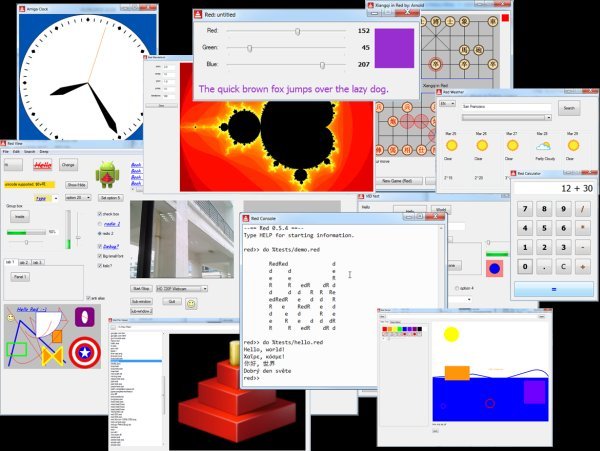 .
.
Why Developers Should Care
Red challenges the status quo by eliminating dependency hell and toolchain fragmentation. Its sub-1MB footprint makes it ideal for IoT, embedded systems, and utilities where minimalism is critical. For scripting, the REPL and GUI dialects offer rapid prototyping. While anti-virus false positives remain a hiccup (due to compact binaries), Red’s BSD/BSL licensing ensures openness.
As multi-core architectures dominate, Red’s planned concurrency support could position it as a versatile ally—blurring lines between high-level agility and low-level control without compromising on either frontier.
Source: GitHub Repository
Comments
Please log in or register to join the discussion