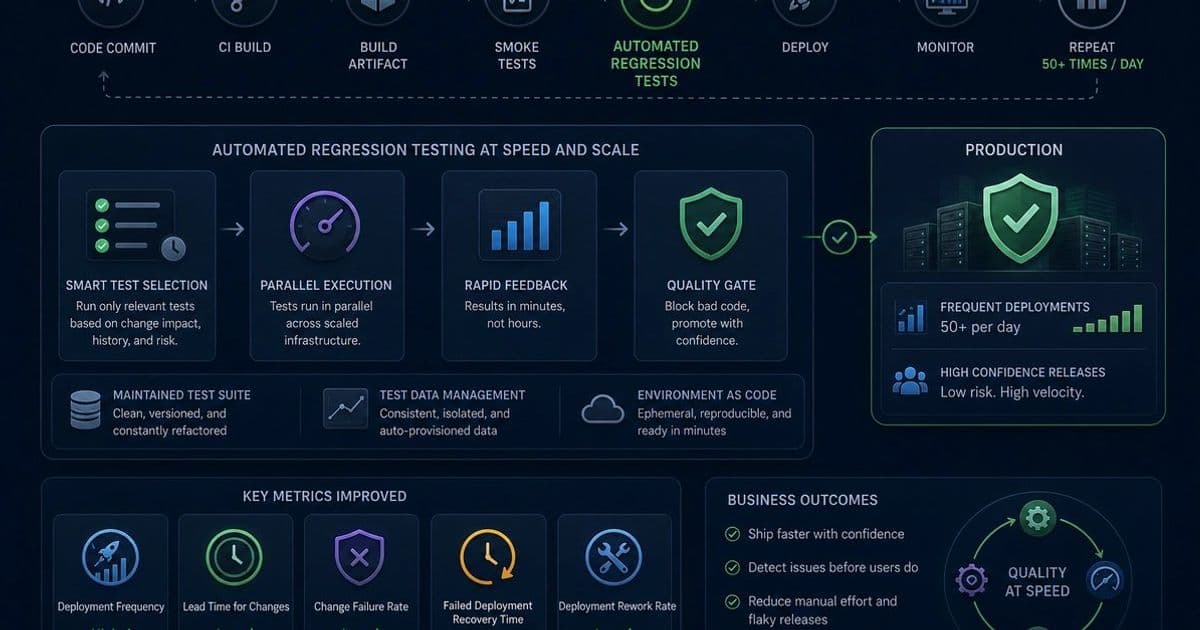
As deployment frequencies increase to 50+ times daily, traditional regression testing approaches break down. This article explores how modern engineering teams must rethink their testing strategies to maintain system reliability without compromising velocity.
Regression Testing in High-Frequency Deployment Environments
The software delivery landscape has undergone a fundamental transformation. While teams once operated with weekly or even monthly release cycles, many now deploy multiple times daily. This shift creates profound implications for regression testing strategies that were designed for a different era of software development.
The Problem: When Traditional Regression Testing Breaks
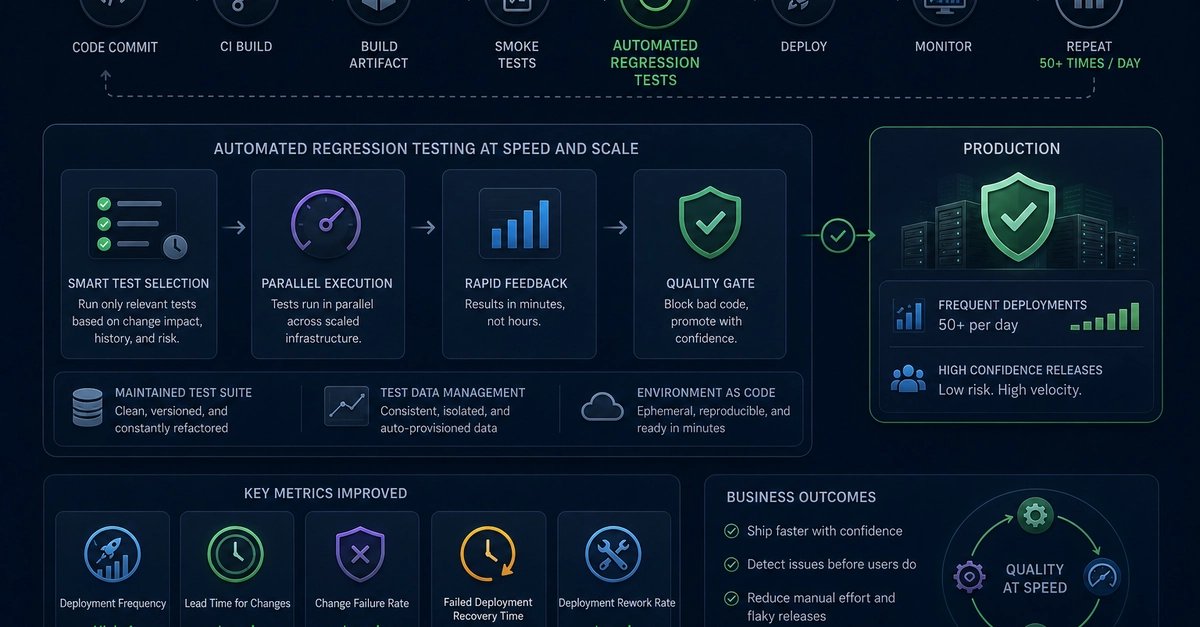
A few years ago, most engineering teams could afford to run comprehensive regression test suites before release day and manually verify edge cases afterward. This approach falls apart completely when deployments happen 50+ times every day. The challenge is no longer just finding bugs before production. The real challenge is maintaining confidence while APIs, services, infrastructure, and deployments evolve continuously throughout the day.
The Pipeline Reality Check
One common assumption is that adding more automated regression testing automatically improves release safety. In practice, the opposite often happens first. Teams start experiencing:
- Slower pipelines that bottleneck development velocity
- Flaky integration tests that create noise and false positives
- Rerun fatigue where engineers spend excessive time chasing intermittent failures
- Inconsistent deployment feedback that makes it difficult to identify actual issues
- Growing test maintenance overhead that consumes engineering resources
A regression suite that worked perfectly at 5 deployments per day may become extremely noisy at 50 deployments per day. The issue is not necessarily poor test quality. The environment itself becomes harder to validate consistently as the system evolves rapidly.
Traditional Testing Assumptions vs. Modern Reality
Most traditional regression testing strategies were designed around:
- Stable staging environments
- Predictable release timing
- Slower deployment frequency
- Tightly coupled applications
Modern distributed systems rarely behave that way anymore. Today's systems involve:
- Independently deployed services with separate lifecycles
- Shared APIs that evolve across multiple teams
- Async workflows with complex dependency chains
- Event-driven communication patterns
- Cloud infrastructure that changes constantly
Under these conditions, regression failures often emerge from service interactions instead of isolated application logic. That changes how automated testing needs to work.
A Case Study: The "Passing" Deployment That Wasn't Safe
Consider a real-world example from a backend team that had a deployment pipeline where all regression tests were passing consistently. Production still broke. The root cause was surprisingly small: a response field that had technically remained optional suddenly started returning null values under certain production conditions.
The contract tests passed. The schema validation passed. The deployment pipeline passed. But one downstream service interpreted null differently and failed silently until production traffic increased later that day. This is the kind of regression modern systems create more frequently—not obvious failures, but behavioral inconsistencies that emerge only under specific production conditions.
Why Mocked APIs Become Less Reliable at Scale
A major issue in high-frequency deployment environments is that mocked testing environments drift away from production behavior very quickly. Mocked APIs often fail to reflect:
- Real payload variability from diverse client applications
- Latency patterns that emerge under load
- Retry behavior that occurs when dependencies fail
- Dependency timing that varies based on system state
- Production traffic conditions that differ from test scenarios
As systems evolve rapidly, regression suites built entirely around static mocked assumptions start missing operational edge cases. This is why many teams are moving toward more production-aware regression testing workflows.
Solution Approach: Modern Regression Testing Strategies
The Shift Toward Behavioral Validation
One of the biggest changes in modern automated regression testing is the move away from purely static validation. Instead of asking: "Did the endpoint return the expected response?" teams increasingly ask:
- Did the workflow behave consistently?
- Did downstream services still interpret responses correctly?
- Did retry behavior change?
- Did API behavior shift under realistic conditions?
That difference matters a lot in distributed systems. Behavioral validation captures the emergent properties that don't appear in isolated component testing.
API Regression Testing as a First-Class Citizen
In systems deploying dozens of times daily, APIs become one of the biggest sources of regression risk. Even small API changes can affect:
- Frontend clients expecting specific response formats
- Internal services consuming shared APIs
- Authentication and authorization systems
- Event pipelines processing API responses
- Third-party integrations with specific expectations
This is why API regression testing is becoming more central to modern CI/CD workflows. Some teams now generate regression tests directly from real application traffic instead of manually maintaining large sets of static test cases.
Platforms like Keploy are part of this broader shift toward validating real application behavior and production-like API interactions rather than relying only on synthetic test scenarios. These tools capture actual production requests and responses, then use them to create comprehensive regression tests that reflect real-world usage patterns.
Production-Aware Testing Techniques
Leading engineering organizations are implementing several production-aware testing techniques:
- Canary testing: Gradually rolling out changes to small subsets of production traffic while monitoring system behavior
- Shadow testing: Routing production traffic to both old and new versions simultaneously without affecting end users
- Feature flagging: Using feature flags to safely test changes in production with the ability to quickly disable problematic deployments
- Chaos engineering: Proactively injecting failures to test system resilience and identify weaknesses
These approaches allow teams to validate system behavior under realistic conditions without the limitations of mocked environments.
Trade-offs: Balancing Speed and Reliability
Test Optimization vs. Test Coverage
One of the most significant trade-offs in high-frequency deployment environments is between test optimization and test coverage. Comprehensive test suites provide thorough validation but can slow down deployment pipelines. Teams must strategically prioritize tests based on:
- Risk assessment: Which components, if changed, are most likely to cause failures?
- Change impact: What specific parts of the system are actually changing in this deployment?
- Historical data: Which tests have most effectively caught regressions in the past?
Centralized vs. Decentralized Testing
Another important consideration is whether to maintain centralized test suites or encourage decentralized testing practices. Centralized testing provides consistency but can create bottlenecks. Decentralized testing allows teams to move faster but may result in inconsistent validation approaches.
The most effective teams often implement a hybrid approach, establishing core testing standards while allowing teams flexibility to implement specialized testing for their specific components.
Mocking vs. Real Environment Testing
While mocked environments have been the traditional approach for testing, they become increasingly problematic at scale. The trade-off is between:
- Mocked environments: Faster test execution, easier setup, but risk of drift from production behavior
- Real environment testing: More accurate validation, but slower execution and more complex setup
Many successful teams are finding middle ground through techniques like:
- Using production data in isolated environments
- Implementing synthetic monitoring that mimics production traffic patterns
- Leveraging service virtualization that captures realistic behavior
The Signal Quality Imperative
One pattern shows up repeatedly in fast-moving engineering organizations: The most effective teams are not necessarily the teams with the biggest regression suites. They are the teams with:
- Reliable validation signals that distinguish real issues from noise
- Fast feedback loops that provide quick results to developers
- Stable CI pipelines that minimize flakiness and delays
- Production-aware testing that validates real-world behavior
- High-confidence deployment workflows that enable safe experimentation
At high deployment frequency, signal quality matters more than raw test volume. A smaller set of well-designed, reliable tests provides more value than a larger set of flaky, slow tests.
Implementing Modern Regression Testing
For teams looking to improve their regression testing approach in high-frequency deployment environments, consider these implementation strategies:
1. Start with API Contract Testing
Implement comprehensive API contract testing to ensure that service interfaces remain consistent. Tools like Prism and Schemathesis can help validate that APIs behave according to their specifications.
2. Adopt Production Data for Testing
Where possible, use production data (anonymized and scrubbed of sensitive information) in your testing environments. This helps ensure that tests reflect real-world conditions rather than artificial scenarios.
3. Implement Test Prioritization
Not all tests are equally valuable. Implement a test prioritization strategy that:
- Runs critical tests first to provide quick feedback
- Runs longer tests in parallel
- Skips tests unlikely to be affected by the current changes
4. Monitor Test Effectiveness
Track which tests actually catch regressions versus those that create noise. Regularly review and prune tests that provide little value while maintaining those that consistently prevent production issues.
5. Foster a Culture of Testing Ownership
Encourage developers to take ownership of the tests they write. This includes ensuring tests are reliable, maintainable, and provide meaningful validation rather than just checking boxes.
Conclusion: Rethinking Regression for the Modern Era
Regression testing in systems deploying 50+ times a day looks very different from traditional release validation. The problem is no longer simply: "How do we test more?" The better question is: "How do we continuously validate real system behavior without slowing delivery down?"
This shift is changing how modern engineering teams think about regression testing, automated testing, and CI/CD reliability altogether. By focusing on behavioral validation, production-aware testing, and signal quality rather than raw test volume, teams can maintain system reliability even as deployment frequencies continue to increase.
The future of regression testing lies in embracing the complexity of modern distributed systems while finding practical ways to validate that changes don't introduce unexpected failures. This requires both technical innovation and a fundamental rethinking of how we approach validation in high-velocity environments.

Comments
Please log in or register to join the discussion