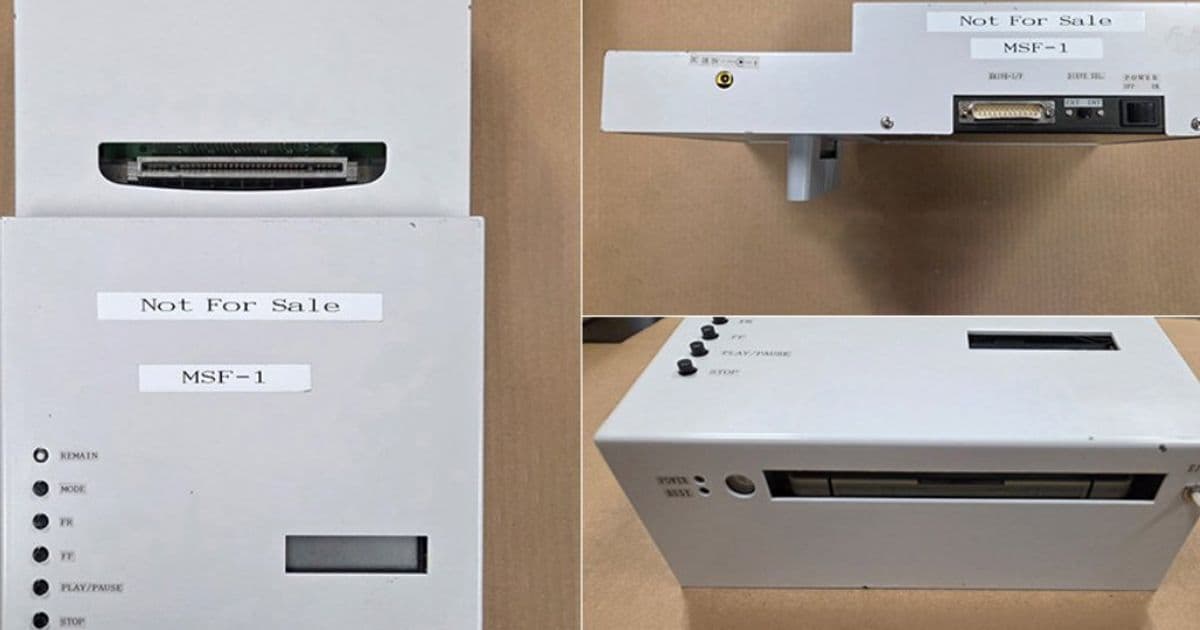
The National Video Game Museum acquires the rare Sony MSF-1, the earliest Nintendo PlayStation prototype, revealing the fascinating origins of Sony's gaming empire.
The gaming world's most coveted piece of hardware history has found a new home. The National Video Game Museum (NVM) in Frisco, Texas, has acquired the Sony MSF-1, the earliest known Nintendo PlayStation prototype, marking a significant moment for retro gaming enthusiasts and historians alike.
The MSF-1 represents the very first steps Sony took toward creating a CD-ROM add-on for the Super Nintendo Entertainment System (SNES). Unlike later prototypes that have surfaced at auction, this chunky white development unit was designed purely for functional testing and development purposes. It's the only known unit in existence, making it an irreplaceable artifact of gaming history.
What makes this acquisition particularly fascinating is the story behind the hardware. The MSF-1 was originally in the hands of Sony's ImageSoft team in Santa Monica, California. The prototype plugs directly into an SNES cartridge slot and features a pass-through port on top, allowing developers to use regular SNES cartridges while simultaneously testing CD-based games. This design showcases the ambitious vision Sony had for expanding the SNES's capabilities through optical media.
The timing of this acquisition feels almost poetic. The MSF-1's emergence coincides with the 26th anniversary of the Sony PlayStation 2's release, creating a full-circle moment that highlights just how far Sony has come since its partnership with Nintendo fell apart. The story behind this split is one of the most dramatic in gaming history.
In June 1991, Sony announced a partnership with Nintendo to create a CD-ROM add-on for the SNES at the Consumer Electronics Show. However, the very next morning, Nintendo shocked the industry by announcing it was partnering with Philips instead for the SNES CD-ROM project. This betrayal left Sony President Norio Ohga considering legal action against Nintendo.
Rather than pursue litigation, Sony made the decision that would reshape the gaming industry forever. Sony engineer Ken Kutaragi convinced executives to build their own console instead. This pivot led to the development of the original Sony PlayStation, released on December 3, 1994. The console's focus on 3D graphics over 2D gameplay proved revolutionary, ultimately outselling Nintendo's Nintendo 64 and establishing Sony as a dominant force in the gaming market.
The MSF-1's acquisition by the NVM gives the public its first opportunity to see this pivotal piece of gaming history up close. While a later-iteration Nintendo PlayStation prototype sold at Heritage Auctions in 2020 for $360,000, the MSF-1 represents an even earlier stage of development. Reports suggest that around 200 units of later prototypes were destroyed after the Sony-Nintendo fallout, making surviving examples extremely rare.
For retro gaming enthusiasts, the MSF-1 answers the question of "what if" that has lingered for decades. What if the Sony-Nintendo partnership had succeeded? Would Sony have become the gaming powerhouse it is today, or would the industry look completely different? The MSF-1 stands as a physical reminder of that pivotal moment when one decision changed the course of gaming history.
The National Video Game Museum's acquisition ensures that this crucial piece of gaming heritage will be preserved and displayed for future generations. It's not just a rare prototype; it's the artifact that represents the birth of Sony's gaming empire and the moment when the company decided to become Nintendo's fiercest rival instead of its partner.
For those interested in experiencing a piece of this history themselves, the PlayStation Classic is available for purchase, though it represents a much later era of Sony's console development. The MSF-1, however, remains a one-of-a-kind window into the gaming industry's most fascinating "what if" scenario.
Comments
Please log in or register to join the discussion