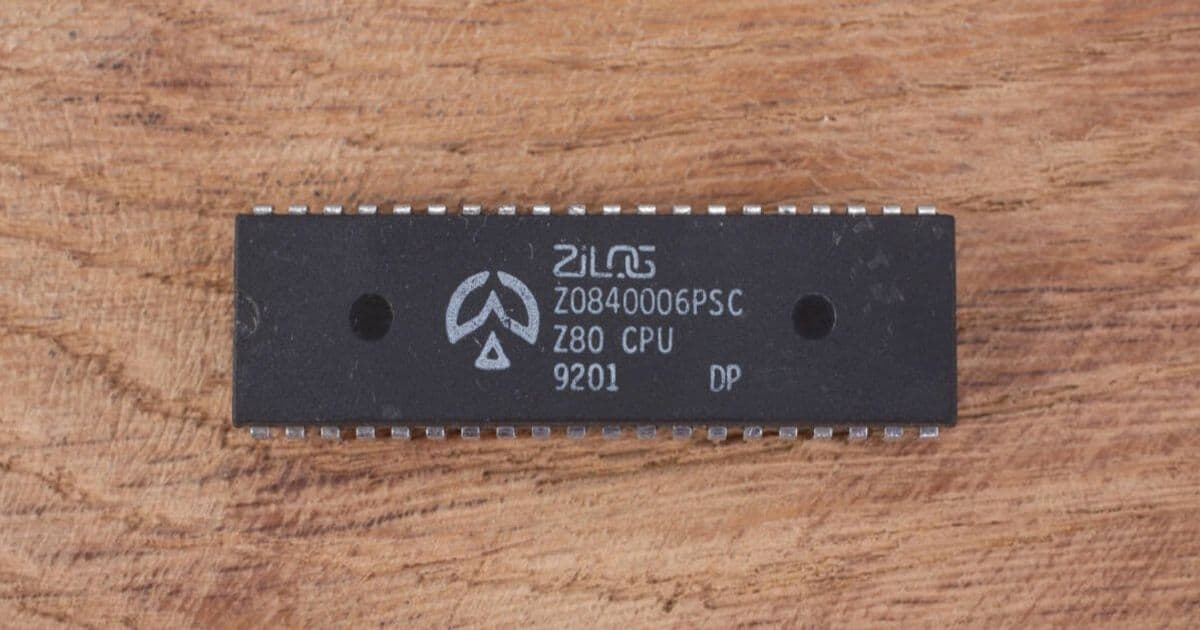
A deep dive into hacking the 1999 CIDCO MailStation, exploring its Z80 architecture, update mechanisms, and potential for modern retro computing projects.
The CIDCO MailStation represents a fascinating footnote in computing history - a late-1990s internet appliance that pushed the boundaries of what was possible with the venerable Zilog Z80 processor. Launched in 1999 when 16-bit computing was already mainstream and 32-bit systems were on the horizon, this device embodied the era's optimism about email accessibility and the "information appliance" concept.
The Last Z80 Computer?
When Zilog discontinued the standalone Z80 processor a couple of years ago, it marked the end of an era that began in 1976. The MailStation, also sold as Earthlink's Mivo 100, stands as a strong contender for the title of "last Z80 computer." Its specifications were respectable for an eight-bit machine: a 12 MHz Z80 processor, 128 KB of RAM, and just over a megabyte of flash storage powering a 320 x 128 monochrome LCD display.
The device's dial-up modem and bidirectional parallel printer port were its only communication interfaces, making it a truly self-contained unit. Sold under the tagline "Email made easy" (later revised to "Email without the PC"), it represented the optimistic vision of internet appliances that would simplify digital communication for non-technical users.
Three Paths to Hacking
Michal Pleban's FOSDEM 2026 presentation revealed three distinct methods for hacking the MailStation, each with its own challenges and opportunities:
Method 1: The Yahoo! News Vector
The most intriguing approach exploits the device's news delivery system. Rather than using markup formats, the MailStation receives daily news as pre-rendered bitmaps - essentially executable attachments sent via email. This innovative update mechanism, patented by CIDCO, involved emailing users a new "app" every day containing formatted news stories.
The encryption used for these updates employed the SDES algorithm with a ten-bit key. While this would be trivially breakable through brute force (generating all 1,024 possible keys), the real obstacle is that the update service was shut down in 2011, requiring US-based phone activation that's no longer available.
Method 2: Firmware Updates via Laplink
Analysis of the firmware reveals text strings related to software updates, confirming that the device supports firmware modification. The documentation, surprisingly concise at about ten pages, describes using a Centronics Laplink cable for updates. However, this presents a significant challenge - very few modern computers have Centronics ports, and USB adapters won't work with this legacy interface.
Method 3: Direct ROM Manipulation
The diagnostics menu, accessible by pressing Ctrl+Shift+T during startup, provides the most direct hacking route. Pressing Shift+5 reveals a hexadecimal viewer of the ROM code, which can be converted to a hex editor for manual firmware modification. The ROM contains a 64-byte loader that accepts new ROM code over the parallel port.
This method's major drawback is the complete lack of validation or error checking. A single mistake during the upload process bricks the device with no recovery procedure available.
The Hacker Community Responds
Despite these challenges, the MailStation has attracted a dedicated hacking community. Pleban himself offers resources including an emulator for testing code, a host application for transferring software, and comprehensive hardware documentation. The community has already achieved impressive feats:
- Josh Stein has developed a Wi-Fi interface for the device
- "Dr Francintosh" is working on a Raspberry Pi brain transplant
- Various developers have created tools for using it as a Z80 development platform
The device's relative obscurity (hundreds of thousands were sold, but it's largely forgotten today) combined with its hackable nature makes it an attractive platform for retro computing enthusiasts and Z80 programming practice.
Why It Matters
The MailStation represents more than just a curiosity - it's a time capsule of late-1990s computing philosophy. At a time when the industry was racing toward 32-bit and 64-bit architectures, someone decided to build a new product around an eight-bit processor. This decision, while seemingly anachronistic, resulted in a device that was simple, reliable, and surprisingly capable.
For modern hackers, the MailStation offers a unique combination of constraints and capabilities. Its limited resources force efficient programming, while its relatively modern features (email, news delivery, firmware updates) provide interesting challenges for software development. The device's obscurity means there's plenty of room for innovation without stepping on established community toes.
Getting Started
For those interested in exploring the MailStation, units can still be found on eBay for under $26, with untested units available for less than $12. The low cost and Pleban's available resources make it an accessible entry point into Z80 programming and retro hardware hacking.
The device's story also serves as a reminder of how quickly technology evolves and how devices that seemed cutting-edge can become obscure relics. Yet through the efforts of enthusiasts like Pleban and the broader hacking community, these devices find new life and purpose beyond their original design intentions.
The CIDCO MailStation may have been designed for simple email communication, but its true legacy may be as a platform for learning, experimentation, and the preservation of computing history. In an era of increasingly closed and complex devices, there's something refreshing about a machine that's both simple enough to understand completely and capable enough to be genuinely useful.
Comments
Please log in or register to join the discussion