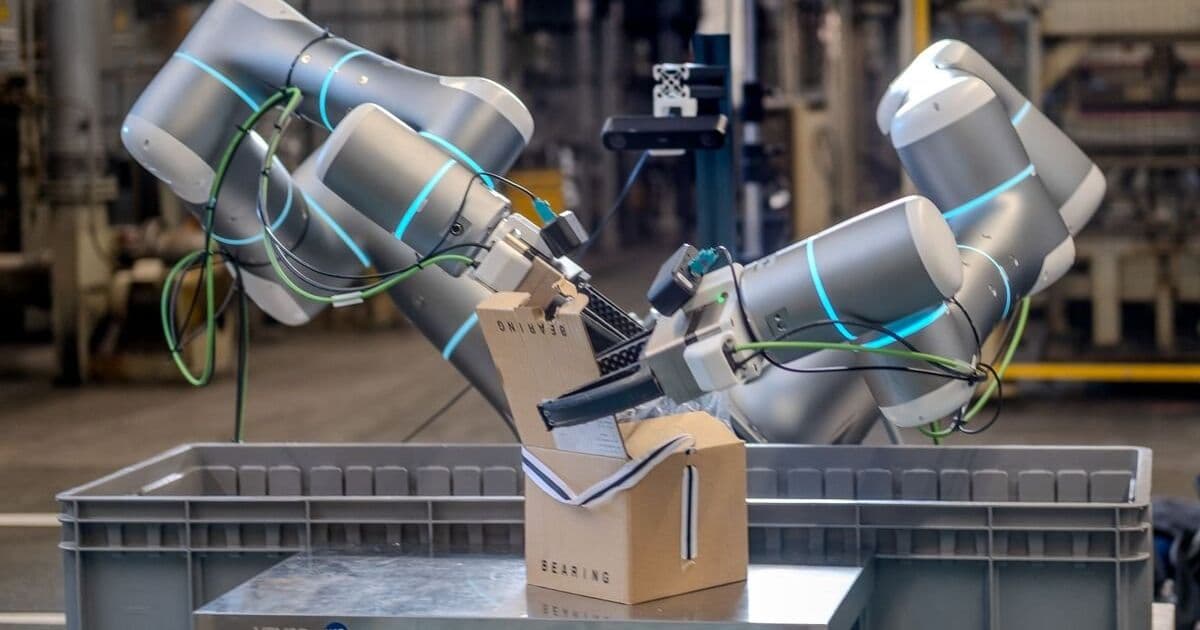
Rhoda AI's massive funding round for industrial robot AI training on public videos highlights growing investor confidence in robotics automation and the potential for AI to transform manufacturing.
Rhoda AI, a startup developing artificial intelligence models for industrial robots trained on public internet videos, has raised $450 million in a funding round led by Premji Invest at a $1.7 billion valuation, according to Bloomberg. The company's approach of using widely available internet video to train industrial robots for various conditions represents a novel method in the robotics space that could democratize access to sophisticated automation technologies.
The funding round comes amid a broader surge in AI and robotics investment, with several high-profile companies securing massive valuations. Just days earlier, Yann LeCun's Advanced Machine Intelligence Labs raised over $1 billion in Europe's largest-ever seed funding round, while Nexthop AI secured $500 million at a $4.2 billion valuation for specialized networking equipment for hyperscalers.
Rhoda AI's business model addresses a critical challenge in industrial robotics: the need for diverse, real-world training data to handle unpredictable manufacturing environments. Traditional industrial robots often struggle with variations in lighting, object positioning, and unexpected obstacles. By training on public internet videos, Rhoda AI aims to create more adaptable systems that can handle the complexity of real manufacturing scenarios.
The company's approach raises interesting questions about data sourcing and intellectual property. Training AI models on publicly available internet videos exists in a legal gray area, similar to debates surrounding large language model training. However, the industrial application may face different scrutiny than consumer-facing AI systems, particularly given the potential economic benefits of increased manufacturing efficiency.
This investment signals growing confidence in robotics automation as a major growth sector. The timing is notable given recent reports about "dark factories" powered by AI and robotics that require essentially no human workers, which are set to upend China's labor market already stressed by tariffs. Rhoda AI's technology could accelerate this trend by making sophisticated robotics more accessible to smaller manufacturers.
The funding also reflects a broader pattern in AI investment where companies are raising massive sums based on technical approaches rather than proven commercial traction. Rhoda AI joins a list of AI startups achieving billion-dollar-plus valuations before generating significant revenue, similar to the trajectory of companies like Anthropic, which reportedly had over $5 billion in all-time revenue since 2023 but may lose billions after clients paused deal talks due to supply chain risk designation.
Industry analysts note that the industrial robotics market represents a significant opportunity for AI deployment, as manufacturing companies seek to reduce costs and improve efficiency in the face of global economic pressures. The ability to train robots using publicly available data could dramatically reduce the cost and complexity of deploying industrial automation systems.
However, the massive valuation raises questions about whether the market can support so many high-valued AI companies simultaneously. With SoftBank's stock down approximately 48% since November amid growing scrutiny of its OpenAI ties, and concerns about a potential AI investment bubble, some investors are questioning whether current valuations are sustainable.
The success of Rhoda AI's funding round may encourage more startups to explore similar approaches to industrial AI training, potentially leading to a wave of innovation in manufacturing automation. As companies continue to seek ways to reduce labor costs and improve efficiency, the intersection of AI and robotics appears poised for significant growth, even as broader economic uncertainties persist.
For the industrial sector, this development suggests that sophisticated robotics capabilities may become more widely available, potentially transforming manufacturing processes across industries. The ability to train robots on diverse, real-world scenarios could help address one of the key limitations of current industrial automation systems, making them more adaptable and effective in complex manufacturing environments.
Comments
Please log in or register to join the discussion