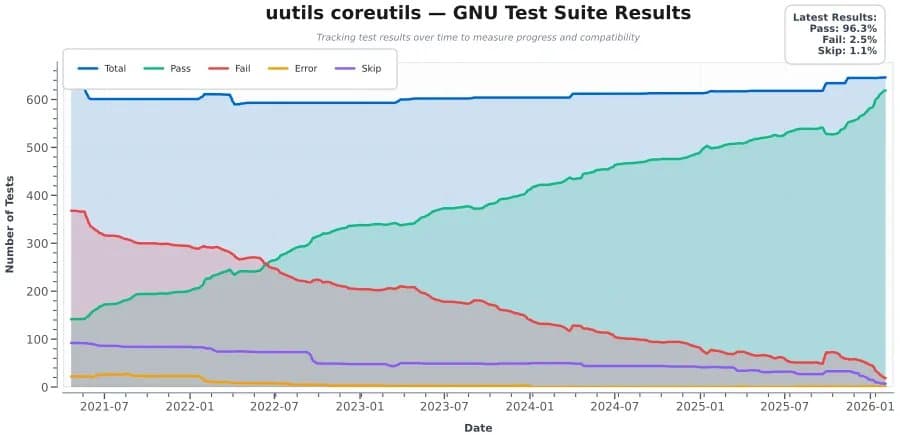
The Rust Coreutils project has reached 96% GNU Coreutils compatibility in version 0.6, while simultaneously removing unsafe code blocks and delivering performance optimizations across multiple utilities.
The Rust Coreutils project has released version 0.6, marking significant progress toward its goal of providing a safe, high-performance alternative to GNU Coreutils written entirely in Rust. The latest release, announced following a presentation at FOSDEM 2026, demonstrates the project's steady advancement in both compatibility and code quality.
Compatibility Reaches 96.28%
Rust Coreutils 0.6 now passes 622 out of 646 tests in the GNU Coreutils test suite, achieving a compatibility rate of 96.28%. This represents substantial progress toward the project's stated goal of 100% pass rate compatibility with the original GNU utilities. The team continues to methodically address failing tests, with each release bringing the project closer to full compatibility.
Safety Improvements Take Center Stage
One of the most significant achievements in this release is the removal of unsafe code blocks from several core utilities, including date and sort. This cleanup effort demonstrates the project's commitment to Rust's core promise of memory safety without sacrificing functionality. The team has replaced raw libc calls with safe equivalents from the Nix crate, reducing potential security vulnerabilities and making the codebase more maintainable.
Enhanced Error Handling and Localization
The 0.6 release introduces more robust error handling throughout the codebase. By replacing direct system calls with higher-level abstractions, the utilities now provide clearer error messages and better recovery options. Additionally, localization support has been improved, making the utilities more accessible to non-English speaking users and better integrating with system locale settings.
Expanded Platform Support
Platform compatibility has received significant attention in this release. Cygwin support has been enhanced, allowing Windows users to leverage Rust Coreutils more effectively in their development workflows. The project has also increased its focus on RISC-V 64-bit testing, ensuring that the utilities perform well on this emerging architecture. These improvements reflect the project's commitment to broad platform support beyond just Linux x86_64 systems.
Performance Optimizations Across the Board
Performance remains a key focus for the Rust Coreutils project, and version 0.6 delivers several notable improvements:
- base64 utility: Reduced memset optimizations have improved encoding and decoding speeds
- shuf utility: Numeric output generation has been optimized for better performance
- uniq utility: Memory usage for ignore-case comparisons has been reduced
- df utility: File-system handling has been optimized for faster disk usage reporting
These optimizations demonstrate that Rust's performance characteristics, combined with careful algorithmic improvements, can match or exceed the performance of traditional C implementations.
The Road Ahead
The Rust Coreutils project continues to make steady progress toward its ambitious goals. With 96.28% compatibility achieved and unsafe code being systematically eliminated, the project is proving that Rust can successfully replace traditional C utilities while maintaining or improving upon their performance characteristics.
The next major milestone will be reaching 100% compatibility with the GNU Coreutils test suite. Given the project's consistent progress and the active development community, this goal appears increasingly achievable. The continued focus on safety, performance, and broad platform support positions Rust Coreutils as a compelling alternative for system administrators and developers seeking more secure and maintainable core utilities.
For those interested in trying Rust Coreutils 0.6, the project provides downloads and detailed release notes on its GitHub repository.
Comments
Please log in or register to join the discussion