The Rust Coreutils project has made significant progress toward full GNU compatibility, with Ubuntu 25.10 already adopting it and Ubuntu 26.04 LTS planning to follow suit. Despite early skepticism and trolling, the project has demonstrated remarkable stability and growing community support.
The Rust Coreutils project continues to make impressive strides toward 100% compatibility with GNU Coreutils, with lead developer Sylvestre Ledru presenting the latest progress at FOSDEM 2026. The presentation highlighted Ubuntu 25.10's successful adoption of Rust Coreutils and plans for Ubuntu 26.04 LTS to continue this transition, marking a significant milestone for the uutils project.
 )
)
Ledru's FOSDEM talk focused on the practical implementation of Rust Coreutils in Ubuntu 25.10, where it has been deployed as a drop-in replacement for GNU Coreutils. While the transition did uncover some bugs, the development team has demonstrated remarkable responsiveness in addressing these issues. The quick turnaround on bug fixes has helped build confidence in the project's stability and reliability.
One of the most interesting aspects of the presentation was the discussion around the skepticism and trolling that surrounded Rust Coreutils in its early stages. Critics questioned whether a Rust rewrite of such fundamental utilities could achieve the necessary compatibility and stability. However, the project's progress has effectively silenced many of these detractors. The successful deployment in Ubuntu 25.10 serves as concrete evidence that the Rust implementation can meet the rigorous demands of production environments.
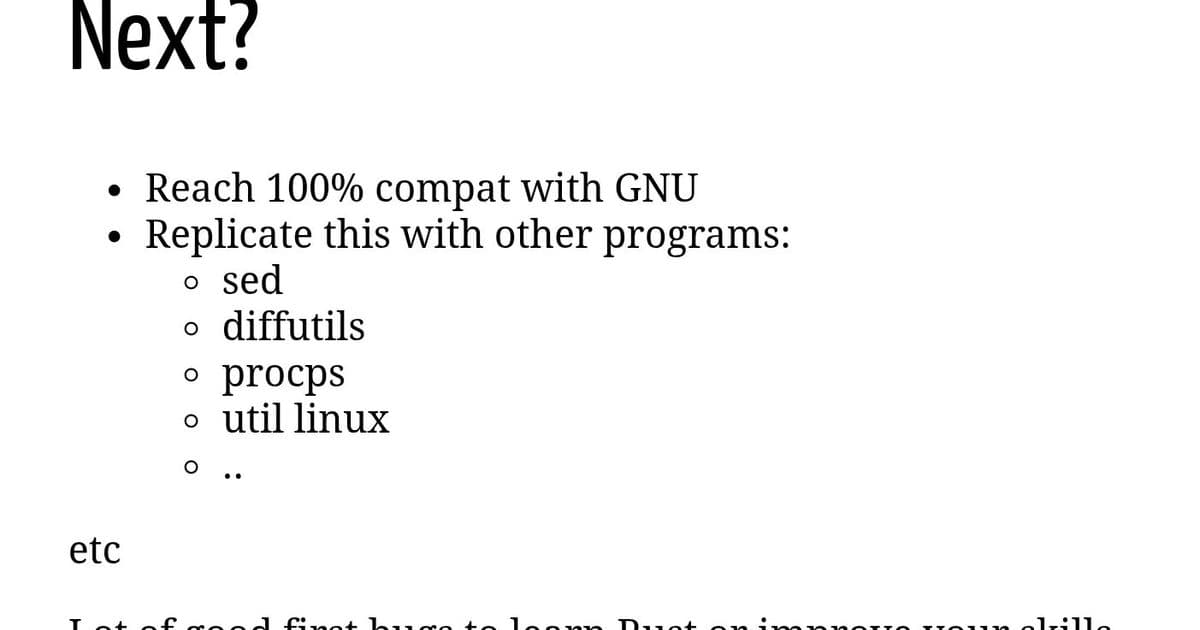
The commitment to 100% compatibility with GNU Coreutils remains the project's primary goal. This focus ensures that existing scripts, tools, and workflows that depend on GNU Coreutils behavior will continue to function without modification. The development team has been meticulous in matching not just the functional behavior but also the edge cases and subtle behaviors that users have come to expect from the GNU implementation.
Community growth has been another positive trend for Rust Coreutils. The project continues to attract new contributors, bringing fresh perspectives and helping to accelerate development across various areas. Cross-platform improvements have been a particular focus, with the Rust implementation offering advantages in portability compared to the traditional C-based GNU Coreutils.
Looking ahead, the success of Rust Coreutils has sparked interest in applying similar approaches to other core Linux utilities. The project demonstrates that Rust can be a viable language for rewriting fundamental system components without sacrificing compatibility or introducing breaking changes. This could potentially lead to a broader ecosystem of Rust-based replacements for other essential Linux tools.
For those interested in diving deeper into the technical details and progress updates, the FOSDEM 2026 presentation materials are available on the official FOSDEM website. The slide deck and video recordings provide comprehensive insights into the implementation challenges, solutions, and future roadmap for the project.
The journey of Rust Coreutils from a controversial experiment to a production-ready alternative exemplifies how open-source projects can overcome initial skepticism through consistent delivery of quality and compatibility. As more distributions consider adopting Rust-based core utilities, the project's success could influence the broader Linux ecosystem's approach to system software development.
Comments
Please log in or register to join the discussion