
Salesforce CEO Marc Benioff declared his company will 'monster the SaaSpocalypse' with AI agents, boasting 180 new IT Service customers while introducing Agent Work Units to measure AI productivity.
Salesforce CEO Marc Benioff delivered an unconventional earnings call this week, declaring his company would "monster the SaaSpocalypse" with AI agents while introducing new metrics to measure their productivity. The CRM giant's Q4 results showed mixed signals as Benioff touted customer wins but shares slipped in after-hours trading.
Benioff's Sasquatch Metaphor Falls Flat
The earnings call began with Benioff's characteristic bravado, claiming Salesforce would devour the supposed "SaaSpocalypse" - the theory that AI has damaged traditional SaaS business models. "If there is a SaaSpocalypse, I think it might be eaten by the SaaSquatch because there are a lot of companies using a lot of SaaS because SaaS just got a lot better with agents as a service," he proclaimed.
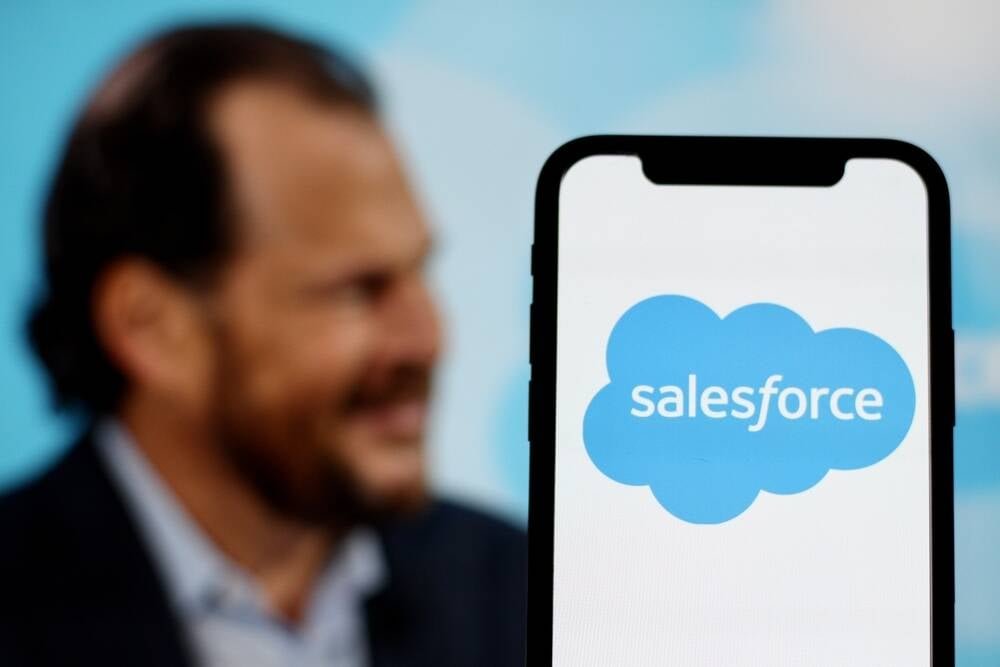
The metaphor drew some head-scratching, as the mythical Sasquatch is typically portrayed as reclusive rather than rapacious. Nevertheless, Benioff used the analogy to position Salesforce's AI agents as the solution to declining SaaS valuations.
180 Customers Abandon ServiceNow for Salesforce ITSM
Benioff's most concrete claim centered on Salesforce's new IT Service Management (ITSM) offering, which he said has already attracted 180 customers since its October launch. "We just launched Salesforce ITSM in October and in just a few months [chief revenue officer] Miguel [Milano] has won over 180 customers, but I especially love five customers who got to leave the purgatory of ServiceNow like SunRun, Cornerstone, Cool Systems and there are others too that we're not allowed to mention, but I might mention them anyway, who are leaving ServiceNow for the new Salesforce IT services," he said.
This represents Salesforce's most credible threat yet to ServiceNow's dominance in enterprise ITSM, a market the company has long coveted but struggled to penetrate effectively.
Mixed Financial Results Despite AI Hype
Despite the bullish rhetoric, Salesforce stock slipped 5.6 percent in after-hours trading. Analysts expressed concern about the company's remaining performance obligations (RPO), which came in at $35.1 billion - below expectations.
"I think that's stoking some concerns with investors. Can Salesforce do both? Can we grow a big Agentforce business and sustain the growth and momentum in the broader Salesforce portfolio? Can we bring along the entirety of the business?" asked Morgan Stanley analyst Keith Weiss.
Full-year revenue reached $41.5 billion, exceeding the company's guidance range of $40.5-$40.9 billion. However, this overachievement was largely due to Salesforce's $399 million acquisition of Informatica, meaning organic revenue growth was closer to $200 million.
New Metrics: Agent Work Units
In a move to quantify AI productivity, Salesforce introduced "Agent Work Units" (AWUs) - a metric designed to measure the discrete tasks executed by AI agents across the platform. Chief Marketing Officer Patrick Stokes explained the rationale: "So what we did is we said: 'What if we could look at those work units relative to the tokens?' and we said: 'Oh there's a relationship between the two.' We can start to see a ratio of tokens being consumed and work coming out and that ratio starts to become very interesting."
AWUs represent the conversion of generative AI capabilities into measurable business outputs, such as resolving customer cases, updating records, or triggering automated workflows. The company can also measure this per customer to show how much work agents are performing.
Financial Strategy and Controversy
Benioff announced plans to repurchase $50 billion in stock and increase the quarterly dividend by 5.8 percent to 44 cents. He also revealed the company laid off 1,000 employees earlier this month, though the announcement was overshadowed by controversy when Benioff made a joke about ICE agents tracking workers during an employee meeting.
Looking ahead, Salesforce expects to generate $16.5 billion in free cash flow this year, up from $15 billion last year. Benioff emphasized the company's underleveraged position and plans to use debt more effectively while buying back stock at what he considers "great prices."
The Verdict
Salesforce's earnings call revealed a company betting heavily on AI agents to revitalize its growth story, but facing skepticism from investors about execution. While Benioff's enthusiasm for Agentforce and ITSM is palpable, the market appears to be waiting for concrete evidence that these initiatives can offset broader SaaS market challenges.
The introduction of AWUs suggests Salesforce recognizes the need to demonstrate tangible ROI from its AI investments - a critical factor as enterprises evaluate whether agentic AI justifies continued SaaS spending in an increasingly competitive landscape.
For now, Salesforce appears to be in a transitional phase, attempting to pivot from traditional CRM to an AI-powered platform while maintaining its core business. Whether the SaaSquatch can indeed devour the SaaSpocalypse remains to be seen.
Comments
Please log in or register to join the discussion