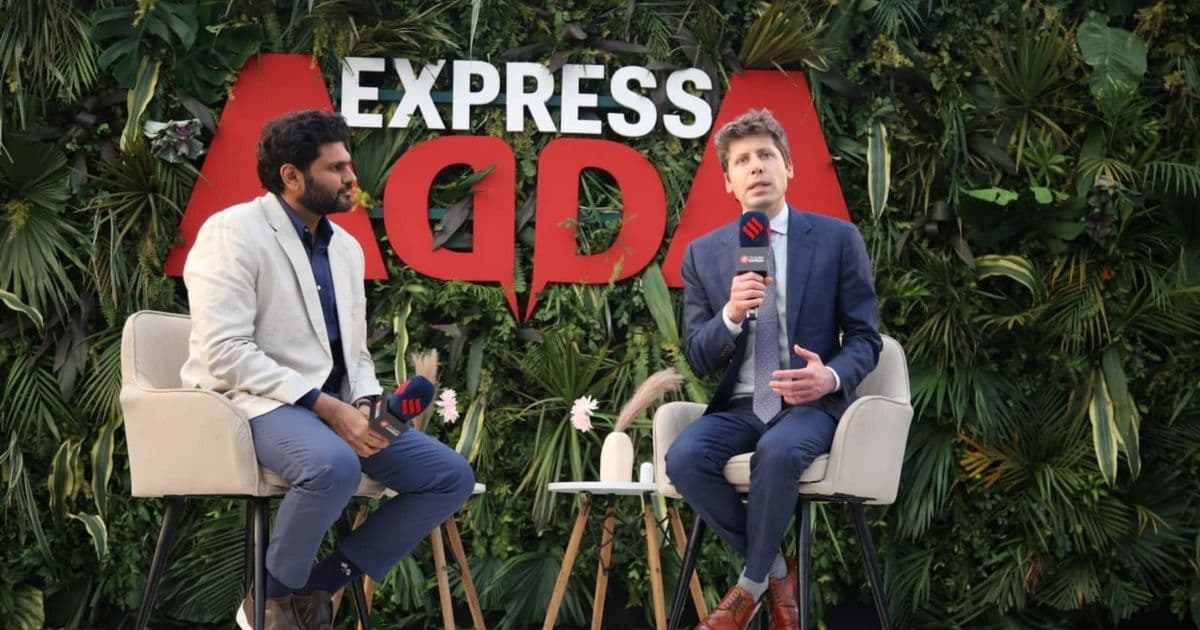
OpenAI CEO Sam Altman dismissed orbital data centers as impractical during The Express Adda event, directly contradicting Elon Musk's vision and highlighting a fundamental split in tech leadership about AI's physical infrastructure needs.

The concept of deploying data centers in orbit, once a fringe idea, has gained surprising traction among tech futurists envisioning solutions to Earth-bound limitations like energy consumption and land use. This vision found its most vocal proponent in Elon Musk, whose SpaceX ventures naturally dovetail with ambitions for extraterrestrial infrastructure. Yet the notion now faces sharp criticism from an unexpected source: Sam Altman, who helped co-found OpenAI with Musk before their divergence.
At The Express Adda forum, Altman didn't mince words: calling the idea of space-based data centers "ridiculous" and stating unequivocally that orbital computing infrastructure "is not something that's going to matter at scale this decade." This stance directly challenges projects like those envisioned by Musk, whose Starlink satellite network provides a potential foundation for such systems. Altman's comments underscore a strategic schism between former collaborators about how to physically support the computational demands of next-generation AI.
Proponents argue space offers compelling advantages: near-unlimited solar energy, natural vacuum cooling eliminating heat dissipation challenges, and latency benefits for global coverage. Companies like Axiom Space have even begun prototyping orbital computing modules. Musk's vision extends this further – envisioning Mars colonies powered by similar infrastructure.
Altman's skepticism appears rooted in scaling economics. Launch costs, despite decreasing, remain prohibitively high for the millions of servers required. Maintenance of hardware in radiation-heavy environments presents another hurdle, as does the complexity of transferring massive datasets to and from orbit. His stance suggests a focus on terrestrial solutions: advanced nuclear reactors, distributed edge computing networks, and radical efficiency improvements in AI chips.
This disagreement reflects broader tensions in tech leadership about AI's tangible requirements. While some chase grand visions like Dyson spheres and orbital server farms, others like Altman prioritize solving bottlenecks within existing planetary constraints. The divide isn't merely technical but philosophical: should humanity leap toward space-based solutions or perfect Earth-bound systems first? As AI's computational hunger grows exponentially, this infrastructure debate will shape not just business strategies, but the physical footprint of our digital future.
Comments
Please log in or register to join the discussion