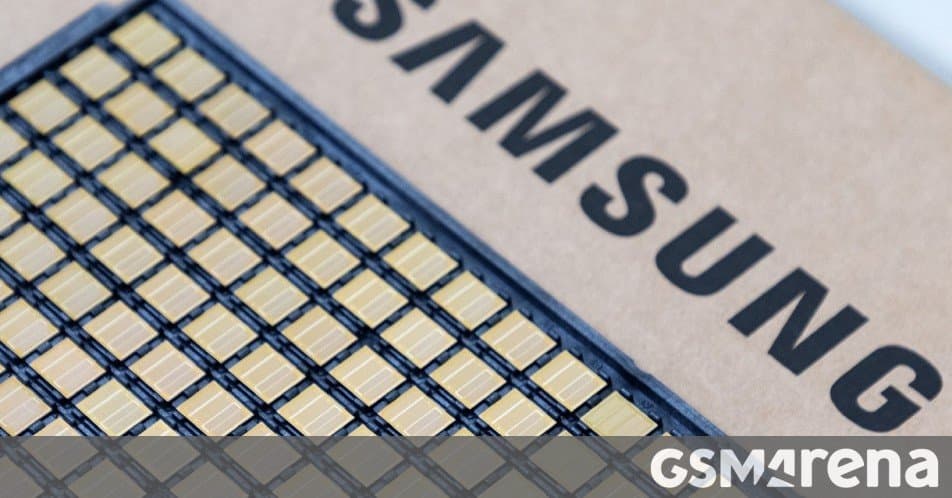
Samsung has started mass production of HBM4 memory, delivering the first shipments to customers with speeds reaching 11.7Gbps per pin and total bandwidth of 3.3TB/s - a 2.7x improvement over HBM3E.
Samsung has officially begun mass production of its next-generation HBM4 memory, marking a significant leap in high-bandwidth memory technology. The company has already delivered initial shipments to customers and announced plans to sample HBM4E (the enhanced version) later this year, positioning itself at the forefront of memory innovation for AI and high-performance computing applications.
HBM4 Technical Breakthroughs
The new HBM4 chips are manufactured using Samsung's 6th generation 10nm-class DRAM process, codenamed "1c." While DRAM nodes aren't directly comparable to CPU manufacturing processes, this advancement represents years of refinement in memory fabrication technology. The HBM4 products also incorporate a 4nm logic base die, which Samsung says delivers higher performance than previous generations.
Perhaps most impressively, Samsung's HBM4 achieves speeds of 11.7Gbps per pin - surpassing the industry standard of 8Gbps by 46%. With 2,048 pins in the configuration, this translates to a total bandwidth of 3.3 terabytes per second. This represents a 2.7x increase over HBM3E memory, which was the previous high-performance standard.
JEDEC Standardization Strategy
The numbers become even more interesting when considering the standardization approach. When JEDEC (the governing body for computer RAM standards) standardized HBM4, they made a strategic decision to reduce per-pin bandwidth compared to HBM3E (which operated at 9.6Gbps) while doubling the number of pins from 1,024 to 2,048. This trade-off was made specifically to improve power efficiency and enhance thermal management - critical factors for data center and AI accelerator deployments.
Samsung has managed to exceed even the per-pin speed targets for HBM4 while maintaining the benefits of the JEDEC design philosophy. The company suggests that future iterations could push speeds to 13Gbps per pin, indicating there's still headroom for performance improvements.
Design and Capacity Options
Currently, Samsung's HBM4 memory utilizes a 12-layer stacking technology and is available in capacities ranging from 24GB to 36GB. The company has indicated it will adapt to customer needs and could introduce a 16-layer design with up to 48GB capacity, providing flexibility for different use cases and performance requirements.
Power Efficiency and Thermal Management
Samsung has implemented several innovations to address the power and heat challenges inherent in high-bandwidth memory. The HBM4 design uses low-voltage through silicon vias (TSVs) and an optimized power distribution network, which together improve power efficiency by 40% compared to previous generations. Additionally, the memory stack achieves 10% lower heat resistance and 30% better heat dissipation compared to HBM3E, addressing one of the most critical challenges in high-performance memory deployment.
Market Outlook and Future Plans
Looking ahead, Samsung expects massive demand for its memory products this year, predicting that sales will triple compared to 2025. In anticipation of this growth, the company is actively working to expand HBM4 production capacity to meet customer demand.
For the immediate future, Samsung plans to sample HBM4E memory to customers in the second half of 2026. Beyond that, the company will begin offering custom HBM samples designed to specific customer requirements starting in 2027, moving away from standardized designs toward more specialized solutions.
Industry Context
This announcement comes as Samsung positions itself to capitalize on the growing AI and high-performance computing markets. The company's decision to "take the leap" and adopt the most advanced nodes like the 1c DRAM and 4nm logic process for HBM4, rather than using existing proven designs, demonstrates its commitment to maintaining technological leadership.
As Sang Joon Hwang, Executive Vice President and Head of Memory Development at Samsung Electronics, explained: "By leveraging our process competitiveness and design optimization, we are able to secure substantial performance headroom, enabling us to satisfy our customers' escalating demands for higher performance, when they need them."
The timing of this announcement is particularly significant given Samsung's recent warnings about upcoming phone price hikes due to memory shortages, and its unveiling of higher capacity HBM3E memory for faster AI training and inference. These moves collectively demonstrate Samsung's strategy to dominate both the consumer and enterprise memory markets.
The mass production of HBM4 represents not just an incremental improvement but a fundamental shift in memory architecture, with implications for everything from AI training clusters to next-generation computing platforms. As the industry moves toward more data-intensive applications, Samsung's early lead in HBM4 production could prove strategically valuable in the years ahead.
Comments
Please log in or register to join the discussion