
Early Geekbench scores reveal the Snapdragon 8 Elite Gen 5 "for Galaxy" outperforms the Exynos 2600 in single-core performance, with a 17% lead, while multi-core scores remain nearly identical between the two chipsets.
Just days before Samsung's Unpacked event, benchmark leaks have provided the first direct performance comparison between the Snapdragon 8 Elite Gen 5 "for Galaxy" and the Exynos 2600 in the upcoming Galaxy S26 series.
Snapdragon maintains single-core dominance
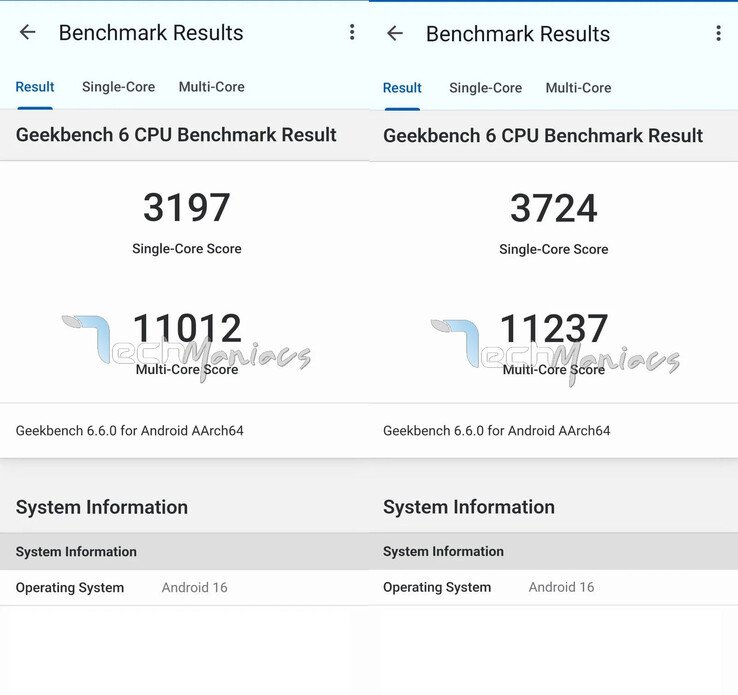
The Geekbench scores, shared by Greek outlet TechManiacs, show the Snapdragon 8 Elite Gen 5 "for Galaxy" in the Galaxy S26 Ultra achieving 3,724 points in single-core and 11,237 points in multi-core performance. These numbers align closely with previous leaks, suggesting the overclocked variant delivers consistent performance gains.
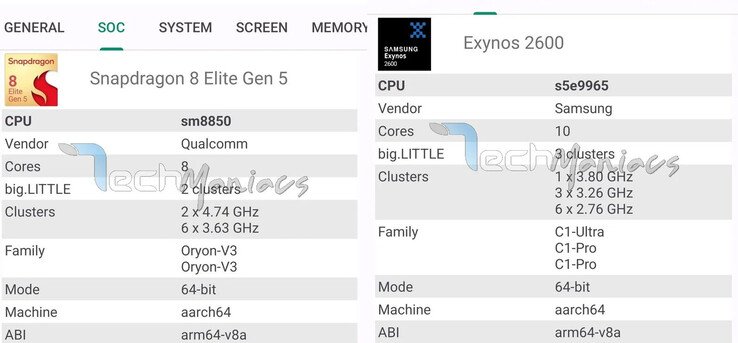
What's particularly noteworthy is the 17% advantage in single-core performance over the Exynos 2600-powered Galaxy S26, which scored 3,197 points. This gap highlights the Snapdragon variant's higher Prime core clock speed of 4.74GHz compared to the Exynos 2600's ARM C1-Ultra chip running at 3.80GHz.

Multi-core performance remains neck-and-neck
Despite the significant single-core difference, multi-core performance tells a different story. The Snapdragon 8 Elite Gen 5 "for Galaxy" maintains only a 2% lead with 11,237 points versus the Exynos 2600's 11,012 points. This narrow gap suggests Samsung's deca-core layout and 2nm GAA process in the Exynos 2600 effectively compensates for its lower peak clocks under parallel workloads.
RAM configuration remains unclear
TechManiacs has redacted certain details from the benchmark results, leaving uncertainty about whether the tested Galaxy S26 Ultra features 12GB or 16GB of RAM. For context, the non-Ultra models in the series are expected to max out at 12GB of RAM, while the Ultra variant may offer higher configurations.
What this means for Galaxy S26 buyers
These early benchmarks suggest that while the Snapdragon variant maintains its traditional single-core performance advantage, the Exynos 2600 has narrowed the gap considerably in multi-core scenarios. For most users, this means the choice between variants may come down to other factors like thermal management, battery efficiency, and regional availability rather than raw performance differences.
The Snapdragon 8 Elite Gen 5 "for Galaxy" represents a modest overclock over the standard version found in devices like the OnePlus 15, with the Prime core boosted from 4.61GHz to 4.74GHz. This small but meaningful increase appears to translate directly into the observed single-core performance gains.
As with all pre-release benchmark data, these results should be viewed cautiously until independent testing can verify real-world performance across various workloads and sustained usage scenarios.
Comments
Please log in or register to join the discussion