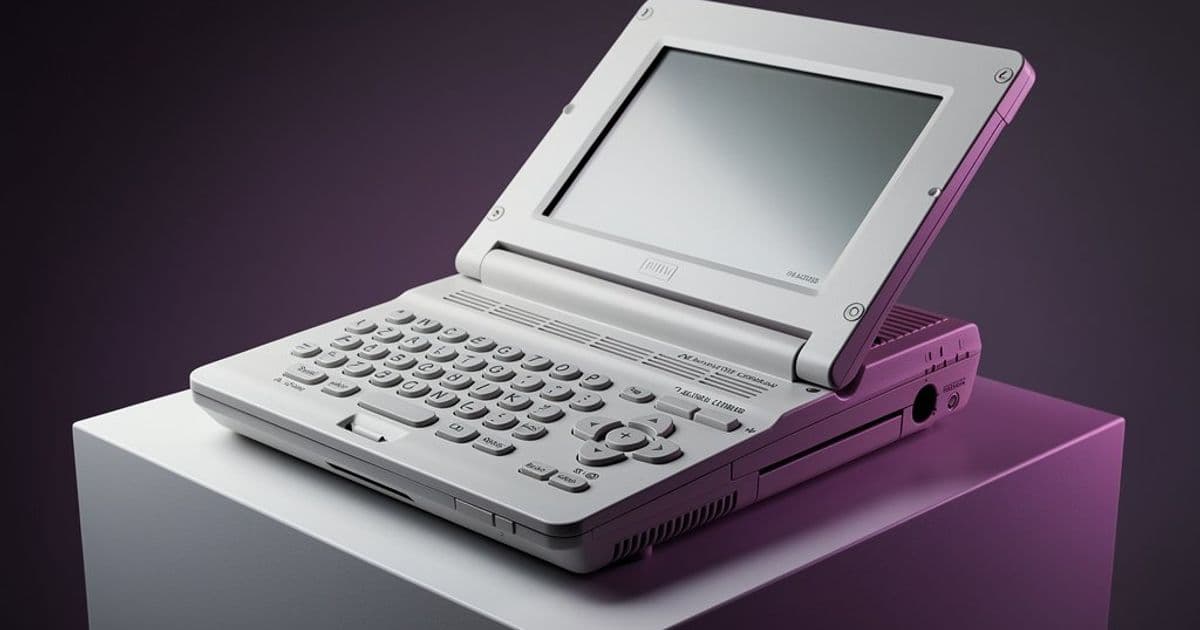
A deep dive into the Sony Data Discman DD-1EX, a 1992 electronic book reader that failed commercially but showcased ambitious PDA-like features before the technology existed to support them. The article explores its hardware, software, and the historical context of its failure, including a look at the bundled electronic books and an unexpected emulator found on the CDs.
The Sony Data Discman DD-1EX is a fascinating artifact from the early 1990s—a device that tried to be a portable electronic book reader and a nascent personal digital assistant, all in a package that predated the widespread adoption of flash memory, affordable hard drives, or even a mature market for digital content. It launched in early 1992 at a retail price of $500, only to be aggressively discounted and discontinued within months, landing in clearance bins by the holiday season. This is the story of a product that was conceptually brilliant but technically premature.
What It Was: A Miniature Laptop for Books
The DD-1EX is a compact, clamshell device that resembles a miniature laptop. It features a full QWERTY keyboard, a directional pad for navigation, and a small LCD screen. Its core function was to play electronic books stored on proprietary mini-CDs housed in protective caddies. The device had a built-in speaker and an A/V output jack, allowing users to connect it to a television for a larger display.
Sony bundled the player with a comprehensive accessory kit, which included an AC adapter, a rechargeable battery, and a secondary battery pack that held AA batteries. This was notably generous compared to later Sony products like the PlayStation Classic, which famously omitted an AC adapter.
The device's design philosophy was clear: it was meant to be a serious, durable tool. It felt substantial in the hand, with a build quality that suggested it was designed for professional or educational use rather than casual entertainment. However, its fatal flaw was a lack of any data storage mechanism. In 1992, SD cards were not commercially available, and miniature hard drives were prohibitively expensive and fragile. The DD-1EX could read data from a CD, but it could not save anything—not a bookmark, not a note, not a user-created file. This limitation effectively capped its utility as a PDA, leaving it as a read-only device.
The Software: Encyclopedias, Translators, and Crosswords
The electronic books available for the platform were a snapshot of early '90s reference material. The bundled software included:
- Encyclopedia: A comprehensive reference work. The content is a historical artifact; it still lists the U.S.S.R. as a country, placing its creation before December 1991.
- Career Guide: A guide to professions and salaries. It includes a section on early '90s software developer salaries, offering a glimpse into the tech job market of the era.
- World Translator: A phrasebook for travelers. The author notes its limitations, such as the lack of a phrase for "I'm a Swedish citizen, please don't turn me over to the secret police."
- Wellness Encyclopedia: A hypochondriac's manual, detailing various ailments and remedies.
- Crossword Dictionary: A searchable list of words and word endings, useful for solving puzzles.
- Wine Guide: A guide to wines and pairings, noted as being of limited use to someone who doesn't spend more than $3.99 on a bottle.
The content is static and non-interactive, with the exception of search functionality. The device's keyboard was essential for this, allowing users to query the databases on the CDs.
The Unexpected Emulator: A Hidden Layer of Functionality
One of the most intriguing discoveries from examining the software is that some of the CDs contain an emulator for the Data Discman itself. When the data files from these CDs are copied to a modern computer, they can be launched in this emulator, allowing the electronic books to be viewed on a desktop.
For example, the Wine Guide and Career Guide CDs include this emulator. The Encyclopedia CD does not, but its data files can be easily transferred to run within the emulator bundled on another CD. This suggests Sony may have been experimenting with cross-platform compatibility or providing a way for users to access content on a PC, though the primary experience was designed for the portable device.
Why It Failed: Technology Outpaced Ambition
The Data Discman's commercial failure can be attributed to several factors:
- High Cost: At $500 in 1992, it was an expensive luxury item. Adjusted for inflation, that's over $1,000 today. For that price, consumers expected a versatile device, not a single-purpose reader.
- Limited Content: The library of electronic books was small and niche. It lacked the breadth to attract a mass audience.
- No Data Persistence: The inability to save user data or notes was a critical handicap. It couldn't function as a true PDA or a dynamic reading tool.
- Pre-Mature Market: The concept of digital books was still foreign to most consumers. Physical books were dominant, and the internet was in its infancy. There was no ecosystem to support such a device.
In essence, the DD-1EX was a solution in search of a problem. It had 90% of the hardware needed for a PDA but lacked the final 10% of technology (affordable, solid-state storage) to make it a practical reality. It was a glimpse into a future that was still a decade away.
Legacy and Preservation
The author of this retrospective acquired the device and its software at a deep discount in 1992 and recently shared ISO images of the CDs online. The files include the emulators and data, allowing modern enthusiasts to experience this piece of tech history. However, due to the author's past experiences with aggressive takedown notices from Sony and EA over unrelated content, the files are hosted with the expectation that they may not remain online indefinitely. For those interested in digital preservation, the Internet Archive is suggested as a more resilient repository.
The Sony Data Discman DD-1EX stands as a testament to ambitious engineering hampered by the technological constraints of its time. It was a device that dreamed of a digital future but was built with the tools of the analog present.
Comments
Please log in or register to join the discussion