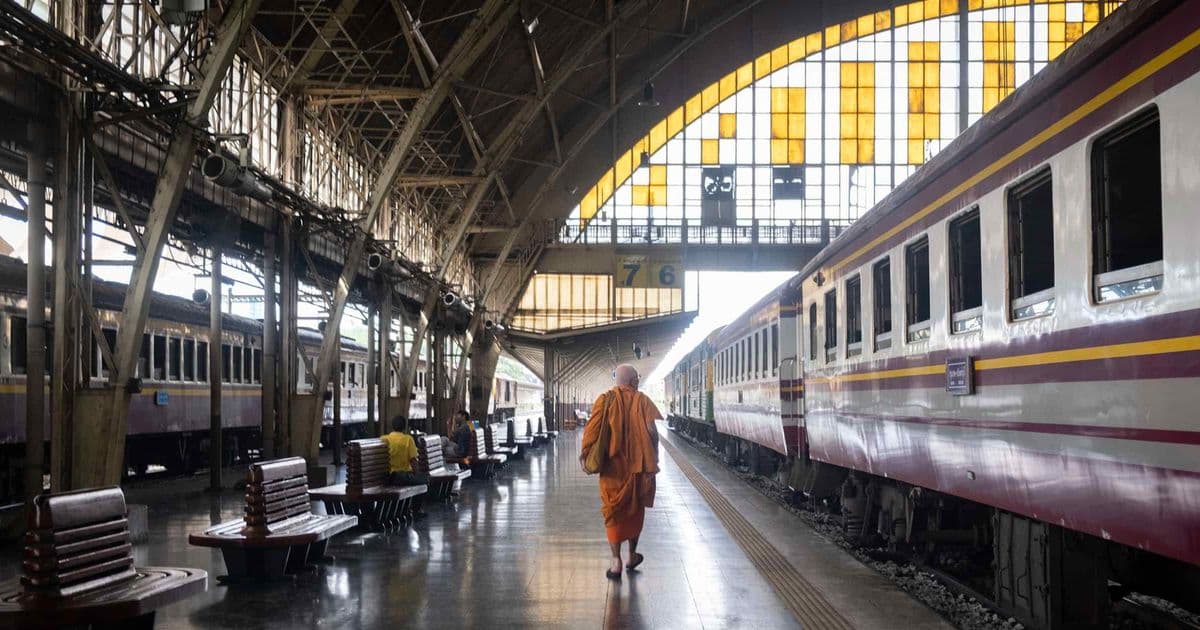
While Thailand's high-speed rail network expands, the traditional 'Rapid' service to Chiang Mai offers a 14-hour journey at $8, highlighting the country's dual-track approach to transportation modernization and the economic realities of slow travel.
The "Rapid" train from Bangkok to Chiang Mai requires nearly 14 hours to complete its journey. For 230 baht (approximately $8), passengers can secure a third-class seat on this service that online travel forums frequently recommend avoiding. Yet this journey represents more than just a budget travel option—it illustrates Thailand's complex railway modernization strategy, where new high-speed infrastructure develops alongside existing conventional services.
Thailand's railway transformation is accelerating under the government's 20-year national strategy. The State Railway of Thailand (SRT) is investing approximately 1.7 trillion baht ($48 billion) in network expansion and upgrades. This includes the Bangkok-Chiang Mai high-speed rail project, which aims to reduce travel time from 12-14 hours to just 3-4 hours. Construction began in 2021, with the first phase between Bangkok and Nakhon Ratchasima scheduled for completion in 2026.
Meanwhile, the conventional Rapid service continues operating as a vital transportation artery. The Bangkok-Chiang Mai route spans 751 kilometers, traversing diverse terrain from the central plains to the mountainous north. Third-class carriages, which lack air conditioning, offer open windows and ceiling fans—a design choice that reduces energy costs and maintenance complexity compared to climate-controlled systems.
The economic implications are significant. While high-speed rail tickets are projected to cost 1,200-1,800 baht ($34-51) for Bangkok-Chiang Mai, the Rapid service remains accessible to lower-income travelers and serves as a freight corridor. SRT data shows conventional lines still carry 85% of Thailand's rail freight, primarily agricultural products and manufactured goods moving between regional production centers and Bangkok's port facilities.
The juxtaposition of old and new infrastructure reflects broader Southeast Asian transportation trends. Vietnam's Reunification Express, India's narrow-gauge "toy trains," and Indonesia's conventional networks all face similar modernization pressures. Thailand's approach—maintaining legacy services while building new corridors—mirrors strategies in Japan, where Shinkansen expansion coexists with local JR lines.
For travelers, the choice between speed and experience creates distinct market segments. The Rapid train's 14-hour journey offers an unfiltered view of Thailand's landscape, from rice paddies to mountain passes, at a price point accessible to domestic workers and budget-conscious tourists. This slow travel experience, while inefficient for business travelers, supports regional economies by enabling mobility for populations with limited transportation budgets.
The SRT's modernization plan includes upgrading conventional lines alongside new high-speed construction. This dual-track strategy acknowledges that not all travel requires maximum speed. Regional connectivity, agricultural logistics, and affordable passenger service remain critical functions that high-speed rail cannot immediately replace.
As Thailand's railway network evolves, the Rapid train's continued operation demonstrates that transportation modernization isn't solely about speed. It's about maintaining accessibility while building capacity, ensuring that economic growth doesn't leave behind populations dependent on affordable mobility. The $8 journey to Chiang Mai may be slow, but it represents a pragmatic approach to infrastructure development in a country where transportation equity remains as important as technological advancement.
Comments
Please log in or register to join the discussion