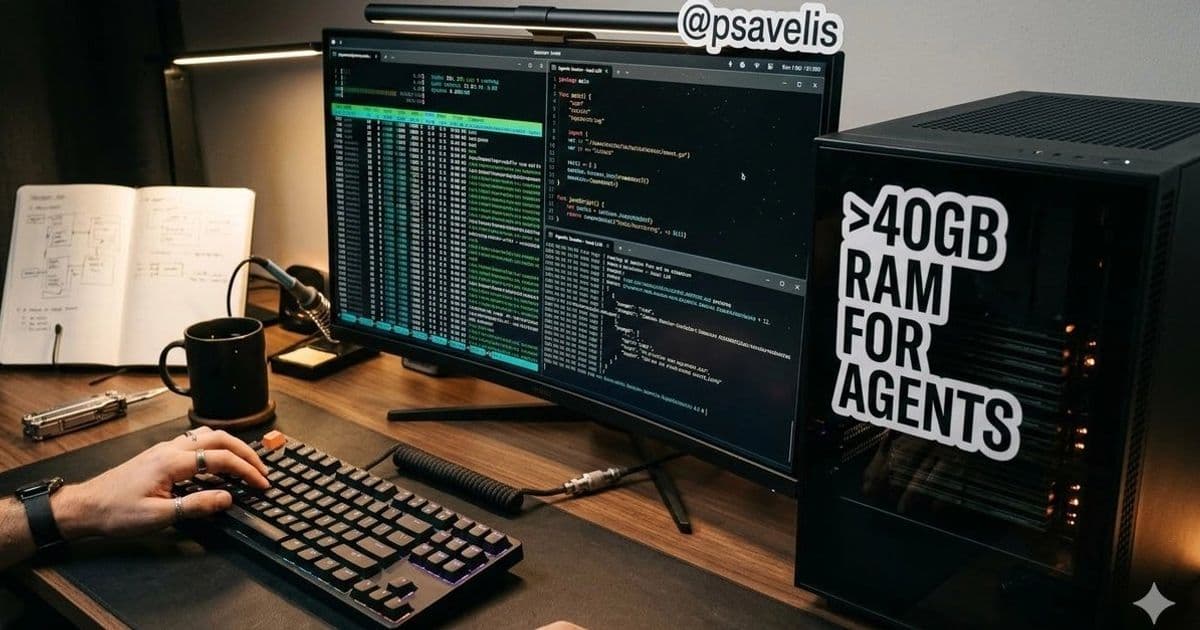
A deep dive into how high-memory systems and tactical agentic workflows are reshaping software development, with specific patterns and hardware requirements for 2026.
The landscape of software development is undergoing a fundamental shift. After shipping production systems using Go, NestJS, and blockchain technologies with heavy agentic workflows, I've stress-tested every lever in the stack. The winner isn't simply "use Claude"—it's a precise combination of Hardware + Context Mastery + Tactical Patterns. This article explores why 16GB RAM is becoming obsolete and how tactical agentic workflows are creating a new competitive advantage.
The Hardware Revolution: RAM as the New Bottleneck
Cloud LLMs excel at conversational tasks, but local agentic coding demands massive memory resources. If you're still developing on 16GB or 32GB systems in 2026, you're hitting an invisible performance ceiling that will increasingly limit your productivity.
The Mathematics of Modern Agentic Workflows
Several factors combine to make RAM the critical resource:
Huge Context Windows: Modern LLMs support 128k–1M+ token contexts, requiring substantial KV cache memory. A 30B coding model with 128k context already consumes approximately 26GB of RAM.
Multi-Agent Orchestration: Running simultaneous Planner + Executor + Reviewer agents creates significant memory pressure.
In-memory RAG: Local codebase indexing without disk-swapping requires substantial RAM for vector databases and embeddings.
Parallel Processing: Cross-checking architecture, security, and performance simultaneously demands headroom.
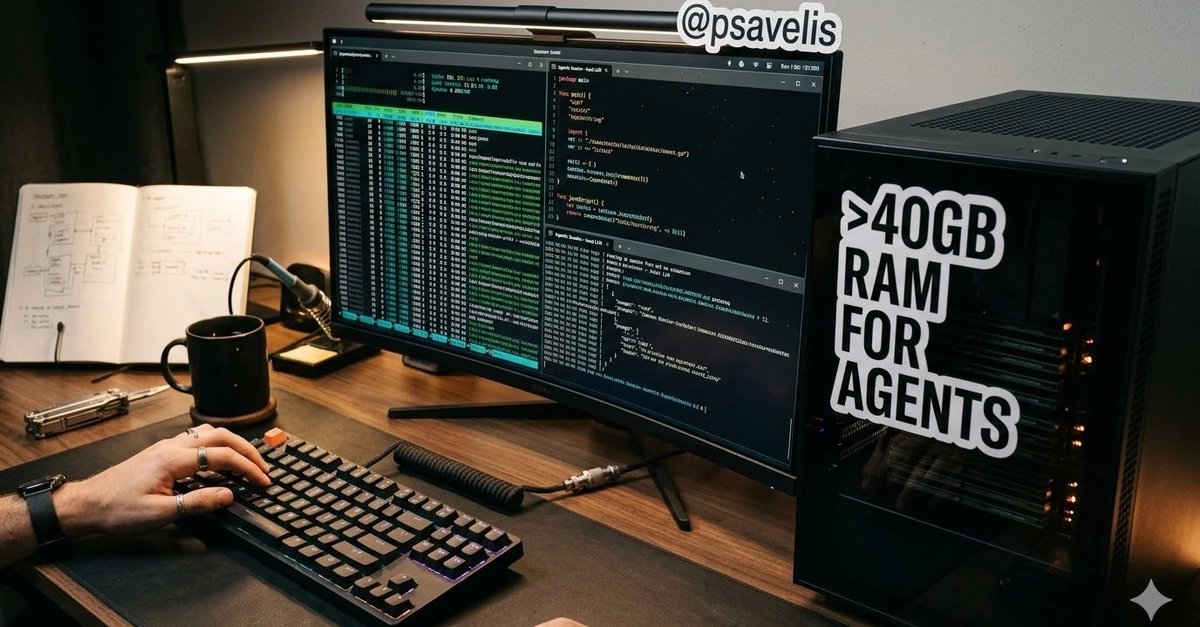
The @psavelis benchmark demonstrates that attempting to run a 70B-class model with full agentic loops on a 32GB machine results in constant swapping and context truncation. The result is frustratingly slow iterations and "forgetting" of important context.
The Performance Advantage of 40-96GB Systems
With 40-96GB of RAM dedicated to agentic sessions:
- Reflection/revision cycles run 10x longer without context loss
- Parallel agents can cross-check multiple aspects of code simultaneously
- Code ships first-try with fewer manual iterations
- Local LLMs maintain full context throughout complex development sessions
This isn't just about faster responses—it's about enabling qualitatively different workflows that were previously impossible.
Tactical Agentic Coding: Beyond "Vibe Coding"
We've moved past simple prompt-based interactions. To ship clean architecture at scale, developers need named, reproducible patterns that create consistent, high-quality outputs.
Core Tactical Patterns
ReAct (Reason + Act): The foundational pattern where agents Think → Tool → Observe. This pattern, documented in Arxiv 2210.03629, creates a feedback loop between reasoning and action.
Reflexion: Self-critique loops that force agents to evaluate their own work before presenting it. This pattern, detailed in Anthropic 2026 Reports, is the primary RAM consumer but dramatically improves output quality.
Plan-and-Execute: Step-by-step verification before writing any code, ensuring architectural coherence from the start.
Tactical Agentic: Persistent threads + state maintenance, as implemented in the IndyDevDan Framework.
The "Close-the-Loop" Rule
In production systems, every agent response triggers a self-critique step. The agent must argue against its own implementation before a human ever reviews the pull request. This pattern catches architectural flaws, security issues, and performance problems before they enter the codebase.
The 2026 "Speed Meta" Stack
Replicating high-velocity agentic development requires a carefully configured stack. The current @psavelis edition setup includes:
IDE Configuration
- Cursor: IDE optimized for AI-assisted development
- Claude Code: Integration with Claude 3.5 Sonnet for complex reasoning
- Aider/Continue.dev: Pair programming tools for local LLM integration
Local LLM Farm
High-RAM optimized setups include:
- Mac Studio with 128GB RAM for macOS developers
- Multi-GPU Linux systems with 96GB+ RAM for maximum performance
- NVMe storage arrays to minimize disk I/O bottlenecks
Workflow Evolution
The progression follows three stages:
- Vibe Coding: Initial exploration with simple prompts
- Agentic: Structured interactions with named patterns
- Tactical Agentic: Autonomous Application Development Workflows (ADWs)
Context Seeds
Custom Clean Architecture templates for Go and NestJS provide starting points that already incorporate best practices, reducing the initial context required.
Trade-offs and Implications
Memory vs. Cost
The primary trade-off is hardware cost against productivity. A 96GB RAM system represents a significant investment, but the productivity gains can justify this for professional developers. The cost of developer time increasingly outweighs hardware costs.
Local vs. Cloud Models
While cloud models offer convenience, local models provide:
- Complete privacy for proprietary code
- No API rate limits or throttling
- Customization for domain-specific knowledge
- Lower long-term costs for heavy users
The trade-off is initial setup complexity and hardware requirements.
Pattern Complexity
As agentic workflows become more sophisticated, the cognitive load shifts from writing code to designing effective patterns. This represents a fundamental change in the developer's role—from coder to orchestrator.
Conclusion: The Future of Development
Raw model intelligence is becoming a commodity. The competitive advantage in 2026 comes from Context Engineering and Hardware Headroom. Developers who invest in high-memory systems and master tactical agentic patterns will achieve unprecedented velocity and code quality.
The shift is clear: stop writing, start orchestrating. The most valuable skill will be designing systems where AI agents handle implementation details while humans focus on architecture, product decisions, and creative problem-solving.
What's your current setup? Share your RAM specifications, favorite agentic patterns, or biggest bottlenecks below. The community is pushing past 40GB+ limits, and the patterns are evolving rapidly.
For ongoing tactical agentic drops, check out github.com/psavelis and join the Backend & Arquitetura Limpa BR Discord for community discussion.
Comments
Please log in or register to join the discussion